Learning Paths
Last Updated: May 26, 2026 at 16:30
Agile vs Lean: What's the Difference and Why It Matters
Where Lean ends and Agile begins — and why getting that distinction right changes how you diagnose delivery problems
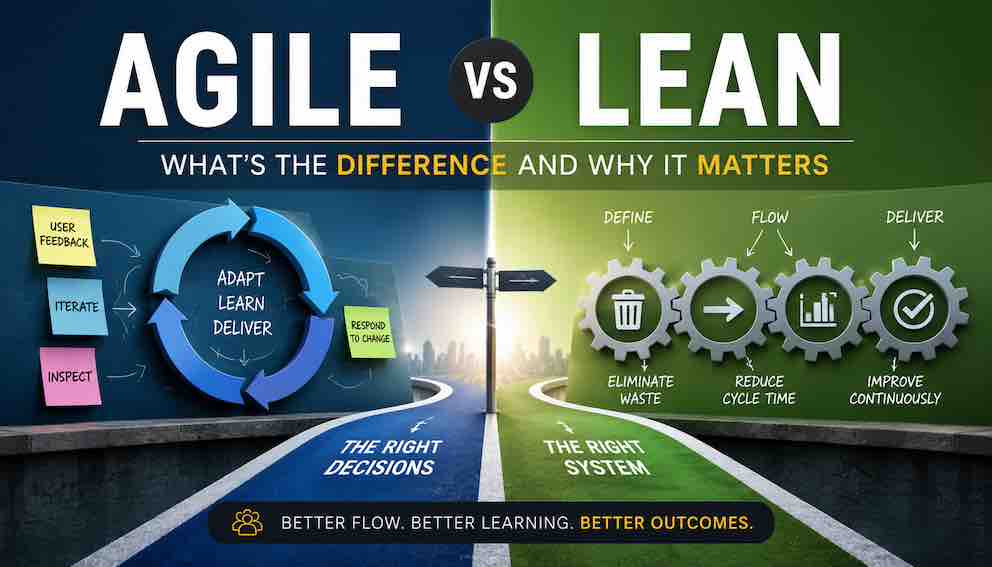
Lean and Agile are not variations of the same system — they address different constraints in software delivery. Lean improves the system that delivers software, targeting waste, flow, and bottlenecks. Agile improves the quality of decisions about what to build, targeting uncertainty through iteration and continuous user feedback. Understanding which constraint is dominant at a given moment is often more valuable than improving either framework in isolation.
Many teams reach a point where things look structurally healthy on the surface, but still feel harder than they should in practice.
Work is planned. Sprints are run. Delivery is regular. The structure of modern software development is clearly in place. And yet something subtle persists underneath it all: features take longer to reach users than expected, or they arrive reliably but fail to move the product forward in a meaningful way.
At that point, teams usually start looking for the right method to fix things. Some lean toward improving delivery flow — reducing bottlenecks, tightening feedback between stages, making work move more smoothly from idea to production. Others focus on improving product direction — testing assumptions earlier, learning faster from users, increasing confidence that the right things are being built in the first place.
Both instincts are valid. Both point to real problems. And both often lead teams toward the language of Agile and Lean.
The difficulty is that these two ideas are frequently treated as variations of the same system. In practice, they are not. They address different constraints in the software development process, and confusing them leads to a very specific kind of frustration: work improves in one dimension while outcomes remain unchanged.
The distinction becomes useful only when it is stated clearly:
Lean improves the system that delivers software. Agile improves the quality of decisions about what to build.
One focuses on flow — how work moves through the system, and where it accumulates, waits, or gets stuck. The other focuses on learning — how decisions are formed, tested, and corrected in response to reality. Understanding which constraint is dominant at a given moment is often more valuable than improving either system in isolation.
Lean vs Agile at a Glance
Lean in a sentence: A system discipline focused on flow efficiency. Origin: Toyota manufacturing. Main enemy: waste — the delays, handoffs, and queued work that consume capacity without delivering value. Tools: Kanban boards, limits on work in progress, cycle time metrics. Success measure: faster, more predictable delivery.
Agile in a sentence: A decision discipline focused on learning and adaptation. Origin: software project failures of the 1990s. Main enemy: uncertainty — building confidently in the wrong direction because assumptions are not being tested fast enough. Tools: sprints, retrospectives, user research, iterative releases. Success measure: better product outcomes.
Lean fights waste. Agile fights uncertainty. Both are real enemies of good software delivery. They just require different weapons.
The rest of this article goes deeper — how to diagnose which problem you have, what happens when you fix one and the other gets worse, and where this tension typically lives in an engineering organisation.
This article is part of the Modern Agile Engineering series. If you are new to either framework, the [Lean Software Development] and [Agile Manifesto] articles cover the foundations in full.
Why the Boundary Feels Blurry
Lean and Agile share genuine conceptual ground. Both value feedback, small batches, fast cycles, and trusting the people doing the work. This is not accidental. Agile was shaped by Lean thinking from the start, and the influence is visible throughout the Manifesto. The two frameworks were always going to overlap.
In practice, the overlap deepens because most teams encounter both through the same tools. Kanban boards come from Lean. Sprints come from Agile. Jira puts them in the same workflow. SAFe calls itself "Lean-Agile." The vocabulary merges because the ideas share common ground — not because someone made an error.
But shared values do not mean shared purpose. The frameworks converge on principles while diverging sharply on the problem they are solving. Lean is asking: why is our delivery system slow or unpredictable? Agile is asking: are we building things that are actually worth delivering? Both questions matter. They are not the same question. And applying the answer to one as a solution to the other is where most framework confusion becomes practically expensive.
The Core Differences Between Lean and Agile
The clearest way to see the difference is through the feedback loops each framework creates — because they seek feedback from completely different places.
Lean feedback is internal to the system. It tells you whether the system is healthy. It moves through cycle time metrics, WIP levels, deployment frequency, and queue lengths. When a pull request sits in review for four days, that is Lean feedback. When QA has a growing backlog despite the team shipping code faster, that is Lean feedback. When lead time increases over three sprints despite the team working harder, that is the system signalling a structural problem — not a people problem. Acting on it means changing the structure: adjusting capacity, removing constraints, redesigning how work moves between stages.
Agile feedback is external to the system. It tells you whether your assumptions are true. It arrives through user research, sprint reviews, product usage data, and the changed priorities that emerge when hypotheses meet reality. When users do not engage with a feature the team was proud of, that is Agile feedback. When a customer's actual workflow does not match the mental model the backlog was built on, that is Agile feedback. Acting on it means changing direction — reprioritising, adjusting scope, sometimes abandoning a line of work the data no longer supports.
A system-health problem requires structural change to how work moves — adding sprint ceremonies will not fix it. An assumption problem requires better decision-making and tighter user feedback — constraining how much work is in progress at once will not fix it. Applying the wrong intervention to the right problem produces the demoralising experience of working hard, doing the process correctly, and watching nothing improve.
How to Use Both
The most useful question a team can ask is not "should we be Lean or Agile?" It is: "which constraint is dominating us right now?"
If delivery is slow, work is piling up between stages, and features take weeks to reach production despite sprints completing on schedule — that is a system constraint. Lean is the right lens: visualise the flow, measure cycle time, find the bottleneck, remove it.
If the team is delivering steadily but users are not engaging, features ship and sit unused, and the product keeps getting built without the underlying problem getting solved — that is a knowledge constraint. Agile is the right lens: shorten feedback loops, test assumptions earlier, treat the backlog as a hypothesis list rather than a plan.
The balance needs to shift deliberately rather than drift accidentally. And it is never finished — resolving one constraint surfaces the other. Teams that improve continuously treat this not as a problem to solve once but as a rhythm to sustain.
This is also why modern frameworks combine both deliberately. SAFe applies Lean principles at the portfolio level — where the challenge is building a delivery architecture across many teams without accumulating dependencies — while applying Agile practices at the team level, where the challenge is building the right thing and learning fast enough to stay pointed in the right direction. Because Lean and Agile address different layers of the same work, they are often combined in practice rather than chosen between. Scrum — which draws from Agile — provides the planning cadence and iteration structure. Kanban — which draws from Lean — provides the flow visualisation and a way to track where work accumulates. The frameworks are not competing. They are solving different problems within the same team.
Diagnosing the Real Constraint
The practical distinction above is clean in theory. In practice, the two constraints mask each other, and getting the diagnosis wrong is easy.
Consider a team whose users are not engaging with recently shipped features. The obvious read is an Agile problem — wrong product decisions, insufficient user research. So the team shortens sprint cycles and runs more user interviews. Six months later, engagement is still flat. What they missed: features were reaching users two to three weeks after the sprint marked them done, because the deployment pipeline was fragile and releases were batched. By the time users saw the feature, the team had already moved on. The Agile ceremonies were sound. The Lean problem in the delivery infrastructure meant the feedback loop Agile depends on was broken at the physical level.
The reverse is equally common. A team struggling with slow cycle times invests in Lean tooling — controlling how much work is in progress at once, tracking flow metrics, making work visible on a Kanban board. Throughput climbs. And yet the team still feels like it is running hard to stay in place, because the features it is now delivering faster are still not the ones users need most. The system got faster. The direction did not get smarter.
This is why teams often feel confused during improvement efforts. They adopt the right practices, work harder than before, and still cannot explain why outcomes are not shifting. The process appears correct. The results do not follow. Usually it is because the intervention was aimed at the visible symptom rather than the underlying constraint.
The distinguishing question is: if you could ship twice as fast tomorrow, would the outcome improve? If yes, the bottleneck is the system. If the honest answer is "we're not sure the right things are in the pipeline," the bottleneck is the knowledge.
And here is the harder truth: resolving one constraint does not end the work — it exposes the next one. A team that successfully reduces cycle time will often find its Agile problems become more visible. When features were slow to ship, it was easy to attribute lack of engagement to latency. Once delivery is fast, that excuse disappears. Features that sit unused are now clearly the product of wrong decisions, not slow pipelines. The Lean improvement did not create the Agile problem; it removed the cover that was hiding it.
The reverse pressure is equally real. A team that sharpens its product discovery will quickly run into the limits of its delivery infrastructure. Good product decisions need fast execution to be tested. If the team can identify the right thing to build but still takes three weeks to get it in front of users, the quality of the decision degrades in the gap. The Agile improvement creates pressure on the Lean system to keep up.
Most teams do not need to choose between Lean and Agile. They need to understand whether their dominant constraint is flow or learning — and know that answering that question correctly is the beginning of the work, not the end of it.
Where This Tension Lives in Your Organisation
There is one dimension of the Lean-Agile relationship that gets almost no attention in framework discussions, even though most practitioners feel it constantly: the two frameworks tend to be owned by different people.
Lean decisions — cycle time, how much work is in progress at any one time, deployment pipelines, release cadence — sit with engineering leads. Agile decisions — what goes in the backlog, how hypotheses get tested, when to abandon a line of work — sit with product. This division is broadly sensible. It reflects a genuine split in expertise.
But it creates a coordination problem. When delivery is slow, an engineering lead can identify the bottleneck — but fixing it may require changing handoff processes that product relies on. When product direction is poor, a product manager can see the backlog is not generating outcomes — but improving it may require faster feedback infrastructure that engineering has to build. Each framework is owned by someone with only partial visibility into the other.
The teams that navigate this best have made the boundary permeable. Engineering leads understand enough about product direction to see when system improvements are enabling bad decisions faster. Product managers understand enough about delivery to see when prioritisation decisions are creating system pressure downstream. Neither is waiting for the other to flag it. That shared literacy — not the ceremonies, not the tools — is what effective Lean-Agile practice actually looks like in an organisation.
Lean vs Agile in Practice
The distinction becomes most visible when one lens is crowding out the other.
When the flow system is neglected. The team runs Agile ceremonies well. Standups happen. Retrospectives produce action items. Sprints complete on time. And yet features take three or four weeks from "done" to visible in production, because the deployment process is fragile, QA has become a permanent bottleneck, or sign-off approvals queue up somewhere that never surfaces in the standup.
Engineers in this situation often feel a particular kind of friction — the sense of being diligent and disciplined while the thing they are trying to achieve remains stubbornly out of reach. Retrospectives keep producing the same action items. The team is not failing at Agile; it has a Lean problem that its Agile process has no mechanism to surface. The tell is in the gap between sprint velocity and features in users' hands — when the team is completing sprints but not closing the distance between its work and user outcomes, the problem is almost always in the delivery system.
When product direction is neglected. Cycle time drops. Deployment frequency goes up. Throughput climbs. The metrics look good. And quietly, the team is building faster in the wrong direction. This pattern is harder to feel from the inside, because resolving a system constraint is genuinely positive — work feels less frustrating, features reach users sooner. The temptation is to attribute flat outcomes to external factors rather than to the quality of product decisions flowing through the now-efficient system. The tell is in the relationship between throughput and outcomes: shipping more but producing no better results usually means a Lean constraint was resolved while the Agile constraint was left untouched.
When both lenses are working. Teams operating both well tend not to describe it in framework terms at all. They plan sprints and track cycle time. They hold retrospectives that surface product direction questions and system bottlenecks in the same conversation. They invest in CI/CD infrastructure not as a Lean initiative but because fast decisions need fast execution. They treat the backlog as a living hypothesis list and a growing review queue as a structural problem — in the same breath.
The frameworks are invisible because they have been absorbed into how the team thinks. The engineering lead knows when a product decision is creating downstream system pressure. The product manager knows when a delivery constraint is degrading the feedback loop that product decisions depend on. Neither is waiting for the other to flag it.
That shared literacy — not the ceremonies, not the tools, not the metrics — is what the combination of Lean and Agile is actually building toward.
About N Sharma
Lead Architect at StackAndSystemN Sharma is a technologist with over 28 years of experience in software engineering, system architecture, and technology consulting. He holds a Bachelor’s degree in Engineering, a DBF, and an MBA. His work focuses on research-driven technology education—explaining software architecture, system design, and development practices through structured tutorials designed to help engineers build reliable, scalable systems.
Disclaimer
This article is for educational purposes only. Assistance from AI-powered generative tools was taken to format and improve language flow. While we strive for accuracy, this content may contain errors or omissions and should be independently verified.