
Learning Paths
Last Updated: May 27, 2026 at 16:30
Sprint Goals Explained: How Agile Teams Stay Focused, Aligned, and Delivering
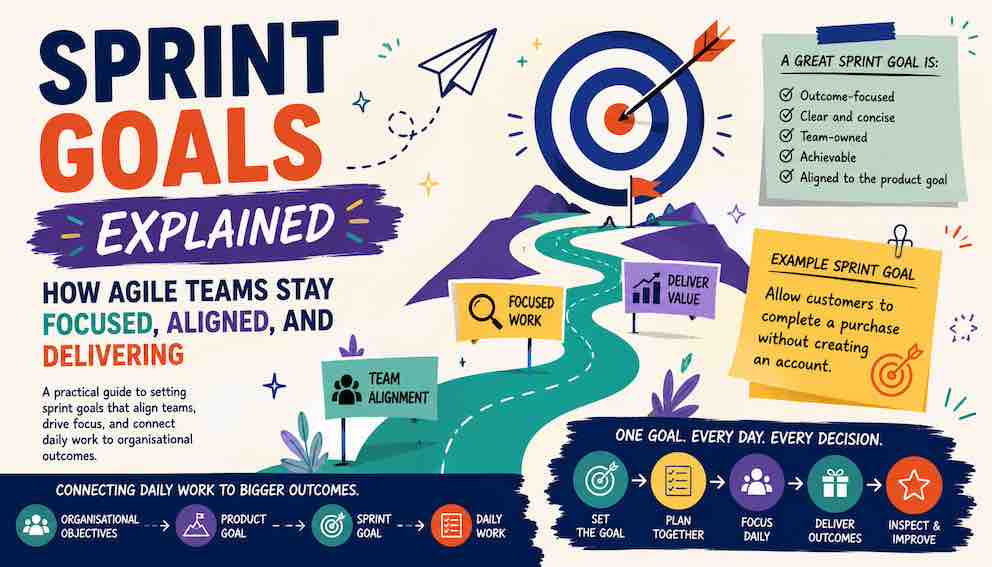
A practical guide to setting sprint goals that align teams, drive focus, and connect daily work to organisational outcomes
A sprint goal is the single outcome a team commits to delivering in a sprint — not a list of tasks, but a statement of what will change for users or the business. Teams that take sprint goals seriously work more cohesively, make faster decisions, and produce more complete implementations than teams that treat each sprint as a collection of independent stories. A well-written sprint goal also creates a direct line of sight from the team's daily work to the product roadmap and organisational objectives, making progress genuinely trackable rather than invisible. This guide covers what sprint goals are, why they matter, how to write them well, and how to make them work in the messy conditions real teams actually operate in.
There is a quiet problem sitting inside many agile teams. On the surface, everything looks fine. Sprints are planned, standups happen every morning, backlogs are groomed and refined, and software ships at the end of each cycle. But if you ask someone on the team what they are actually trying to achieve this sprint — what the point of all this work is — you often get a pause, followed by a list of tickets.
That pause is the problem.
A list of tickets is not a sprint goal. Both teams may be shipping software. But one team's work is cohesive, traceable, and directional — it adds up to something. The other team is harder to read from the outside, harder to align with organisational priorities, and more likely to accumulate work that is technically done but never quite finished.
This article is about sprint goals: what they are, why they matter more than most people realise, how to write them well, and how to avoid the patterns that quietly undermine them.
What a Sprint Goal Actually Is
A sprint goal is the single objective for a sprint — a concise statement of the outcome the team commits to delivering, expressed in terms of value to the user or the business, not in terms of tasks or features.
The Scrum Guide defines it as the single objective for the sprint. It is the answer to the question: what are we trying to achieve, and why does it matter?
A sprint goal is not a summary of the sprint backlog. It is not a headline stuck above a list of stories. It is an expression of intent — a statement of the outcome the team is committing to deliver by the end of the sprint, framed in terms of value to the user or the business.
The distinction between outcome and output is worth dwelling on. An output is something you produce. An outcome is the change in the world that production creates. "Build password reset functionality" is an output. "Enable users to recover their accounts without contacting support" is an outcome. The tasks might be identical in both cases, but the framing changes everything about how the team thinks, makes decisions, and measures success.
A well-written sprint goal has a few qualities. It is short enough that everyone on the team can repeat it from memory. It is specific enough to guide decisions during the sprint. It is focused on what changes for users or the business, not on what the team will do. And it is achievable — not a vague aspiration, but a real commitment that the team believes they can honour in the time available.
Here is a simple example to make this concrete. Imagine a team building an e-commerce platform. A poor sprint goal might look like this: "Complete checkout stories, fix three bugs, and start work on the new analytics dashboard." A strong sprint goal for the same sprint might be: "Allow customers to complete a purchase without creating an account." The first is a to-do list. The second is a purpose.
Why Sprint Goals Matter
It is tempting to treat the sprint goal as a formality — something to write in a planning doc and then forget about until the review. Many teams do exactly this. But when sprint goals are taken seriously, they change the texture of the whole sprint in ways that are hard to achieve through any other mechanism.
They give the team a shared direction
When a team shares a sprint goal, they share a definition of success. Everyone — engineers, designers, testers, the product owner — knows what they are working toward and why. This shared understanding changes the quality of conversations throughout the sprint. Decisions that might otherwise escalate into long debates get resolved quickly because there is a reference point: does this help us achieve the goal?
Without a shared goal, team members tend to optimise locally. Each person focuses on their own tasks, does good work in isolation, and delivers their individual contribution. The sprint backlog gets ticked down, but the work does not always add up to anything coherent.
A sprint goal creates the connective tissue that turns individual effort into collective achievement.
Golden rule: If the sprint goal cannot be used to resolve a disagreement or reject a new request, it is not specific enough to be useful.
They reduce cognitive load and scattered work
One of the most common sources of inefficiency in software teams is cognitive fragmentation — having too many unrelated things in flight at the same time. When a sprint contains stories from five different areas of the product, the team is constantly context switching. The mental overhead is real and expensive. But there is a more specific cost that often goes unnoticed.
Every problem domain requires research. Before a developer can make good decisions about a piece of work, they need to understand the codebase in that area, the edge cases, the prior decisions and why they were made. That research takes time. When a team splits attention across three unrelated areas in a single sprint, each person is doing that orientation work multiple times — and so is every other team member who touches the same areas. Now multiply that by every sprint where focus is absent.
It gets worse when work is split across sprints. A story that starts in one sprint and finishes in another requires everyone involved to re-establish the context they had built up the first time. The research gets done twice. The mental model has to be reconstructed. Small decisions that would have been obvious in the flow of focused work become uncertain again.
A focused sprint goal eliminates most of this waste. When the whole team is working in the same domain, context accumulates rather than evaporates. One person's discovery becomes the whole team's knowledge. A question raised in the daily scrum gets answered by someone who has been thinking about exactly that problem all week.
A focused sprint goal also acts as a natural constraint on scope creep. It pulls work toward a single domain and discourages the kind of opportunistic backlog stuffing that scatters attention. When the team knows the sprint is about checkout, requests to sneak in a quick analytics feature feel obviously out of place.
Without a goal, there is no principle to push back with.
Golden rule: If stories from more than two unrelated areas are in the sprint, the team is probably not working toward a goal — they are running a mini-project-queue.
They enable real teamwork and collective learning
There is a difference between a team that is executing tasks assigned to them and a team that owns a goal they helped define. Sprint goals, when co-created by the team during planning, shift the dynamic from the first to the second. The goal becomes something the team chose to commit to, not something imposed from above.
But ownership also changes the practical texture of how the team works day to day. When everyone is working toward the same outcome, work can be divided fluidly based on what the goal needs rather than what each person was originally assigned. If a teammate is blocked, another can step in — not because they were told to, but because they understand exactly what is at stake and what needs to happen. If a piece of work turns out to be larger than expected, the team can rebalance without needing to renegotiate scope with a manager. The goal provides the shared context that makes all of this natural.
There is also a learning dimension that is easy to underestimate. When a whole team spends a sprint in the same problem domain, they think together. Questions get raised in conversation and answered collectively. Someone's approach to a hard problem becomes visible to the rest of the team. Assumptions get challenged before they become bugs. Over time, teams that consistently work toward coherent goals develop a shared mental model of the product that makes every subsequent sprint faster and less uncertain.
This contrasts sharply with the pattern where everyone works on separate stories in separate areas and convenes only for ceremonies. That team is a collection of individual contributors who happen to share a sprint board. The team with a real sprint goal is something more.
This matters for morale, but it also matters for quality. Teams that feel ownership over an outcome tend to solve problems more creatively, raise issues earlier, and push harder when things get difficult. The sprint goal becomes the rallying point: we said we were going to make this possible for our users, and we are going to find a way.
Golden rule: If team members cannot explain how their current task connects to the sprint goal, the goal is not doing its job.
They produce more complete, higher-quality work
There is a subtler benefit that is easy to miss. When a team is working toward a coherent goal, the resulting work tends to be more coherent. Design decisions are made in the context of the same problem. Interfaces are built with the same user journey in mind. Edge cases are considered together rather than in isolation.
Focused effort also produces more complete solutions. When the whole team is pointed at the same outcome, the implementation gets thought through fully — corner cases are caught, integration points are considered, and the feature actually works end to end before the sprint closes. When effort is divided across five different areas, each piece gets a fraction of the attention it deserves. Things get built to a point, then abandoned when the next priority pulls focus away. The result is a backlog full of partially realised work that each requires its own context re-establishment the next time someone picks it up.
This is the difference between a team operating in goal-oriented mode and one operating in operations mode. An operations-oriented team processes work — stories come in, stories go out, the backlog moves. A goal-oriented team pursues outcomes — they start each sprint with a clear picture of what they are trying to make possible, and they do not consider the sprint successful unless that thing is real. The mode shapes everything: how stories are written, how testing is approached, how done is defined, and how much quiet technical debt accumulates beneath the surface.
When a sprint is just a pile of unrelated tasks, implementation decisions get made without shared context. The result is often code that solves each individual problem adequately but does not fit together well — creating the kind of low-level technical debt that accumulates quietly and becomes expensive later.
Here is the counter-intuitive part: a team that commits to less in a sprint often delivers more over time. Narrowing scope to a single goal feels like a constraint. But it produces complete, coherent implementations rather than a wider scattering of half-finished work. Teams that chase breadth sprint after sprint rarely outpace teams that go deep on one thing at a time.
Golden rule: Done means the goal is achieved — not that the stories are closed.
They align the team with organisational goals and make progress visible
Good sprint goals do not exist in a vacuum. They connect the team's day-to-day work to the product goal, and through that to the business strategy. When someone on the team understands not just what they are building but why it matters to users and to the company, they make better decisions at every level. They ask better questions in refinement. They spot problems that a purely task-focused colleague would miss.
But the connection goes further than individual decision-making. When sprint goals are deliberately aligned with organisational objectives, the team becomes a reliable unit of delivery against the roadmap. Each sprint is a measurable step toward something the organisation cares about — not a black box of activity that produces output, but a named commitment that produces traceable progress.
This matters enormously for planning at the organisational level. When leadership can see that each sprint goal maps to a roadmap milestone, they can track whether the product is advancing at the right pace. When the sprint goal is disconnected from any larger objective, progress becomes invisible — the team is working, something is shipping, but it is hard to say whether it is the right thing. That ambiguity tends to produce exactly the kind of stakeholder anxiety that leads to scope interference and mid-sprint disruption.
The Scrum Guide explicitly links the sprint goal to the product goal — the longer-horizon objective the product is working toward. Sprint goals are how that larger ambition gets translated into two-week chunks of real, working software. A team that consistently writes sprint goals aligned with the product goal is a team the organisation can plan around.
Golden rule: If leadership cannot tell from this sprint's goal whether the product is moving in the right direction, the connection to the roadmap has broken down.
Common Sprint Goal Mistakes and Anti-Patterns
These failure modes appear even in teams who think they are doing it right.
Describing tasks instead of outcomes. "Complete user authentication, fix the payment bug, and refactor the database layer" is a backlog summary, not a goal. A goal states what these tasks are supposed to make possible — not what the team will do, but what will change.
Treating it as optional reporting. The sprint goal is a decision-making tool, not documentation. If it is not being used to evaluate new requests or resolve mid-sprint trade-offs, it is not functioning as a goal.
Writing something too vague to be useful. "Improve platform stability" sounds like a goal but cannot guide a single decision. If a team member cannot use the goal to resolve an unexpected choice mid-sprint, the goal is not specific enough.
Setting it without the team. A goal handed down from above is an instruction, not a commitment. The product owner should propose a direction; the team should shape and own the final wording. A goal that was assigned is never owned in the same way as one that was agreed.
Writing it and then ignoring it. The most common failure mode. The goal sits in a planning doc while the team works from the task board. If it is not visible, not referenced in standups, and not used to push back on new requests, it is just a label.
Never reviewing the goal in retrospectives. Teams improve many things through retros but rarely examine whether their goals were well-written. Was it clear? Did it actually guide decisions? This reflection is how goal-setting gets better over time.
How to Write a Good Sprint Goal
Start with the user or the business, not the backlog. Ask: what should be different by the end of this sprint? What problem are we solving? The answer to that question is the seed of the goal.
Phrase it as an outcome, not an activity. "Implement X" is an activity. "Enable users to do Y" is an outcome. The distinction matters because it keeps the team focused on purpose, not just delivery.
Keep it short enough that everyone can repeat it from memory. If it takes a paragraph to explain, it is trying to do too much. Make sure it is genuinely achievable — stretch goals feel motivating in planning and create demoralisation by Thursday.
Write it together. The product owner should propose a direction; the team should shape the final wording. A goal that was handed down is assigned. A goal that was agreed is owned.
A Sprint Goal Template Worth Keeping
"This sprint, we aim to [desired outcome] so that [user or business value]."
Add a middle clause when the approach needs to be part of the commitment:
"This sprint, we aim to [desired outcome] by [key approach], so that [user or business value]."
For example: "This sprint, we aim to allow customers to complete a purchase as a guest, so that we stop losing conversions from users who do not want to create an account."
Good Sprint Goals and Bad Ones, Side by Side
The pattern is consistent across every example: weak goals describe what the team will do; strong goals describe what will change.
E-commerce checkout
- Weak: "Complete checkout stories, fix three bugs, and start analytics dashboard work."
- Strong: "Allow customers to complete a purchase without creating an account."
Mobile app performance
- Weak: "Backend API work and some frontend polish."
- Strong: "Reduce product listing load time by 40% to improve conversion on mobile."
Seller tools
- Weak: "Sprint 14 — various seller improvements."
- Strong: "Enable sellers to manage their inventory directly from the mobile app."
Onboarding
- Weak: "Work on onboarding stories and fix some UX issues."
- Strong: "New users can complete account setup and send their first message without needing help."
None of the strong examples mention implementation. They describe what becomes possible and leave the team free to figure out how.
The Sprint Goal Across the Agile Ceremonies
The sprint goal does not just matter at the start of the sprint — it has a role in every event.
Planning shifts from "what stories will we pull?" to "what are we trying to achieve, and what work does that require?" The backlog becomes a source of candidate work, not a conveyor belt.
The daily scrum gains a sharper question: not just what did I do and what will I do, but are we on track to achieve the goal? This turns the standup from a status report into a genuine coordination conversation.
The sprint review becomes an outcome inspection rather than a feature demo. The question to stakeholders is whether the committed outcome was achieved — which gives them something more meaningful to respond to than a list of completed stories.
The retrospective should examine the goal itself, not just the team's processes. Was it clear? Did it guide decisions? Did the team protect it? This is how goal-setting improves over time.
Golden rule: The sprint goal should be visible in every ceremony — not filed away after planning and retrieved for the review.
Making the Sprint Goal Sprint-Ready
Writing a good sprint goal is one thing. Ensuring the team can actually deliver on it is another. A sprint goal is only as strong as the preparation behind it — and the most common reason goals collapse mid-sprint is not poor execution, it is unresolved uncertainty at the point of commitment.
Sprint-ready means the team enters planning with enough clarity to commit with confidence. That requires a few things to be true before planning begins.
Unknowns have been investigated. Technical questions that could derail a goal should be answered before the sprint, not during it. This is what spikes are for — short, time-boxed investigations that establish feasibility, surface constraints, and give the team a realistic basis for estimation. A story that looks like two days of work can turn out to require a completely different architecture when no one has looked closely at it. Spikes move that discovery outside the sprint, where it belongs.
Dependencies have been surfaced and resolved. An API from another team, a design sign-off, a stakeholder decision, a third-party integration — these are the hidden landmines of sprint goals. Most of them are knowable in advance. A team doing good pre-sprint work identifies them, chases them down, and either resolves them or builds a plan around them before committing. A goal committed to with an unresolved dependency is not really a commitment — it is a hope.
The backlog is genuinely refined. Stories supporting the goal should be well-understood, appropriately sized, and free of the kind of ambiguity that generates mid-sprint debates. Refinement is not a formality — it is the primary mechanism for ensuring that planning conversations are about priorities and sequencing, not about what the work actually involves.
Capacity is realistic. Sprint goals fail when teams commit to an outcome without accounting for leave, operational overhead, support load, or the inevitable friction of real work. Sprint-ready means the goal has been sized against what the team can actually do — not against an idealised version of the sprint.
The discipline is not about eliminating all risk — that is neither possible nor desirable. It is about ensuring that when a team commits to a goal, they have done the reasonable work to make that commitment real.
Golden rule: If the team cannot answer "are we confident we can achieve this?" at the end of planning, the goal is not sprint-ready.
Edge Cases: When the Sprint Gets Complicated
The single-goal principle is sound, but real teams operate in conditions that do not always accommodate it cleanly. Here is how to think through the most common situations where the ideal meets reality.
When the live product generates its own demands
Many teams maintain a product that is already in users' hands, which means every sprint arrives with some volume of support work, bug fixes, and operational tasks that have nothing to do with the planned goal. This is not a dysfunction — it is the normal condition of any team responsible for a live system.
The practical approach is to treat this work as a standing allocation rather than a competing goal. If the team consistently spends roughly 20% of sprint capacity on live service work, plan for that explicitly and set the sprint goal against the remaining 80%. The goal still provides direction for the primary work. The operational work sits alongside it as a known and expected overhead, not as a second goal fighting for priority.
What to avoid is letting the live service work expand to fill the sprint and then calling whatever got squeezed in alongside it a "goal." If operational demands are genuinely consuming most of the team's capacity, that is a resourcing or prioritisation conversation — not a sprint planning problem.
When cross-functional team members have no work in the current goal
This is a real and common tension. A sprint goal focused on backend performance, for example, may leave a UX designer with little directly applicable work. A database-heavy goal may not require the team's front-end engineers in any meaningful way.
The first question is whether this is genuinely true or whether it reflects stories being written too narrowly. A goal like "reduce product listing load time by 40%" could reasonably involve front-end optimisation, API redesign, and database indexing — it depends on where the problem actually lives. Before assuming a team member has no relevant work, it is worth checking whether the work definition is too constrained.
Where a genuine mismatch exists, the options are: bring forward preparatory work for a future goal that does involve those skills, use the sprint for research or spike work that reduces uncertainty in upcoming sprints, or accept that some team members will be at lower utilisation this sprint. None of these require diluting the sprint goal. The goal should reflect what the team is primarily trying to achieve, not what every team member happens to be doing.
When a high-priority item gets dropped on the team mid-sprint
This happens. A critical bug surfaces in production. A business decision creates an urgent new requirement. A dependency from another team lands unexpectedly and needs immediate response.
The first thing to do is assess the impact honestly. Does this new work displace the sprint goal, or can it be absorbed without threatening it? If it can be absorbed — perhaps by deferring a lower-priority story — the goal stays intact and the team adjusts the backlog accordingly.
If it genuinely displaces the goal, the product owner and team need to make an explicit decision: is the new priority important enough to abandon the sprint goal? If yes, that decision should be named and communicated, not quietly absorbed into the sprint while pretending the goal is still on track. A sprint goal that has been effectively abandoned but never officially acknowledged is how teams lose confidence in the planning process.
If this pattern happens regularly — urgent work consistently disrupting planned goals — that is a signal worth taking seriously. It usually means either that the sprint goal is being set without sufficient awareness of the environment the team operates in, or that the organisation does not have a clear enough mechanism for handling urgent work outside the sprint cycle.
When the sprint has work across genuinely different areas
Sometimes a team has two independent streams of work that both need to advance, and neither is clearly dominant. This is the hardest case.
One approach is to identify a primary goal — the outcome that matters most to users or the business right now — and treat the secondary work as maintenance or supporting activity that runs alongside it. The sprint goal captures the primary intent. The secondary work is acknowledged and planned for, but it does not share the goal's status.
Where two streams are truly equal in priority and genuinely independent, it is acceptable to have two goals — provided the team is honest that this sprint is a compromise and that focus will be split. That is a different thing from making it the default.
Sprint Goals, the Product Goal, and the Organisational Roadmap
Sprint goals do not exist in isolation. The Scrum Guide explicitly connects them to the product goal — a longer-horizon objective that takes multiple sprints to reach. Each sprint goal should be a meaningful step toward that destination, not just a collection of whatever is next in the backlog. A team that sets sprint goals without reference to a product goal can work hard, ship regularly, and still end up nowhere in particular.
The chain extends further. Most organisations have objectives above the product level — quarterly goals, OKRs, a roadmap with named milestones. When sprint goals are aligned with product goals that are in turn aligned with those organisational objectives, something genuinely useful becomes possible: real progress tracked sprint by sprint. Not story points completed, but actual movement. Did the team achieve the goal? Did it advance the product goal? Is the product on track?
These questions can only be answered honestly when the chain is intact. When it is, sprint reviews become progress checkpoints rather than feature demonstrations, and stakeholders can make informed decisions about priorities and investment based on where the product actually stands.
At every planning session the product owner and team should be able to answer: how does this sprint goal advance the product goal, and how does the product goal serve what the organisation is trying to achieve? If the answer is unclear, that is worth resolving before the goal is committed to.
Golden rule: A sprint goal that cannot be traced to a larger organisational objective is activity, not progress.
A Closing Thought
Sprint goals are one of those things in Scrum that seem simple on the surface but reveal significant depth when you start working with them seriously. They are not a management tool for tracking what teams deliver. They are not a reporting format for stakeholder updates. They are the mechanism by which a team transforms a backlog of tasks into a purposeful commitment — a shared statement of what they are going to make possible in the next two weeks, and why it matters.
Teams that get this right do not just deliver more. They think differently. They argue productively about priorities. They support each other across disciplines. They learn faster from their mistakes. They feel a genuine sense of accomplishment at the end of each sprint, not because they closed all their tickets, but because they moved something real.
The sprint goal is, in the end, the answer to a simple question: what are we here to do? Getting that answer right — and returning to it throughout the sprint — is one of the most valuable things any agile team can do.
About N Sharma
Lead Architect at StackAndSystemN Sharma is a technologist with over 28 years of experience in software engineering, system architecture, and technology consulting. He holds a Bachelor’s degree in Engineering, a DBF, and an MBA. His work focuses on research-driven technology education—explaining software architecture, system design, and development practices through structured tutorials designed to help engineers build reliable, scalable systems.
Disclaimer
This article is for educational purposes only. Assistance from AI-powered generative tools was taken to format and improve language flow. While we strive for accuracy, this content may contain errors or omissions and should be independently verified.