
Learning Paths
Last Updated: April 20, 2026 at 18:30
Retry, Timeout, and Exponential Backoff in Distributed Systems: A Complete Guide for Developers
The resilience primitives every distributed system depends on — and how to configure them correctly
This article explains how retries, timeouts, and exponential backoff work in distributed systems and how they collectively shape system behavior under both normal operation and failure conditions. It shows why these mechanisms are essential for handling real-world issues like transient network failures, latency spikes, and partial service degradation, while also highlighting how misconfigured retry logic can unintentionally amplify load and contribute to large-scale outages. Understanding these patterns is critical for building resilient backend systems that can both recover from temporary faults and remain stable under sustained stress. The key insight is that retries are not just recovery tools — they are load-sensitive control mechanisms that must be carefully balanced with timeouts, jitter, and circuit breakers to maintain system stability.
Introduction
When a network call fails in a distributed system, the instinct is simple: try again. But "just try again" is one of the most dangerous assumptions in backend engineering. Retries consume resources, multiply load on already-struggling services, and can turn a minor slowdown into a full platform outage.
This guide explains the three core mechanisms that govern how distributed systems behave under failure — timeouts, retries, and backoff — and how they interact with circuit breakers, service discovery, and message queues. Everything is explained from first principles, so if you are relatively new to distributed systems, you will be able to follow along and understand not just what to configure, but why.
Why These Patterns Exist
Before getting into how each mechanism works, it is worth being explicit about why they exist at all.
Distributed systems are not designed to avoid failure. They are designed to continue operating while parts of the system fail.
In a monolith, failure is immediate and local. A bad database query throws an exception, the call stack unwinds, and the error surfaces. In a distributed system, failure is partial, probabilistic, and often temporary. A service does not go from healthy to dead — it goes from healthy to slow, then slower, then intermittently unavailable, then eventually down. Networks drop packets occasionally. Latency is variable, not constant. Services degrade under load rather than failing cleanly.
Failure in distributed systems is not a rare edge case. It is the normal operating condition. The question is not whether something will fail, but how well the system behaves when it does.
This is why timeouts, retries, and backoff are not optional safety features. They are the primitives that make resilience possible:
Timeouts define failure boundaries. Without them, a slow dependency can silently exhaust the resources of every service that calls it. Timeouts are what let a service say "this call has failed" and move on — preserving its capacity to serve other requests.
Retries automatically recover from transient failures. Without them, a brief network hiccup or a momentary load spike surfaces as a user-visible error that requires manual intervention. A well-placed retry keeps these short-lived issues invisible, turning what would have been a visible failure into a seamless success.
Backoff and jitter help a system recover during partial outages by controlling when retries happen. When many clients experience a failure at the same time, they tend to retry together. Without any delay, or with a fixed delay, those retries arrive in bursts — large spikes of traffic hitting a service that is already struggling. Each spike resets recovery, keeping the service unstable.
Backoff increases the wait time between retries after each failure, reducing pressure on the system over time. Jitter adds randomness to those delays, so different clients retry at slightly different moments instead of in lockstep. Together, they spread retry traffic smoothly over time, giving the service breathing room to stabilise and recover under real load.
The goal of these patterns is not to prevent failure — you cannot. The goal is to control how failure spreads through the system, and to give failing components the space to recover.
With that framing established, the rest of this guide covers each mechanism in depth: what it does, how to configure it, and what goes wrong when it is misconfigured.
The Broken Assumption: "Just Try Again"
When a call fails, retrying is sometimes the right move. Networks glitch. A momentary load spike can cause a timeout that would succeed if attempted a second later. In those cases, a well-placed retry turns a user-visible error into a seamless success.
The problem is the assumption that retries are always safe. They are not.
When one client retries a failed call, it doubles the number of requests it sends to the downstream service. In a real system with hundreds or thousands of clients, each configured with multiple retries, a failing service can receive many times its normal traffic — at exactly the moment it is least equipped to handle it.
Retries are essential for resilience — they recover the failures that would otherwise surface to users — but they carry a real cost that must be understood. When one client retries a failed call, it doubles the number of requests it sends to the downstream service. In a real system with hundreds or thousands of clients, each configured with multiple retries, a failing service can receive many times its normal traffic at exactly the moment it is least equipped to handle it.
The key principle is simple: retries help when the problem is brief, but make things worse when the problem persists.
If a failure is transient — a short network glitch or a momentary spike — a retry happens after the issue has already passed, and the request succeeds. In that case, retries improve reliability by smoothing over small, temporary failures.
But if the failure is sustained — the service is slow, overloaded, or down — retries don’t fix anything. They add more requests to a system that is already struggling. Each retry increases load, which makes the service slower, which causes more retries. The system enters a feedback loop.
When retries are used carefully — limited in number, spaced out with backoff, and applied only to safe (idempotent) operations — they quietly improve success rates. When misconfigured, even a small slowdown can escalate: a service that is only slightly degraded can be pushed into complete unavailability because retries multiply the pressure at exactly the wrong time.
The Three Control Levers
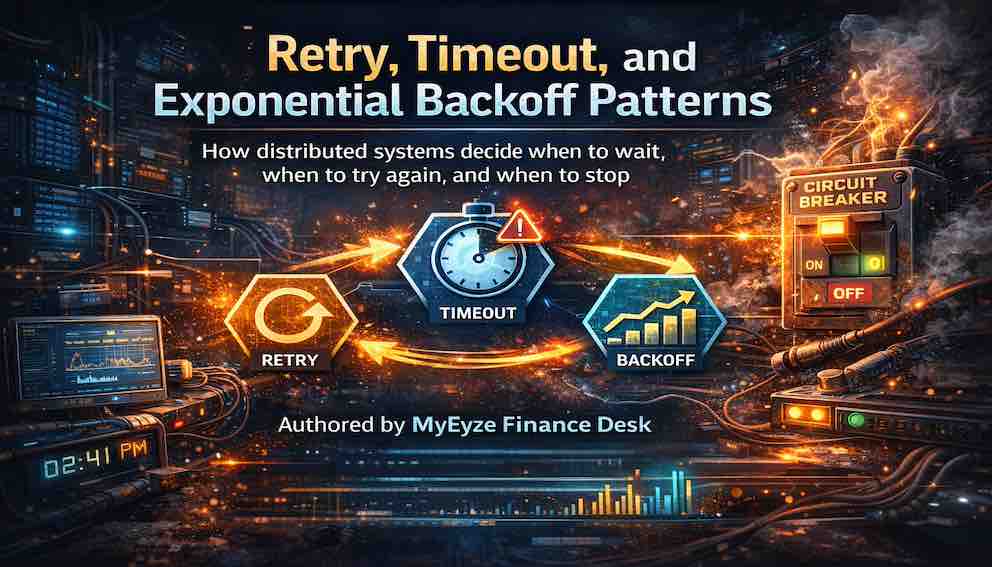
Timeouts, retries, and backoff are not independent knobs. They form a feedback loop that shapes how your system behaves when things go wrong.
Timeout answers the question: how long are you willing to wait for a single attempt?
Retry answers: how many times are you willing to try?
Backoff answers: how long do you wait between tries?
Change one, and the behaviour of the others changes. A short timeout with many retries can produce the same total elapsed time as a long timeout with few retries, but with very different resource consumption profiles. You cannot tune these in isolation.
Timeouts: The Boundary of Patience
What a Timeout Actually Does
A timeout is a failure classification decision. When you set a timeout of two seconds, you are stating: "Any response that takes longer than two seconds is not worth waiting for." That is a business decision as much as a technical one.
Many frameworks ship with default timeouts that are either infinite or extremely high. An infinite timeout means a single slow downstream call can block a thread forever. If your thread pool has 200 threads and 200 slow calls arrive, your service stops responding to everything else — not because it has failed, but because it is waiting.
Always set timeouts explicitly. Never rely on framework defaults.
The Hidden Cost of Waiting
When calls wait too long, several things happen quietly in the background:
Threads are occupied for the full duration of the slow call. If your normal call takes 100ms and threads are sized accordingly, a call that takes 3 seconds ties up a thread for 30 times longer than expected. Throughput falls by the same factor.
Connection pools fill up. Database connections, HTTP connections, and gRPC channels are finite resources. Slow calls hold connections open. When the pool exhausts, new requests cannot acquire a connection and fail immediately.
Memory accumulates. In-flight requests hold state in memory. As calls pile up, heap pressure increases. In extreme cases, this can trigger garbage collection pauses or out-of-memory errors, compounding the original problem.
A service that waits too long does not fail fast. It fails slowly and expensively, and it often takes other services down with it.
The Three Types of Timeout
For any downstream call, you should configure three distinct timeout values:
Connection timeout — how long to wait when initially establishing a connection. Keep this short and reasonable. A connection that takes longer than this is unlikely to succeed and is worth failing fast.
Read timeout — how long to wait for a response once the connection is established. This is where most tuning happens and where the impact on thread and connection pool exhaustion is greatest.
Total request timeout — the maximum time for the entire operation, including all retry attempts. If retries push the total elapsed time past this ceiling, stop immediately regardless of how many retries remain. This is your safety net.
Timeout Budgeting Across Call Chains
If your service fans out to multiple downstream services — calling Service A, then Service B, then Service C — you must divide your total request timeout across those calls deliberately.
You cannot give each dependency a three-second timeout if the entire request must complete in three seconds. If all three calls take three seconds each, the user waits nine seconds — far beyond what any reasonable SLA would permit.
A simple approach is to allocate time proportionally based on the expected latency of each dependency, leaving some buffer for overhead. If your total budget is 2,000ms and you have three calls, you might allocate 500ms to the fast read, 1,000ms to the slow write, and keep 500ms in reserve.
The Key Insight on Timeouts
Timeouts do not prevent slowness. They redistribute it.
A short timeout pushes slowness to the caller: more failures visible at the surface, but resources released quickly. A long timeout absorbs slowness locally: fewer failures visible, but resource exhaustion building underneath. Choose based on your tolerance for each outcome and the downstream impact of each.
Retries: Recovery Versus Amplification
When Retries Help
Retries are effective for transient failures: a momentary network glitch, a connection reset, a brief timeout caused by a load spike that has already passed. In these cases, a retry often succeeds cleanly. The problem has resolved itself in the milliseconds it took to back off and try again.
When Retries Destroy Systems
Retries are dangerous for sustained failures. A downstream service that is genuinely unavailable, or pathologically slow, will not recover in milliseconds. Every retry adds load to a service that is already struggling. The situation worsens, not improves. This is the key distinction: retries are right for transient failures, and wrong for sustained ones. The patterns in the rest of this section — idempotency, retry limits, backoff — exist to keep retries firmly in the first category.
Idempotent vs Non-Idempotent Operations
This distinction is critical. Getting it wrong can cause harm far worse than the original failure.
An idempotent operation produces the same result whether it is called once or ten times. Reading a record is idempotent. Setting a resource to a specific value is idempotent — if the value is defined absolutely, not relatively. Deleting a record is idempotent in the sense that deleting something that is already deleted produces the same end state.
A non-idempotent operation has side effects that compound with each call. Creating a new record is non-idempotent. Charging a payment is non-idempotent. Sending an email is non-idempotent. If you retry a payment capture blindly and the original request was processed, you charge the customer twice.
The rule is clear: only retry idempotent operations automatically. For non-idempotent operations, either design them with idempotency keys, or do not retry them at all.
What is an idempotency key? It is a unique token the client generates and includes in the request. The server stores the key alongside the result of the first successful execution. If it receives a second request with the same key, it returns the stored result without re-executing the operation. The client can safely retry; the server handles deduplication.
When NOT to Retry
Some failures are permanent. Retrying them wastes resources and delays the user's error feedback. Do not retry:
Validation errors. If the request data is invalid, the server will reject it every time. No amount of retrying will make invalid data valid.
Authentication and authorisation failures. A 401 or 403 response means the credentials are wrong or the caller lacks permission. The credentials do not become correct on the second attempt.
Known permanent failures. A 404 (resource not found) or similar response indicates the resource does not exist. It will not appear spontaneously on a retry.
Non-idempotent operations without idempotency keys. As described above, the duplicate effect is often far worse than the original failure.
Synchronous user-facing flows with tight latency budgets. Three retries with a 500ms delay each add 1.5 seconds to the user's wait, plus the time for each failed attempt. In some cases it is better to fail fast and show the user an error immediately than to silently wait through a retry cycle.
Engineering Law: Do not retry something that is guaranteed to fail.
Setting a Safe Retry Count
More than two to three retries rarely recovers a genuinely failing dependency and significantly amplifies load. If a service has not responded successfully after two to three attempts, it is probably experiencing a sustained failure that more retries will not resolve.
Exponential Backoff: Spacing Out Retries
The Problem with Fixed Delays
If all your clients retry after a fixed delay of, say, 100ms, they all experience the failure at roughly the same time, wait the same interval, and retry at the same moment. The failing service receives a synchronised wave of retry traffic — potentially larger than the original load — at exactly the moment it is trying to recover.
Engineering Law: Backoff without jitter is synchronised failure in disguise.
Even if you increase the fixed delay, if every client uses the same formula, the retries remain bunched together.
Exponential Backoff
The solution is to increase the delay after each consecutive failure. This gives the failing service progressively more time to recover between waves of retries.
Attempt 1 fails → wait 100ms
Attempt 2 fails → wait 200ms
Attempt 3 fails → wait 400ms
The simplest implementation of the formula is straightforward: delay = baseDelay × 2^attempt
Jitter: The Missing Piece
Even exponential backoff can produce synchronisation if all clients start from the same initial state. If a deployment event or a shared upstream failure hits hundreds of instances simultaneously, they will all run through the same delay sequence in lockstep.
Jitter adds randomness to each backoff delay, spreading retries across time so they do not arrive in a single wave.
A common and effective formula:
delay = min(maxDelay, baseDelay × 2^attempt)
delay = random(delay × 0.5, delay × 1.5)
This ensures that even clients who started failing at the same moment will retry at different times, smoothing the retry load on the recovering service.
Maximum Delay Cap
Without a ceiling, exponential backoff delays grow without bound. A cap of 10 to 30 seconds is typical and prevents clients from waiting so long that they effectively become unresponsive from the caller's perspective.
Putting It Together: A Complete Retry Strategy
The following describes the full flow for any downstream call, combining all three levers:
- Set a total request timeout — the maximum time the entire operation can take, including all retries.
- Set a per-attempt timeout — how long to wait for a single call.
- Set a maximum retry count — typically 2 or 3.
- Make the call with the per-attempt timeout.
- If it succeeds, return the response.
- If it fails, check: (a) are retries remaining? (b) does the total timeout allow another attempt?
- If both are true, calculate the backoff delay using exponential growth with jitter, wait, then retry — ideally using a fresh service discovery lookup to potentially reach a different instance.
- If all retries are exhausted, signal failure — ideally to a circuit breaker.
Engineering Law: Retries should be rare, bounded, and increasingly delayed.
Rare means not every failure needs a retry — only transient ones. Bounded means there is always a finite limit; infinite retries are never correct. Increasingly delayed means giving the system progressively more time to recover between attempts.
Circuit Breakers: Knowing When to Stop
A circuit breaker monitors the rate of failures on a downstream dependency. When failures exceed a threshold — say, 50% of calls failing within a 10-second window — the circuit opens. Subsequent calls are rejected immediately without even attempting to reach the failing service.
After a configurable cooldown period, the circuit enters a "half-open" state, allowing a small number of test requests through. If those succeed, the circuit closes again and normal traffic resumes. If they fail, the circuit re-opens and the cooldown resets.
Retries and circuit breakers are complementary, not redundant.
Retries handle brief, recoverable failures. The circuit breaker handles sustained, unrecoverable ones. Without a circuit breaker, retries run indefinitely against a service that is clearly not recovering, amplifying load until something collapses. Without retries, a circuit breaker might open on a single transient failure, overreacting to a momentary glitch.
Engineering Law: Retry feeds failure into the circuit breaker. The circuit breaker decides when recovery is no longer worth attempting.
Together, they create a two-stage response to failure: try again briefly, then back off entirely.
Service Discovery: Don't Retry to the Same Instance
A common oversight is retrying to the same failing instance. If the failure is instance-specific — a memory leak, a stuck thread, a bad configuration on one node — retrying to the same host accomplishes nothing.
Engineering Law: A retry to the same failing instance is not a retry. It is repetition.
Before each retry, if applicable, perform a fresh service discovery lookup. Your service registry may surface a different set of healthy instances. Choose a different instance for each retry attempt. This is especially important in containerised environments where unhealthy instances may take time to be deregistered.
Note that your service registry may not immediately know that an instance is unhealthy. Health check intervals are typically 10 to 30 seconds. In the window between a failure and deregistration, you may still receive the failing instance from the registry. This is normal and expected — fresh discovery improves your odds without guaranteeing avoidance.
Retries in Message Queues
Message queues introduce a particular failure mode that is worth addressing separately.
Many queues have infinite retries configured by default. A consumer that fails to process a message will retry it forever. If the message is malformed, or the processing logic has a bug, the queue will never drain. The same broken message will cycle through the consumer indefinitely, blocking progress for messages that could be processed successfully.
Always configure a maximum retry count on queue consumers. Route messages that exhaust their retries to a dead-letter queue (DLQ). A DLQ captures messages that could not be processed, where they can be inspected, manually reprocessed, or alerted on without blocking the main queue.
Failure Modes to Watch For
Retry Storms
With N clients each configured with M retries, a failing service can receive N × M requests simultaneously during a failure. This can be orders of magnitude beyond normal load.
Mitigate with: circuit breakers, exponential backoff with jitter, and low retry count limits (2–3 maximum).
Infinite Retries in Message Queues
As described above, configure maximum retry counts on all queue consumers and route exhausted messages to a dead-letter queue.
Retrying Non-Idempotent Operations
A payment request fails mid-flight. Did the server receive it? Did it process it? The client cannot know. If the client retries and the original request was processed, the customer is charged twice.
Design non-idempotent operations with idempotency keys. The server stores the key and the result of the first successful execution, and returns the stored result for any subsequent duplicate request.
Synchronised Retries
All clients use the same fixed backoff formula. They all experience the failure together. They all retry together. The failing service receives periodic waves of traffic that may prevent recovery.
Always add jitter. It is the single cheapest fix for synchronised retries.
Retries Masking Real Issues
A service is consistently slow. Retries succeed after two attempts. The system appears healthy. The root cause is invisible.
Track a metric called "success after retry rate" — the proportion of successful responses that required at least one retry. If most of your successes are happening on the second or third attempt, your system is already degraded. Retries are hiding a deeper problem.
Engineering Law: If most of your successes happen after retries, your system is already degraded.
Alert on high retry rates. Investigate root causes before they become outages.
Observability: What to Track
A healthy system rarely needs retries. When retry rates climb, something is wrong. Track these metrics per downstream dependency:
Timeout rate — how often calls exceed the per-attempt timeout. A rising timeout rate is an early warning that a dependency is slowing down.
Retry count per request — the distribution across zero, one, two, and three-or-more retries. Ideally, the vast majority of requests should require zero retries.
Success after retry rate — how often a retry succeeds where the first attempt failed. High values indicate the system is degraded but hiding it.
Failure after all retries — how often every attempt fails. High values indicate the circuit breaker should open, if it has not already.
Total elapsed time including retries — not just the first attempt. This is the actual latency the user experiences, and it includes all retry delays.
Set alerts on timeout rate and retry rate spikes. Do not wait for circuit breakers to open. A rising retry rate is your leading indicator — it means something is wrong before the situation has fully escalated.
Summary
Timeouts, retries, and backoff are the resilience primitives that allow distributed systems to keep operating when parts of them fail. Failure in these systems is not rare — it is the normal state. Networks drop packets. Services degrade under load. Latency spikes. These patterns exist to absorb that reality gracefully rather than propagating failure across the entire system.
They are also the control theory of how your system behaves under pressure. Change one lever, and the behaviour of the others changes. The goal is not to prevent failure — it is to control how failure spreads, and to give recovering components the space they need.
The key points to take away: Retries multiply downstream load. N clients times M retries equals N × M effective load on a struggling service. Always treat retries as a cost, not a free recovery mechanism.
The three levers — timeout, retry, and backoff — must be tuned together. They form a feedback loop, not a list of independent settings.
Short timeouts fail fast and expose more failures to users. Long timeouts absorb slowness but exhaust resources quietly. Choose deliberately based on your tolerance for each outcome.
Only retry idempotent operations automatically. For non-idempotent operations, use idempotency keys or do not retry at all.
Always add jitter to backoff delays. Fixed delays create synchronised retries, which recreate the failure they were meant to resolve.
Circuit breakers and retries are complementary. Retries handle transient failures. Circuit breakers handle sustained ones. You need both.
Before each retry, if applicable in your setup, use fresh service discovery. Retrying to the same failing instance is repetition, not recovery.
If most of your successes are happening on the second or third attempt, your system is already degraded. Retries are masking a deeper problem.
A healthy system rarely retries. Retries should be the exception, not the expectation.
About N Sharma
Lead Architect at StackAndSystemN Sharma is a technologist with over 28 years of experience in software engineering, system architecture, and technology consulting. He holds a Bachelor’s degree in Engineering, a DBF, and an MBA. His work focuses on research-driven technology education—explaining software architecture, system design, and development practices through structured tutorials designed to help engineers build reliable, scalable systems.
Disclaimer
This article is for educational purposes only. Assistance from AI-powered generative tools was taken to format and improve language flow. While we strive for accuracy, this content may contain errors or omissions and should be independently verified.