
Learning Paths
Last Updated: May 9, 2026 at 13:30
Monolith to Microservices Migration: A Practical Step-by-Step Blueprint for Safe, Incremental Decomposition
How to break down a monolith into microservices without creating a distributed monolith — covering data ownership, consistency boundaries, migration patterns, and real-world failure modes
Migrating a monolith to microservices is not a code rewrite but a gradual shift in how systems are designed, owned, and operated under production constraints. Success depends less on extracting services and more on separating consistency boundaries, especially around data ownership and shared state. Most failures occur when teams focus on code decomposition while leaving database coupling intact, creating distributed systems that behave like monoliths at runtime. A successful migration is incremental and disciplined, improving delivery speed, resilience, and team autonomy rather than simply increasing architectural complexity.
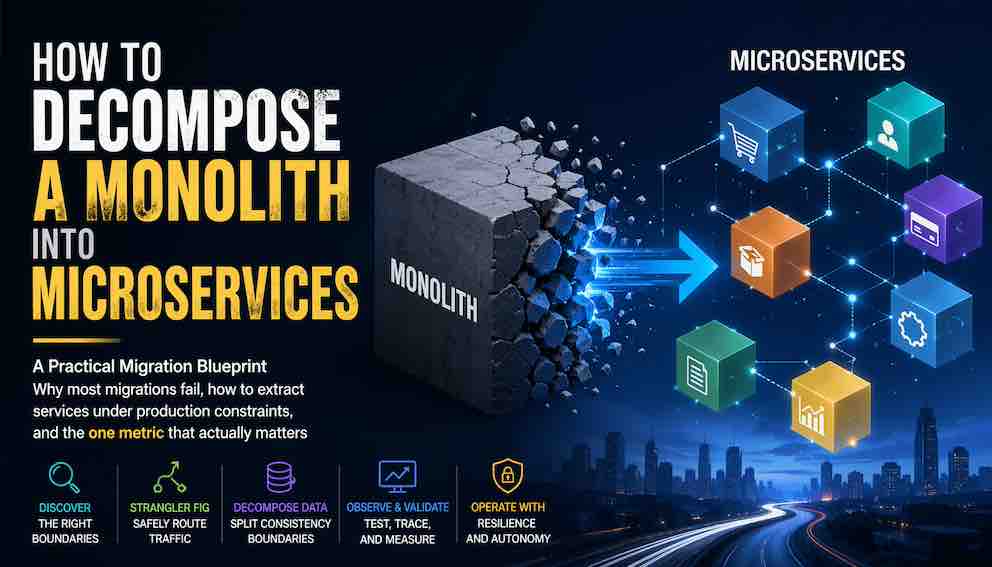
Microservices do not reduce complexity — they relocate it. And the teams that struggle most with migration are not the ones who lack technical skill. They are the ones who treat migration as a technical exercise rather than what it actually is: a fundamental shift in how a system is designed, owned, reasoned about, and operated.
That mindset shift is the real migration. The code is secondary.
One invariant anchors everything that follows: no service should require runtime coordination with another service in order to be changed, deployed, or recovered. If a change to service A requires a simultaneous change to service B, or if deploying service A requires service B to be healthy, you do not have independent services — you have a distributed monolith. Every decision in this article — where to draw boundaries, how to handle data, how to design APIs, how to sequence extractions — is ultimately in service of preserving this invariant.
The corollary is this: you are not splitting services — you are splitting consistency boundaries.
In a monolith, a single database lets you join tables freely, enforce foreign keys, and rely on transactions to keep everything consistent. Once you split the system, those guarantees do not come with you. A query that once joined data across multiple tables now spans multiple services. A foreign key constraint becomes a rule you must enforce in application logic.
Every join you break becomes an application-level coordination problem. Every foreign key you remove becomes a consistency guarantee you must now enforce in code. Every synchronous call you introduce becomes a runtime dependency that chips away at system independence.
Understanding this upfront changes how you approach every decision that follows.
Is Migration Actually the Right Move?
Many discussions on microservices migration begin with the premise that it is the right direction. It’s worth taking a moment to validate that assumption for your own system — not as a rejection of microservices, but as a way to ensure the move is solving a real problem.
If your monolith is not genuinely painful — if teams can ship independently, deployments are fast, and scaling is not a bottleneck — migration may simply relocate complexity rather than reduce it. Microservices earn their cost when you have clear, stable domain boundaries, teams large enough to own services independently, and the operational maturity to run a distributed system. Without those conditions, you are more likely to introduce new problems than solve existing ones.
A useful way to test this is to look at how clearly your system’s responsibilities are defined. Can you describe, in simple terms, the major parts of your system — what each one owns, how they interact, and where one responsibility ends and another begins?
In domain-driven design, these boundaries are called bounded contexts — but the label matters less than the clarity. If defining those boundaries leads to significant debate or ambiguity, that uncertainty will not disappear during migration. It will resurface later as data inconsistency, unclear ownership, and fragile service contracts in production.
Seen in that light, the next step becomes clearer. Before introducing network boundaries, many systems benefit from strengthening their internal ones. A modular monolith — with well-defined package boundaries, explicit ownership, and disciplined interfaces — often provides the clarity and structure needed to make any future migration far more predictable.
For some systems, that clarity is enough. For others, it becomes the foundation that makes microservices viable.
Migration as an Opportunity, Not Just a Risk
Most teams think about migration defensively — as a minefield to navigate carefully. That framing is incomplete. Done well, migration is one of the highest-leverage moments in a system's lifetime to address years of accumulated debt and reset engineering practices.
When you extract a service, you are not just moving code. You are making a deliberate choice about how that domain is built and operated going forward. That choice opens doors that are effectively closed inside a monolith. But each opportunity listed below also introduces a new class of failure if handled carelessly — the point is not to take every door, but to be deliberate about which ones you open and why.
Adopting new technologies and runtimes. A monolith locks you into whatever language, framework, and runtime was chosen years ago. A new service has no such constraint. Teams extracting a notification service might choose a lightweight runtime better suited to high-throughput messaging. The risk is technology proliferation — too many languages across too many services creates hiring problems, shared tooling debt, and on-call complexity. Choose deliberately, not opportunistically.
Upgrading frameworks and dependencies. Upgrading a major framework version in a monolith is a project that touches every team and blocks everyone simultaneously. A service boundary makes it a local decision. The team that owns the service schedules the upgrade, tests it in isolation, and ships it without waiting for organisational alignment. The risk is that local decisions accumulate into a fragmented dependency landscape(breaking architecture principle - control technical diversity) that no one has a full picture of. Track it.
Introducing modern engineering practices. Services are small enough that teams can genuinely adopt practices that are impractical to retrofit into a large codebase. Test-driven development becomes achievable when the scope is bounded. Continuous delivery becomes real rather than aspirational. If your monolith has 40% test coverage and everyone knows it, the service extraction is your chance to start fresh. The risk is that "starting fresh" becomes an excuse to skip the hard work of understanding the domain before rewriting it. Extraction is not a rewrite. Understand what you are extracting before you change how it works.
Resetting on data storage. A service that was previously a module reading from a shared relational database can choose the right persistence model for its domain. An inventory service might move to a document store. An analytics service might adopt a columnar database. The risk is that polyglot persistence fragments your operational model — each new database technology is a new failure mode, a new backup strategy, and a new skill your team needs to operate under pressure.
The teams that get the most value from migration treat each extraction as a greenfield project within a defined scope, not just a transplant of existing code. But they scope their ambition carefully — changing the domain boundary, the technology, the data model, and the engineering practices all at once is how services get extracted and immediately become unmaintainable.
The Mindset Shift That Precedes Everything Else
A monolith is not just code. It is an implicit execution model shaped by years of business evolution, shortcuts, and accumulated coupling. Inside it, data flows freely, transactions are invisible, consistency is guaranteed by the database, and failures are mostly local. It is, in many ways, a remarkably forgiving architecture.
Microservices remove all of that forgiveness. Latency, failure, and consistency — previously handled implicitly — become explicit design problems you must solve across a network you do not fully control.
This demands a different way of thinking. In a monolith, you think in functions and modules. In microservices, you think in contracts, failure modes, and deployment boundaries. A developer who joins tables freely in SQL must now think about what it means to query data owned by another service. A team that shares a database must now think about what it means to change a schema that other systems depend on. An engineer debugging a failure must now think in distributed traces rather than stack traces.
The unifying invariant from the introduction is not just an architectural principle — it is a decision filter. When a design choice makes a service harder to deploy independently, or requires runtime coordination to change, that is the signal to reconsider. The teams that succeed at migration are not the ones who move fastest. They are the ones who internalise this filter early and apply it consistently.
Three Layers of Migration: Readiness, Execution, Evolution
One of the most common reasons migrations stall is that teams conflate three things that need to be kept distinct: the conditions that must be true before migration begins, the mechanics of how migration is executed, and the ongoing evolution of the system after services are extracted.
Blurring these layers creates confusion about what needs to be done now versus what comes later. Here is how to think about each layer clearly.
The readiness layer is about preconditions. Before you extract anything, you need a CI/CD pipeline with automated deployments and rollback, centralised logging with correlation IDs flowing through every request, basic metrics and monitoring, an automated test suite, and clear incident ownership per domain. You should be able to deploy and roll back quickly, and trace any request through your logs. If any of these are absent, build them into the monolith first. The migration can wait.
The execution layer is the incremental process of extraction — the routing layer, the strangler fig pattern, the database decomposition, the data ownership transfers. This is the work most teams think of when they imagine "doing the migration." It is important, but it sits on top of the readiness layer, not alongside it.
The evolution layer is what happens after services exist. Service-level SLOs, API versioning, consumer-driven contract testing, canary deployments, per-service on-call rotations, an internal developer platform. Teams that skip thinking about this layer extract services that are technically operational but practically difficult to evolve independently — which defeats much of the purpose.
Approaching migration through these three layers prevents the most common planning mistake: starting execution work before the readiness prerequisites are in place, and neglecting the evolution infrastructure until problems force attention on it.
Migration Is Not a Big Bang — It Is an Incremental Journey
One of the most damaging myths about microservices migration is that it has a completion date. It does not. Migration is a continuous, incremental process that moves through deliberate intermediate states, and the organisation that treats it as a project to be finished usually ends up in the migration valley of death — too decomposed to go back, too broken to go forward.
The intermediate architecture is not a compromise. It is the strategy.
A healthy migration path looks like this: begin with a modular monolith, extracting clean internal boundaries without changing the deployment model. Introduce a routing layer and extract edge services — the low-risk, high-confidence wins. Let the hybrid state stabilise before the next extraction. Move data ownership gradually, one domain at a time. Reach full service ownership only for the domains where independence genuinely matters.
At any given point, the system will be partly monolith and partly services. That is not a problem. That is the plan. The strangler fig pattern — named after a vine that grows around its host tree, gradually replacing it — is the canonical execution model precisely because it respects this reality. The monolith handles all traffic by default. New services intercept specific routes as they become ready. Traffic shifts gradually. Rollback is always available.
The deeper reframe: you are not migrating services — you are migrating execution paths for specific user journeys. A checkout flow that runs through the new payment service but still falls back to the monolith for order creation is a valid and stable intermediate state. "Service complete" is a misleading milestone. What matters is whether the execution path is observable, stable, and independently deployable.
How We Actually Decide What Becomes a Service
Service extraction is not a mechanical “cut here and deploy” exercise. If you treat it that way, you end up with services that are technically separated but still deeply coupled in behaviour.
Instead, good decomposition follows three signals that already exist in the system.
The first is bounded contexts from the business domain. These define where one part of the business stops needing to understand the internals of another. If two areas of the system require constant internal knowledge of each other to function, they are not separate services yet — they are still one context.
The second is the set of seven service archetypes that naturally emerge in most systems: user-facing experience services, core transactional services, aggregation and composition services, workflow orchestration services, data services, integration services, and supporting utility services. These archetypes are useful because they prevent naive splitting — for example, you do not extract a service just because it is “large”, you extract it because it behaves like a specific archetype with clear responsibilities.
The third is the five decomposition forces that determine whether a boundary is actually viable: how data is owned, how frequently change happens, how the system needs to scale, how resilient it must be under failure, and how strongly it aligns to a business capability. A candidate service that looks clean in code but violates these forces — for example, by sharing heavily mutated data or requiring tight synchronous coordination — is not a real boundary yet.
When these three align — bounded context clarity, a clear archetype fit, and stability across the five forces — extraction becomes safe and meaningful. When they do not, what looks like a service is usually just a module that has been moved across a network boundary.
This is why decomposition is not about splitting code. It is about recognising where the system already behaves as if it is separated — and then making that separation explicit in a controlled way.
How a Promising Migration Dies
The failure pattern is remarkably consistent, and it rarely looks like failure at the start.
A team begins with a safe win: the notification service. It is stateless, has no database dependencies, and deploys cleanly. Confidence builds. Encouraged, they move to the catalogue service — but instead of separating data ownership, it continues reading from the shared database. Then comes inventory. Now multiple services — and the monolith — are all reading and writing the same tables.
On the surface, the system looks decomposed. Underneath, it is still tightly coupled through the database.
The first real failure exposes this. A bug in the inventory service corrupts shared data. Because every system depends on the same tables, the impact is immediate. Orders begin to fail. Rolling back the service does not fix the problem — the data is already corrupted, and the monolith may continue writing inconsistent state on top of it.
At the same time, a quieter friction begins to build.
Developers start running into problems that used to be trivial. Queries that were once simple joins now require stitching data across services. What used to be a single transaction becomes multiple calls with edge cases. The system still works, but it feels wrong. To compensate, shortcuts appear — synchronous calls, shared assumptions, temporary coupling.
Those shortcuts accumulate.
Catalogue calls inventory to check stock. Inventory calls orders to account for pending transactions. What was once a single database query becomes a chain of network calls. Latency climbs — a request that once took 50ms now stretches toward 500ms at the tail. Failures cascade. Data begins to diverge, because there is no longer a single transactional boundary enforcing consistency.
Debugging becomes its own problem. Logs are scattered, correlation is partial, and reconstructing a single request path takes manual effort across systems.
At the same time, teams begin to feel the operational strain. Without the necessary groundwork — automated pipelines, clear ownership, consistent tooling — even simple changes become cumbersome. Builds take longer. Deployments require coordination across services. What was meant to increase delivery speed begins to slow it down.
By the time the pattern is clear, the system is already in a difficult middle state. Data is partially moved. The monolith is no longer authoritative, but the services are not independent. Rolling back is no longer clean. Moving forward means untangling months of hidden coupling.
This is where many migrations stall.
The root cause is simple: services were extracted without extracting data ownership. Execution was distributed, but consistency was not.
Beneath that, there is a deeper issue. What was missing was a clear understanding of microservices as an architectural model — its patterns, its strengths, and its trade-offs. Without that foundation, teams make locally reasonable decisions that compound into systemic failure.
The result is a distributed monolith — all the operational complexity of microservices, with none of the independence they promise.
If you are new to microservices, step back before attempting a migration. Build that understanding first. Then return to the problem with a clearer mental model — and the decisions will look very different.
Common Anti-Patterns to Recognise and Avoid
Failure in microservices migrations tends to follow recognisable patterns. Naming them explicitly makes them easier to spot before they take hold.
Shared database across services. Multiple services writing to the same tables is the most common mistake. It looks like progress — services are deployed independently — but they are coupled at the data layer. A schema change by one team silently breaks another. This is a distributed monolith in disguise.
Synchronous call chains. Service A calls service B, which calls service C, which calls service D. Each hop adds latency and a new failure point. A timeout in service D cascades up the chain. What looks like a decoupled architecture behaves like a tightly coupled one at runtime.
Missing ownership boundaries. Two or more teams share a service, or one team owns code that another team depends on without a formal contract. The deployment independence that microservices are supposed to deliver disappears, replaced by inter-team negotiation that never quite resolves.
Extracting without extracting data. Moving code into a service while leaving its data in the shared schema is not a completed extraction — it is a half-finished one. The service cannot survive independently. Changes to the schema still require cross-team coordination. The coupling is just less visible.
Accidental distributed monolith formation. This is the end state of all the above patterns running together. Services look independent on a diagram. In production, they cannot function without each other. Failures cascade. Deployments require coordination. The architecture has the cost of microservices and the limitations of a monolith.
Recognising these patterns by name helps teams flag them early in design reviews, before they become embedded in the production system.
Discovery: Map Everything Before You Touch Anything
Discovery is not optional. It is the work that determines whether migration succeeds or fails, and most teams skip it in their eagerness to begin.
Map your domain boundaries — identify business capabilities, find hidden subdomains, locate cross-cutting concerns like authentication, auditing, and notifications. Then build a dependency graph that covers not just code dependencies but database access patterns: which module writes to which tables, which modules read from them, and — critically — what hidden coupling exists in the form of triggers, stored procedures, batch jobs, and reports that touch multiple schemas.
These hidden dependencies are the landmines of migration. A stored procedure that enforces a business rule across three tables, a nightly batch job that reads from six schemas, a report that joins across domain boundaries — none of these show up in your code dependency graph, and all of them will break when you try to separate the data.
From this mapping, classify extraction candidates by risk. Easy wins are stateless, low-coupling services — notifications, logging, email delivery. Medium complexity covers read-heavy services like catalogue and search. High risk is your core transactional logic — orders, payments, inventory. These come last, after your team has built operational instincts on lower-stakes extractions.
What makes a good first service candidate? Look for these characteristics: no database writes (or writes to a table that is genuinely not shared), no synchronous dependencies on other business domains, a clearly named team ready to own it from day one, and an existing test surface that can be ported or rewritten without business logic archaeology. If you cannot tick all four of these, the service is not a low-risk first extraction — it just looks like one.
Team Ownership Must Precede Service Extraction
Conway's Law states that your system will mirror your organisation. The practical implication for migration is this: team ownership must precede service extraction, or happen in lockstep with it.
You cannot cleanly extract a payment service if two teams share ownership of the payment code. You will have created a deployment boundary without creating a decision boundary, and the coordination overhead that microservices are supposed to eliminate becomes an inter-team negotiation problem that lives permanently on Slack.
Every extracted service needs a single accountable team from day one — a team that owns the deployment pipeline, the on-call rotation, and the API contract. If two teams own one service, you have not decomposed the system. You have duplicated the coordination overhead across a network boundary. Resolve ownership at the whiteboard before you resolve it in the routing layer.
The Hardest Part: Breaking the Database
If microservices are hard, the database is the reason. This is where most migrations get stuck.
The transition from shared schema to service-owned data happens in three phases. Phase one is the shared database — the new service and the monolith read and write the same tables. It is the fastest starting point and the most dangerous; treat it as temporary, measured in weeks. Phase two introduces dual writes or Change Data Capture to keep both systems consistent during transition. Phase three is the target: each service owns its schema, its persistence model, and its data lifecycle, with no other service accessing its database directly.
Getting out safely requires confronting several genuinely hard problems.
Breaking joins. Queries that previously joined across five tables in a single SQL statement now require either denormalisation, deliberate data duplication, or multiple service calls stitched together in application code. There is no clean solution — only conscious trade-offs. Teams that assume this will be straightforward are consistently surprised by how much business logic lives inside multi-table joins.
Referential integrity disappears. Foreign key constraints enforced by the database do not exist across service boundaries. The consistency guarantees you relied on implicitly must now be enforced explicitly in application logic. This is harder to reason about, harder to test, and considerably easier to get wrong.
Shared sequences and IDs. Auto-increment IDs generated by a shared database become a coordination problem. Services need distributed ID strategies — UUIDs or Snowflake IDs — and existing integer foreign key relationships need a migration path. This is unglamorous work that takes longer than anyone estimates.
Schema changes become API changes. In a monolith, renaming a column is an internal refactor. In microservices, it is a breaking change that requires API versioning, consumer coordination, and a deprecation window. Teams must develop the discipline of thinking in contracts — not just code.
Historical data ownership. Who owns data written before the service existed? Backfilling is non-trivial and consistently underdiscussed. The new service cannot fully own its domain until it owns its history, and migrating historical data safely — without downtime, without corruption, with a rollback plan — is often one of the most time-consuming phases of the entire migration.
Reporting and analytics. Reports that previously joined freely across the entire database now have no single source of truth to query. The typical solutions — a dedicated analytics database that aggregates across services, event-driven data pipelines, or a read model maintained via CDC — each introduce their own complexity. Plan for this explicitly. Teams that discover the reporting problem late are the ones who end up with the most awkward data architecture.
The N+1 problem at the network level. What was an N+1 SQL query problem — bad but manageable — becomes an N+1 network call problem, orders of magnitude more expensive. A loop that fetches product details for each item in an order basket, previously handled in a single query with a join, now becomes a chain of service calls. Designing around this requires deliberate API design: bulk endpoints, event-driven caching, or accepting denormalisation in read models.
Three patterns make the transition tractable. The Saga pattern replaces distributed transactions with a sequence of local transactions and compensating rollback actions — each step in the saga does its local work, and if a later step fails, earlier steps are undone via compensating actions. The Outbox pattern ensures reliable event publishing by writing events to an outbox table in the same database transaction as the business data, then publishing them asynchronously — this eliminates the split-brain where a write succeeds but its downstream event never fires. CQRS (Command Query Responsibility Segregation) separates read and write models, which is optional but powerful when read patterns diverge significantly from write patterns — which they often do once joins are broken.
An anti-corruption layer (ACL) sits between the monolith and the new service and acts as a translator between the two.
In practice, this means the new service does not directly depend on the monolith’s database schema or data model. Instead, it talks in its own terms — its own API, its own concepts — and the ACL handles the messy translation. It might map old table structures to new domain objects, adapt legacy field names, or combine multiple queries into a shape the new service understands.
This protects the new service from inheriting all the quirks and coupling of the monolith. Internally, the service stays clean and consistent, even while the underlying data is not.
But this protection is temporary.
The ACL does not remove the underlying coupling — it hides it. The monolith’s schema, assumptions, and constraints are still there, just behind a layer of translation. If those dependencies are not identified and removed over time, they become permanent, and the service never truly becomes independent.
Used well, the ACL buys you time to migrate safely. Left in place indefinitely, it becomes another form of hidden coupling.
Testing, Contracts, and API Versioning
Once services exist, testing and API contracts stop being a secondary concern and become part of what makes the system safely changeable.
In a monolith, you can change code and rely on a single runtime and database to validate everything together. In a distributed system, that safety net disappears — services evolve independently, and a change in one can silently break another without any compile-time warning. This is why testing has to shift from “does the system work?” to “can each service evolve without breaking its consumers?”
Unit and service-level integration tests ensure that each service behaves correctly in isolation. But isolation alone is not enough, because services still depend on each other through APIs. That is where contract testing comes in: it explicitly defines what a consumer expects and verifies that the provider does not break those expectations. API versioning then allows those contracts to evolve safely over time instead of forcing simultaneous change across teams.
Feature flags complete the model by separating deployment from activation. Code can be shipped safely before it is fully relied upon, allowing gradual rollout and rollback without coordination across services.
Without these mechanisms, services may be separated in code, but they remain tightly coupled in behaviour — and the system still behaves like a monolith, just spread across the network.
Consistency: A Different Way of Thinking
Developers trained on ACID transactions find eventual consistency genuinely hard to internalise. It is not just a technical adjustment — it is a conceptual one. In a monolith, consistency is a database guarantee. In microservices, it is a design discipline.
Eventual consistency means two services may disagree on the state of the world for a window of time. The questions this raises are not technical — they are product decisions. What does the user see when the inventory service says an item is available and the order service has not yet confirmed the reservation? Who wins? For how long? What happens if they never reconcile? These questions need answers before the services are built, not after customers start experiencing the inconsistency.
Idempotency becomes a first-class requirement. Because async messaging and network retries are ubiquitous in distributed systems, every operation must be safe to execute more than once. An order creation endpoint that receives the same request twice must produce one order, not two. This is a design discipline most monolith developers have never needed at this scale, and it needs to be built in from the start, not retrofitted.
Ordering guarantees require explicit design. Events from multiple services arrive out of order. A system that assumes "order placed" always arrives before "payment confirmed" will fail in production in ways that are difficult to reproduce and debug.
Partial failure is a new category of problem. A monolith either works or it does not. Microservices introduce partial availability: three services are healthy, two are degraded, one is down. What does the user experience? What does the system do? These failure modes require explicit design — circuit breakers, graceful degradation, fallback responses — and a new kind of operational discipline.
The New Obligations Microservices Create
Several concerns that barely existed in your monolith become significant, non-optional engineering obligations the moment you adopt microservices.
Observability. A monolith gives you observability nearly for free — one process, one log, one memory space. Microservices remove that entirely. You must rebuild it deliberately: correlation IDs assigned at the gateway and carried by every service, centralised logging searchable across all services, per-service RED metrics (Rate, Errors, Duration), and distributed tracing that reconstructs the full call chain for a single request.
Without this infrastructure, debugging becomes guesswork. Critically, distributed debugging is a different skill from monolith debugging. A stack trace is self-contained. A distributed trace spans services, systems, and time, and reading it fluently takes practice.
Security. A monolith authenticates at the edge and trusts everything inside. That trust model is incompatible with independently deployed services. Microservices require zero-trust security from the outset: mTLS or JWT tokens for service-to-service authentication, centralised identity validation rather than duplicated auth logic per service, dedicated secrets management, and least-privilege permissions so that a compromised service has limited blast radius. This is not optional hardening — it is the baseline security model the architecture requires.
Event-driven architecture. Async messaging starts as a transport optimisation — a way to decouple services and avoid synchronous coupling. Over time it evolves into something more fundamental: domain events become the primary integration model. Services emit events describing what happened in their domain; other services react. This inverts the dependency structure, makes services genuinely independent, and changes how you think about data flow across the system. It also introduces new engineering problems: event schema versioning, backward and forward compatibility, and ensuring consumers can handle schema evolution without coordinated deployments.
Operational model. Before migration, you have one deployment pipeline, one release cycle, and shared team ownership. After, you need independent CI/CD per service, service-level SLOs, per-service on-call rotations, canary deployments, and independent rollback mechanisms. Getting this right takes longer than the technical migration, and starting it late is a common reason migrations stall.
At scale, these responsibilities naturally push the organisation toward a platform layer — an internal developer platform that standardises the heavy operational work so product teams can stay focused on domain logic. Without it, every team ends up re-implementing the same building blocks: logging and tracing setup, authentication and service-to-service communication, retry and resilience patterns, and deployment pipelines. This duplication is easy to ignore when you have only a few services, but it compounds quickly as the system grows, turning operational consistency into a bottleneck rather than an enabler.
Sequencing, Debt, and When to Stop
Sequence matters a lot in a migration. The safest place to start is at the edges — services like notifications, logging, or analytics — where failures are contained and easy to recover from. These early extractions are about building confidence in your new operating model. Once that stabilises, move into read-heavy services that reduce load on the monolith without introducing complex write paths. After that, tackle more isolated domains such as authentication. The most critical transactional systems — orders, billing, inventory — should come last, once the team has real experience handling distributed concerns like partial failure, retries, and compensating actions in production.
Every migration also introduces technical debt, and it has to be treated deliberately. Dual-write logic is one of the most fragile parts of a migration. It means the same change is being written to both the monolith database and a new service at the same time to keep them in sync during transition.It should be tracked and removed on a clear timeline. Shared database access is a temporary bridge with an expiry date — if it exists in phase one, it must already have a plan to disappear. Gateway and routing logic will also grow in complexity over time, so it needs regular cleanup before it turns into a hidden monolith. The key principle is simple: anything temporary must be explicitly marked, owned, and time-bound. If it isn’t tracked, it tends to become permanent by accident.
Finally, know when to pause. If change failure rates rise significantly above the monolith baseline, if recovery times start increasing, or if a growing share of engineering effort is spent fixing migration-related issues, the system is telling you something important. Multiple unresolved data inconsistencies are another strong warning sign. These are not indicators to push harder — they are signals to stop, reassess the approach, and stabilise before continuing.
After the Migration: The Distributed Monolith Problem
Even successful-looking migrations can fail in a quieter way. The system appears decomposed — multiple services are deployed, teams are independent, and pipelines are working — but in practice the architecture behaves like a monolith spread across the network. This is the distributed monolith.
It forms gradually. Teams introduce synchronous calls for convenience. Services begin to depend on each other at runtime. Over time, what were meant to be independent bounded contexts turn into a tightly coupled call graph where no service can function without several others being available.
The impact shows up in latency and fragility. A simple user request may now traverse multiple services sequentially, multiplying response times and failure points. A delay or outage in any one service propagates outward, breaking flows that should have been independent. What used to be a single in-process failure becomes a cascading system-wide incident.
A simple rule helps detect this early: if a user action requires more than a small number of synchronous service hops, your boundaries are already weakening. The corrective direction is clear — reduce runtime coupling, favour asynchronous communication, and accept controlled data duplication over tight coordination chains.
The underlying principle is simple: a system is not decomposed if it requires runtime coordination to function correctly.
What Success Actually Looks Like
Architecture purity is not a success metric. These are:
Deployment frequency should increase — teams deploying less often after migration means the architecture is adding friction.
Lead time for changes should decrease — services being independently deployable should mean code reaches production faster.
Change failure rate should stay the same or fall — if it rises, instability is accumulating faster than it is being resolved.
Mean time to recovery should decrease — failures should be easier to isolate and fix, not harder.
Team autonomy should increase — teams should deploy without coordinating across the organisation.
If these numbers do not improve over time, the migration is not working — regardless of how many services have been extracted or how clean the architecture diagram looks.
A Final Word
Migrating from a monolith to microservices is not a structural exercise — it is a change in how systems are understood, owned, and evolved. The code split is the visible part, but the real work lies in how boundaries are defined, how responsibility is distributed, and how teams adapt to living with failure, latency, and independent change.
Successful migration depends less on “splitting services” and more on identifying true consistency boundaries — where data ownership, change patterns, and business capabilities naturally separate. The five forces and service archetypes are not theoretical models; they are practical filters for deciding what deserves to exist independently and what should remain coupled.
The hardest challenges are rarely technical in isolation. They emerge in the gaps: shared databases that were never fully decomposed, teams that still think in monolith terms, and systems where synchronous convenience quietly reintroduces coupling. Migration fails when the mindset remains monolithic even after the architecture changes.
Culturally, the shift is just as important as the technical one. Teams move from optimising local code to owning full lifecycle systems — deployment, observability, failure handling, and evolution. Without that ownership mindset, microservices become fragmentation rather than autonomy.
Handled well, migration is not about reaching a fully distributed system. It is about gradually discovering the boundaries your system should have had from the beginning, and evolving toward them safely.
The goal is not more services. It is clearer systems, clearer ownership, and fewer hidden dependencies — regardless of how many services you end up with.
About N Sharma
Lead Architect at StackAndSystemN Sharma is a technologist with over 28 years of experience in software engineering, system architecture, and technology consulting. He holds a Bachelor’s degree in Engineering, a DBF, and an MBA. His work focuses on research-driven technology education—explaining software architecture, system design, and development practices through structured tutorials designed to help engineers build reliable, scalable systems.
Disclaimer
This article is for educational purposes only. Assistance from AI-powered generative tools was taken to format and improve language flow. While we strive for accuracy, this content may contain errors or omissions and should be independently verified.