
Learning Paths
Last Updated: May 6, 2026 at 16:30
API Gateway Pattern Explained: Architecture, Benefits, and Best Practices for Microservices
How a single entry point simplifies clients, secures services, and scales your system without chaos
This article explains the API Gateway pattern as the critical front door to a microservices architecture, showing how it centralises routing, security, caching, and observability. It matters because without a gateway, clients become complex orchestrators, internal services get exposed, and cross-cutting concerns fracture across teams. You will learn how to design a production-ready gateway, handle failures, scale across regions, and understand where it fits alongside BFFs and service meshes. The key insight: a well-designed gateway doesn’t just simplify access — it defines your system’s security perimeter and turns distributed complexity into something you can actually control.
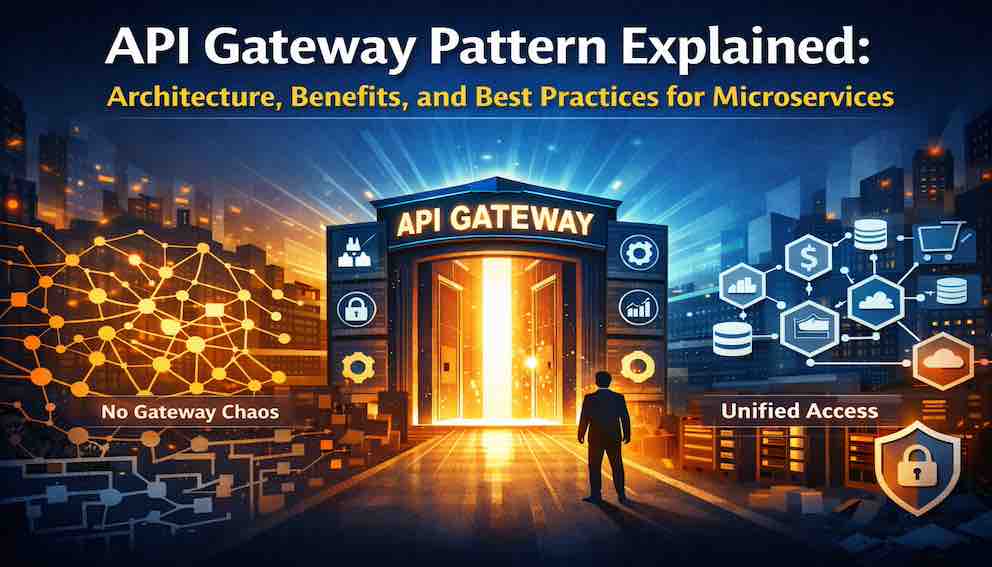
The Core Problem: Clients Lost in a Maze
Microservices architectures rarely fail at the backend. They fail at the edge.
As systems grow, complexity leaks outward. Consider an e-commerce system: to render a single product page, a mobile app needs product details, reviews, inventory, and pricing from multiple services. Without an API gateway, the client makes several slow, unreliable network calls — handling retries, failures, and response shaping on its own. A web app faces the same problem, often with different data needs. Partner integrations may force you to expose internal endpoints that were never meant to be public.
What you end up with is not a system. It is a maze:
- Clients become orchestrators — They know about every service, its failure modes, and response formats. Change your backend, and you must update every client.
- Internal details leak — Service names, API designs, and versioning become public contracts. Refactoring breaks clients.
- Cross-cutting concerns fracture — Every team reimplements authentication, rate limiting, and logging differently.
- Protocol mismatch — You cannot adopt gRPC internally if clients only speak HTTPS.
- No central caching — Every request travels all the way to the database.
- Security boundaries blur — Every service becomes a public entry point. Your attack surface multiplies.
This is the class of problems the API gateway is designed to address.
What Is an API Gateway?
An API gateway is a single entry point that sits between clients and your microservices. Instead of clients calling multiple services directly, every request first goes to the gateway, which then routes it to the appropriate backend — or to multiple services if needed.
A useful mental model is a reception desk in a large office building. You do not walk directly into internal departments. You go through a single front door, where identity is checked and requests are directed appropriately.
At a minimum, an API gateway handles:
- Routing — sending requests to the correct service
- Authentication — validating who is making the request
- Rate limiting — controlling traffic volume
- Caching — reducing backend load
- Observability — logging, metrics, and tracing
In advanced setups, it can also aggregate responses, translate protocols (e.g., HTTP to gRPC), and apply resilience patterns like retries and circuit breakers.
The key idea is simple: clients talk to one thing, and one thing talks to everything else. This turns a collection of services into a system with a clear, controlled boundary.
The Pattern: A Single Entry Point for Microservices
A monolith has a front door. A microservices system without a gateway does not — every service becomes its own entry point. You are no longer securing one boundary but many. Consistency becomes difficult to enforce.
The API gateway restores a single, controlled boundary. It sits between all clients — mobile apps, web applications, partner systems — and your backend services. Every request passes through the gateway first, where it is validated, routed, and monitored before reaching internal systems.
With an API gateway, clients no longer need to understand your internal architecture. They only need to know one address: the front door.
What a Gateway Actually Does (In Layers)
Rather than a flat list of responsibilities, think in layers. This is how experienced architects reason about gateways.
Layer 1: Traffic Control — Routes requests by path, method, or headers. Load balances across service instances and supports canary deployments (e.g., 5% of traffic to a new version).
Layer 2: Security — Authenticates every request (API keys, JWT, cookies) before it reaches your services. Rate limits per client, returning 429 before the backend sees abusive traffic.
Layer 3: Performance — Caches read-only responses (e.g., product details for an hour). Aggregates multiple client round trips into one gateway call plus parallel internal calls — often the biggest performance win for mobile clients.
Layer 4: Resilience — Applies timeouts, retries (idempotent only), and circuit breakers. When a service fails repeatedly, the gateway stops sending traffic for a recovery period, preventing cascading failure.
Layer 5: Observability — Because every request passes through, the gateway is the ideal place to collect metrics, logs, and traces. A unique request ID propagates to all downstream calls, tracing a single user journey across the entire system.
Notice what is absent from all five layers: business logic. The gateway does not know about products, orders, or users. It knows about requests, responses, and services. Adding domain logic to a gateway is a signal something has gone wrong.
The Gateway and the BFF: One Important Distinction
This distinction matters enough to state clearly.
The gateway is infrastructure. The BFF (Backend for Frontend) is application logic.
The gateway handles cross-cutting concerns that apply equally to all clients — authentication, rate limiting, routing, caching. It has no opinion about screens, devices, or user journeys.
The BFF is client-specific. It knows about the mobile app's screen layout, the desktop app's data requirements, and the specific shape of response each client needs. It orchestrates calls to downstream services and transforms the results.
They work together in sequence: client → gateway → BFF → downstream services. The gateway authenticates and routes. The BFF orchestrates and shapes. Confusing the two leads to gateways that accumulate business logic over time and eventually become the very monolith you were trying to escape.
Making the Gateway Highly Available
The gateway is the single entry point into the system, which makes its reliability critical. If it becomes unavailable, traffic cannot flow further into the system. The goal, therefore, is not to treat it as a potential failure point, but to ensure it is never a meaningful one in practice.
High availability starts with redundancy. The approach depends on how the gateway is deployed.
If you are running your own gateway (Kong, Envoy, NGINX, or similar), it should never exist as a single instance. At minimum, run multiple instances behind a load balancer so traffic can continue flowing even if one instance becomes unhealthy.
If you are using a managed gateway (such as AWS API Gateway, Azure API Management, or Google Cloud Apigee), the provider typically handles instance-level availability for you. Even so, it is still important to understand their SLA and consider multi-region setups if your reliability requirements go beyond a single region’s guarantees.
Across both models, the principle is the same: the gateway layer must not rely on any single point of failure.
To support this, deploy across multiple availability zones so that infrastructure-level issues in one zone do not impact traffic flow.
The gateway should also remain stateless, meaning no in-memory session data or local state that would tie requests to a specific instance. This allows instances to be added, removed, or replaced freely without disruption.
At the interaction level, the gateway should fail fast and stay simple. It should use timeouts and circuit breakers to protect itself from unhealthy downstream services. When a service is failing, the gateway should stop waiting on it and return a clear error response, rather than accumulating load or delay. Decisions about partial responses or degraded user experiences belong in higher-level components, such as a BFF or orchestration layer, where domain context is available.
Timeouts are essential. Every downstream call from the gateway should have a defined upper bound. A few hundred milliseconds is often a reasonable starting point, adjusted based on observed latency patterns.
Circuit breakers add another layer of protection. When a service begins to fail consistently, the circuit breaker opens and temporarily stops traffic to it. After a cooldown period, it allows limited traffic through to test recovery. This prevents cascading failures caused by repeatedly stressing an already unhealthy dependency.
Retries should be applied with care. For idempotent operations such as reads, or writes protected by idempotency keys, controlled retries with backoff can improve resilience. For non-idempotent operations like order creation, automatic retries should be avoided to prevent unintended side effects. In these cases, the system should return the error and allow the client to decide how to proceed.
Edge Gateway vs Internal Gateway
In production systems of any scale, there is often more than one gateway in play.
An edge gateway sits at the boundary between the public internet and your system. It handles authentication, rate limiting, TLS termination, and routing to internal services. This is what most people mean when they say "API gateway."
An internal gateway — sometimes implemented as a service mesh — handles traffic between services inside your private network. It manages service discovery, load balancing, retries, and observability for east-west (service-to-service) traffic. This is often implemented with sidecar proxies such as Envoy running alongside each service.
The edge gateway faces outward. The internal gateway faces inward. They serve different purposes and are often different technologies. Small systems do not need an internal gateway. For larger systems with dozens of services, it becomes increasingly valuable as service-to-service complexity grows.
Multi-Region Design
For applications with a global user base, a single gateway in one region is both a single point of failure and a latency problem for users far from that region.
The answer is regional gateways. Deploy a gateway in each region where you serve users — US East, US West, Europe, Asia-Pacific — and use geo-DNS to route each user to the closest region. Route 53, Cloudflare, and similar services can make this routing decision based on the user's geographic location.
Each regional gateway routes to regional instances of your backend services. For data that must be globally consistent — user accounts, order history — regional gateways route to a primary region or read from a globally replicated data store.
The Evolution Path: From Monolith to Service Mesh
One of the most valuable ways to understand the gateway pattern is to see where it fits in a system's natural evolution. This is not a one-time architectural decision. It is a step on a journey.
Stage 1: Monolith. One application, one database. Clients call the monolith directly. No gateway needed. Life is simple.
Stage 2: Split the monolith. You extract a few services. You now have three services and a legacy monolith. Clients start making multiple calls. You begin to feel the pain described earlier in this article.
Stage 3: Add a gateway. You introduce a gateway to route requests, aggregate responses, and centralise authentication. The gateway starts simple — mostly routing, some aggregation — and grows from there.
Stage 4: Add BFFs. Your mobile and web clients diverge in their data needs. You add a mobile BFF and a web BFF behind the gateway. The gateway routes to the appropriate BFF based on the client. Each BFF handles client-specific orchestration and response shaping.
Stage 5: Add a service mesh. You now have fifty services. Service-to-service communication needs its own observability, retries, and circuit breakers. You add a service mesh (Istio, Linkerd, or similar) with sidecar proxies on each service. The edge gateway remains at the perimeter. The service mesh handles internal east-west traffic.
Stage 6: Multi-region. You go global. You deploy regional gateways with geo-DNS routing.
Most systems stop at stage three or four, and that is entirely appropriate. The point is to understand the path so you know when to take the next step — and when not to.
When You Might Not Need a Gateway
The gateway pattern is not free. It adds operational complexity, a new component to monitor, and at least one network hop. Here is when you can reasonably skip it.
Single service, few clients. One backend service, one web app. A gateway adds complexity without adding much value. Call the service directly.
Internal systems with no public exposure. If your system is entirely internal to a trusted network, a service mesh or direct service calls may be sufficient.
Extremely low latency requirements. Every hop adds latency. If your system requires microsecond-level response times, the gateway overhead may be unacceptable.
Early-stage projects. For a new project with few services and liited number of clients, skip the gateway. Build it when you feel the pain. A premature gateway is as harmful as no gateway — it adds complexity before you understand what problems you actually need to solve.
One Final Insight: The Gateway Is Your Security Perimeter
Let us return to the castle metaphor one last time, because it captures something important that goes beyond routing and caching.
Without a gateway, your microservices architecture is a city with no walls. Every service is its own building, directly reachable from the outside. You must secure ten doors. An attacker only needs to find the weakest one.
The API gateway rebuilds the castle wall. It consolidates your security perimeter into one place. Behind the wall, your services can trust each other. They can communicate without per-request authentication because they are inside a trusted internal network. They can use efficient internal protocols without worrying about external client compatibility. Your payment service, your internal admin endpoints, your data processing pipelines — none of them need to be reachable from the public internet.
The gateway is not just a router. It is your security perimeter, your observability platform, your control plane, and your resilience layer — all in one. It is what turns a collection of services into a coherent, governable system.
Summary
The API gateway pattern places a single, unified entry point between all clients and all your backend services. It handles traffic control, security, performance optimisation, resilience, and observability in one place.
Without a gateway, clients become orchestrators, internal services get exposed, cross-cutting concerns get duplicated across teams, and your attack surface grows with every new service you deploy.
The gateway is infrastructure, not application logic. It is not a BFF, though it works with one. It is not a load balancer, though it works alongside one.
Use a gateway when you have multiple services and multiple clients. Skip it for early-stage projects where the overhead outweighs the benefit. When you do build one, keep it stateless, keep business logic out of it, and design for failure with multiple instances, circuit breakers, and aggressive timeouts.
Understand the evolution path: monolith → split services → gateway → BFFs → service mesh → multi-region. Know where you are on that path. Do not jump ahead.
The gateway is the front door of your microservices architecture. Build it well, guard it carefully, and everything behind it becomes simpler, safer, and more manageable.
About N Sharma
Lead Architect at StackAndSystemN Sharma is a technologist with over 28 years of experience in software engineering, system architecture, and technology consulting. He holds a Bachelor’s degree in Engineering, a DBF, and an MBA. His work focuses on research-driven technology education—explaining software architecture, system design, and development practices through structured tutorials designed to help engineers build reliable, scalable systems.
Disclaimer
This article is for educational purposes only. Assistance from AI-powered generative tools was taken to format and improve language flow. While we strive for accuracy, this content may contain errors or omissions and should be independently verified.