
Learning Paths
Last Updated: March 19, 2026 at 17:30
Choosing the Right Software Architecture Style: A Practical Guide for Developers and Architects
How to evaluate trade-offs, team structure, scalability needs, and organisational context to make informed architectural decisions
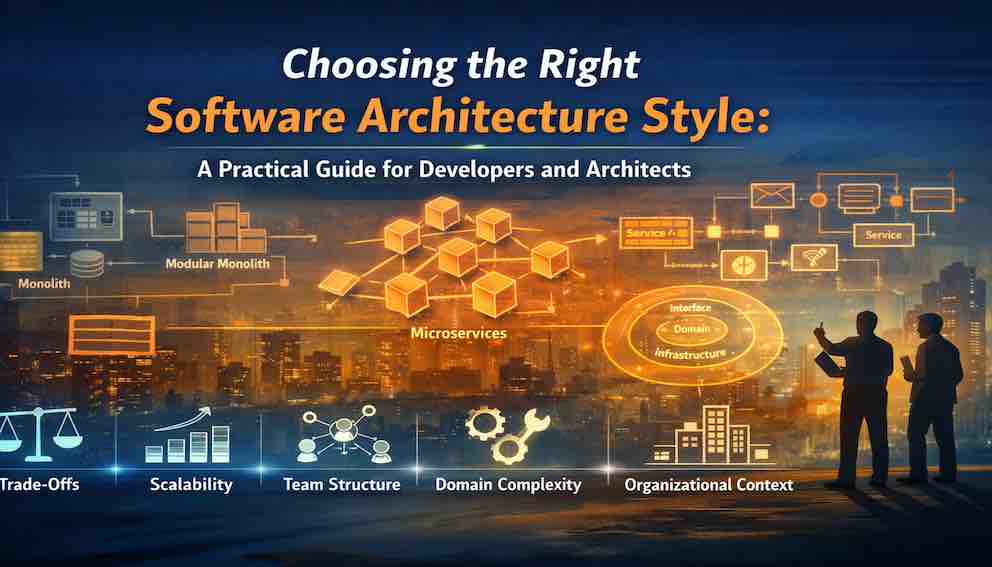
Modern software development offers many architecture styles, from monoliths and modular monoliths to microservices, event-driven systems, and clean architecture. After learning these patterns, developers often face the most important practical question: how do you actually choose the right architecture for a real system? This tutorial explains how experienced architects evaluate trade-offs using decision frameworks that consider team size, scalability requirements, domain complexity, operational capability, organizational structure, and long-term maintainability. Through detailed scenarios and practical examples, readers will learn why there is no universally "best" architecture, why simpler designs are often the most effective starting point, and how architecture decisions evolve over time. By the end of the tutorial, readers will understand how to think architecturally—analyzing context, weighing trade-offs, and choosing structures that fit the real constraints of a project rather than following industry trends
Introduction: The Question Every Architect Faces
After studying software architecture, developers encounter many ways to structure systems—monoliths, microservices, event-driven architectures, clean architecture, and more. Each pattern solves particular problems and has circumstances where it excels and others where it struggles.
This leads to a natural question: which architecture should you actually choose for a real project?
This question is harder than it appears. Knowing what microservices are is different from knowing when to adopt them—and when not to. The latter requires judgment, not just pattern recognition.
Architectural decisions are never made in a vacuum. Every project exists within a context that shapes everything: team size, domain complexity, expected load, operational capabilities, regulatory environment, and timeline. Architecture cannot be chosen by copying what other companies do or following trends. It must be chosen by thinking carefully about your specific situation and reasoning through trade-offs.
This article explains how experienced architects evaluate options, what factors they weigh, and how they arrive at decisions that fit their actual situation rather than reflect current fashion.
The Fundamental Lesson: No Perfect Architecture
Every architectural style solves certain problems while introducing others. Every choice is a trade-off.
The Monolith
A single, unified application built and deployed as one piece.
Strengths: Development is straightforward. Developers run the entire system on one laptop. Debugging is simple—you follow execution through code without jumping between services. Deployment is one artefact. Testing is easier with everything in one environment. No network failures between components, no service discovery, no eventual consistency headaches.
Weaknesses: As the system grows, codebases become difficult to navigate. Many developers working together constantly interfere—merging code becomes painful, deployments must be coordinated, changes in one area unexpectedly affect another. The entire application redeploys when any part changes. Different parts cannot scale independently. Without deliberate effort, boundaries erode toward a "big ball of mud."
The monolith solves for simplicity and development speed. It introduces problems at organisational scale.
Microservices
Many small, independently deployable services, each with its own codebase, deployment pipeline, and typically its own data store.
Strengths: Teams work independently without coordinating every change. Services deploy on independent schedules. Individual services scale independently—scale just the payment service during a sale, not the entire system. Different services can use different technologies. If one service fails, it doesn't necessarily take down the whole platform.
Weaknesses: Every service interaction now crosses a network boundary, introducing latency and failure modes. Operations becomes dramatically more complex: many deployment pipelines, logs scattered across services, many databases to manage. Debugging across services requires distributed tracing. Maintaining data consistency across boundaries requires patterns like sagas. For a new product, all this infrastructure work must happen before delivering business features.
Microservices solve for organisational scale and independent deployability. They introduce substantial operational complexity.
That said, a small team with deep expertise in technology and operations can absolutely handle a microservices architecture with ease.
Event-Driven Architecture
Systems structured around publishing events to shared channels, with consumers reacting independently.
Strengths: Systems become highly decoupled—publishers don't know their consumers. Event queues absorb traffic bursts by buffering messages. The event stream creates a natural audit trail. Asynchronous processing distributes large volumes of work.
Weaknesses: Event-driven systems are notoriously difficult to reason about. Behaviour emerges from many asynchronous flows—tracing what caused what requires effort and tooling. Eventual consistency becomes the norm. Managing event schema evolution requires discipline. Testing is harder because full behaviour only appears when multiple components interact.
Event-driven architecture solves for decoupling and scalability. It introduces challenges in observability and comprehensibility.
Clean Architecture
Code organised around the business domain rather than technical infrastructure. Business rules sit at the centre, free of dependencies on databases, frameworks, or external services.
Strengths: The most important code—business rules—is completely isolated. It can be tested without starting a database or making network calls. It evolves freely without being constrained by specific vendors. When you change persistence layers or switch cloud providers, business logic remains untouched.
Weaknesses: Requires more code—interfaces at each boundary, adapters to translate between domain and infrastructure. Learning curve is steep for unfamiliar developers. For simple applications mostly reading and writing data, the extra structure adds overhead without proportional benefit.
Clean architecture solves for long-term maintainability and domain protection. It introduces short-term overhead that may not be justified for simpler systems.
The Factors That Shape Architectural Decisions
Team Size and Structure
Conway's Law: Organisations design systems that reflect their communication structures. Architecture must work with how people are organised.
Small teams (2-5 developers): Simplicity is most important. Small teams communicate directly and frequently. A monolithic application lets them move quickly, debug easily, and focus on product rather than infrastructure.
Growing teams (6-40 developers): Multiple developers on a shared codebase create problems—changes affect others unexpectedly, merge conflicts increase. Strong modular boundaries within the application become valuable. Each sub-team owns one or more modules with explicit interfaces.
Multiple teams (50+ developers): Independent deployability matters. Coordinating releases across many teams is extremely difficult. Service-based architectures allow teams to deploy on their own schedules.
Geographically distributed teams: Well-defined boundaries and explicit interfaces become essential when developers can't have quick conversations.
Team experience: If the team is unfamiliar with distributed systems, adopting microservices before they have the skills is a recipe for chronic instability. If turnover is high, simpler architectures new developers can understand quickly are more appropriate.
Scalability Requirements
A monolithic application on sufficiently powerful hardware can handle enormous traffic. Many successful systems serve millions of requests daily from a well-optimised monolith.
Distributed architectures support horizontal scaling more naturally but come with operational complexity, network overhead, and consistency challenges.
Critical insight: Not every system needs massive scale. An internal tool for three hundred employees doesn't need Netflix's infrastructure. Prematurely optimising for scale that never materialises is one of the costliest architectural mistakes. Teams spend months building distributed systems infrastructure before delivering any business value.
Start with an architecture matching current and near-term scale. Evolve toward more distributed designs only when concrete evidence demands it.
Domain Complexity
Simple domains (CRUD applications): Internal dashboards, request tracking, basic reporting. Elaborate domain-protecting architectures add overhead without meaningful benefit. A well-organised layered application provides everything needed.
Complex domains: Financial trading platforms with sophisticated risk models. Healthcare systems enforcing clinical rules and patient consent. Insurance underwriting with thousands of eligibility rules. In these systems, business logic is the heart of the application.
In complex domains, the architectural goal is protecting that business logic from infrastructure pressures. Domain-focused architectures (Clean, Hexagonal, Onion) place business rules at the centre, explicitly separated from all infrastructure concerns. Domain-Driven Design provides techniques for modelling complex domains and identifying natural boundaries between sub-domains. It's important to note, however, that the principles of Hexagonal, Onion, or Clean Architecture are not limited to monoliths; they can be applied just as effectively within each individual microservice.
Operational Capability
Running a monolith: One deployment pipeline. One place to look at logs. One service to monitor. Simple backup and recovery. A small IT team competently manages multiple monolithic applications.
Running a distributed system: Service discovery must be set up and maintained. Logs from dozens of services must be aggregated. Tracing user requests requires distributed tracing infrastructure. Monitoring many services, dependencies, and network connections requires sophisticated tooling. Each service needs its own deployment pipeline, configuration, and scaling rules.
Organisations that adopt microservices without the operational maturity to manage them find systems chronically unhealthy. Services fail unpredictably. Problems are hard to diagnose. Deployment becomes a source of anxiety.
The honest question: does this organisation have the operational maturity to run this kind of system? If not, adopting a highly distributed architecture is premature regardless of technical merits.
Deployment Frequency
Infrequent changes: Compliance reporting systems updated a few times yearly. Internal tools with stable user bases. Legacy systems in maintenance mode. Independent deployability offers no meaningful benefit.
Constant change: E-commerce platforms running dozens of A/B tests simultaneously. Consumer SaaS products releasing weekly. These systems genuinely need deployment independence—coordinating releases across many teams becomes an enormous organisational bottleneck.
For high deployment frequency with multiple teams, architectures supporting independent deployability provide real business value.
Regulatory Requirements
Financial systems require detailed audit trails, strict consistency guarantees, and compliance with PCI-DSS or Sarbanes-Oxley. Healthcare systems must comply with patient privacy regulations. GDPR introduces requirements around data deletion, portability, and consent management.
These requirements can push architects toward simpler, more centralised designs. When data is scattered across dozens of microservices, answering "show me all data we hold about this user" requires querying many separate systems and aggregating results. Simpler architectures with more centralised data are often easier to audit and certify.
Expected System Lifespan
Short-lived systems: Prototypes, temporary integrations. Architectural purity is largely irrelevant. Shortcuts unacceptable in long-lived systems are perfectly reasonable when the system won't be maintained for long.
Long-lived systems (15-20+ years): Core banking, insurance policy administration, healthcare records. The quality of the architecture directly determines how expensive and risky every future change will be. Systems with clean architectural boundaries age gracefully—domain logic remains protected from infrastructure changes, new requirements can be accommodated without disturbing unrelated parts, technology choices can be updated without rewriting core business logic.
For long-lived systems, architectural investment is not optional. It's one of the most important decisions about the system's future.
Time to Market
For startups that haven't validated their business idea, speed is often the most critical property. Every week building infrastructure that isn't needed yet is a week that could have been spent putting the product in front of users. A simple architecture that can be built quickly, deployed easily, and changed rapidly based on feedback is almost always the right choice.
For established products with proven business models, the balance shifts. There's stability to justify longer-term investments. The team is larger, the system more complex. The cost of poor architecture becomes more visible every day.
A Framework for Making the Decision
Start with contextual assessment:
- What is the complexity of the business domain?
- How large and organised is the team?
- What operational capabilities does the organisation actually have today?
- What are the genuine scalability requirements of the next year or two?
- How frequently will the system be updated, and by how many independent teams?
- How long does the system need to last?
- Are there regulatory constraints?
- How much time is available?
From this assessment, rough guidance emerges:
When the domain is simple, the team is small, the timeline is short, and regulatory environment straightforward: Start with a monolith or cleanly layered architecture. Build quickly, keep operational overhead low, evolve if and when the situation changes.
When the business domain is genuinely complex and the system needs to live for many years: Invest in domain-protecting architecture regardless of team size or scale. Clean or Hexagonal Architecture keeps core logic understandable and testable as the system evolves.
When multiple teams need to deploy independently AND the organisation has operational maturity: Service-based architectures become appropriate. Both conditions matter equally—multiple teams without maturity leads to an unmanageable distributed system; maturity without multiple teams leads to unnecessary complexity.
When the system must handle extreme scale: Distributed architectures are necessary. Event-driven designs, space-based architectures, and microservices can provide horizontal scalability. But introduce architecture only to the degree actual scale demands, not in anticipation of scale that may never materialise.
The Evolutionary Path
You don't have to choose one architecture and commit forever. Architecture can and should evolve as requirements grow.
A product might begin as a simple monolith. As the team grows, internal module boundaries are added. As the product matures and certain areas need to scale or deploy independently, those modules are extracted into separate services—one at a time, as the need arises. As the system grows into a platform with many teams, a fuller service-based architecture takes shape, supported by mature operational infrastructure.
Each step is driven by a concrete need that has become real, not a hypothetical future need. The complexity at each stage is the minimum required by the current situation.
This requires willingness to refactor—to change the architecture as understanding grows. Treat the initial choice as a starting point, not a permanent commitment.
Practical Scenarios
Scenario One: Startup Building a SaaS Product Prototype
Three developers, Ten months of funding, need product quickly. Domain moderately complex. No dedicated operations.
Choice: Modular monolith. Single deployable application organised into clearly separated modules. Build features quickly without managing service boundaries. Deploy with one pipeline. Run entire system locally. Debug in one environment.
Scenario Two: Enterprise Banking Platform
Large bank, thousands of internal users, multiple external integrations. Fifteen-year lifespan expected. Extremely complex domain. Multiple large teams. Mature operations organisation.
Choice: Domain-protecting architecture within each bounded context (Clean/Hexagonal). Service-based architecture at top level: separate services for accounts, payments, loans, fraud detection. Event-driven communication between services for asynchronous workflows. Substantial investment in operational infrastructure.
Caution: Avoid fragmenting into too many tiny services. Compliance and audit become more difficult with data scattered across many stores.
Scenario Three: Global E-Commerce Platform
Millions of orders daily. Hundreds of engineers across multiple countries. Continuous experimentation. Independent deployability essential.
Choice: Microservices aligned with business capabilities. Each team owns a service, deploys independently. Requires substantial supporting infrastructure: container orchestration, service mesh, distributed tracing, centralised logging, automated CI/CD, mature monitoring.
Caution: Avoid decomposing services too finely. Services should align with genuine business capabilities, not broken into ever-smaller units.
Scenario Four: Internal Analytics System
Three developers, internal users (hundreds). Scheduled data processing, dashboards. No dedicated operations. Stable requirements.
Choice: Simple layered architecture or straightforward monolith with batch processing component. Pipe-and-filter pattern internally for data transformation stages. Entire application can be run and maintained by small team with limited operational expertise.
Scenario Five: IoT Data Platform
Millions of sensors, continuous event streams, real-time anomaly detection, historical analysis. Twenty developers with cloud-native experience.
Choice: Event-driven architecture for ingestion and processing pipeline. Events flow from sensors through message bus into horizontally scalable processing components. Stream processing frameworks for real-time analysis. Management plane (configuration, dashboards) as conventional services. Hot path (real-time) and cold path (historical) designed independently.
Complexity justified by concrete requirements. Team has operational maturity to manage it.
Common Architectural Mistakes
Over-engineering: Adopting complex architectures before the problems they solve have appeared. Teams take on enormous complexity before having a proven product or team large enough to justify it. Months pass building infrastructure. Features are delayed. The system ends up harder to change than a simpler approach would have been.
Under-engineering: Never investing in architecture even as the system grows. The codebase gradually becomes an entangled mess without meaningful boundaries. Every modification carries risk of unexpected side effects. Developers spend more time understanding existing code than writing new code. The result is a "big ball of mud."
Ignoring organisational context: Designing elegant service-based systems that don't align with how teams are organised. Architecture creates boundaries where teams need to collaborate constantly, and provides independence where teams have no reason to work separately.
Chasing trends: Advocating for the latest architectural style regardless of whether it addresses any actual problem. Architecture should be driven by specific requirements, not by desire to be associated with fashionable technology.
Treating architecture as static: The initial architecture responds to the initial context. As the system grows, as the team changes, as requirements evolve, the context changes too. Systems need to be refactored architecturally as they mature.
Ignoring operational costs: Focusing on the experience of building while underestimating the experience of running. An architecture that's fast to build but difficult to operate creates pain felt continuously, every day the system is in production.
How Experienced Architects Actually Think
Start with questions, not answers. Before forming any opinion, ask: What is this system actually for? What is the core business problem? Who are the users? What is the team's situation? What are the real constraints?
Maintain constant awareness of trade-offs. Don't look for options with no downsides—they don't exist. Look for options whose downsides are most acceptable given the specific situation.
Have a strong bias toward simplicity. Every unit of complexity has a cost—in comprehension, operations, debugging, onboarding. Don't add complexity without articulating concretely what problem it solves. When in doubt, prefer the simpler option and increase complexity later when need becomes undeniable.
Think about architecture as serving people. The developers who will build it, the operators who will run it, the users who will depend on it. A technically elegant architecture that the development team cannot understand is not a good architecture.
Accept that you will be wrong about some things. Build in mechanisms for change. Make architectural decisions reversible where possible. Build clear boundaries that can be redrawn as understanding improves. Treat architecture as a living thing.
Conclusion: The Art of Architectural Thinking
There is no universally correct architecture. Every style involves accepting some costs in exchange for some benefits. The question is which trade-offs are most acceptable given your particular situation.
Architecture decisions are shaped by a constellation of factors—team size, scalability requirements, domain complexity, operational capability, deployment frequency, regulatory requirements, expected lifespan, time to market. No single factor determines the answer. All of them together inform it.
Team structure often shapes architecture more than technology does. Systems that fight their organisational context create constant friction. This is why we see such varied outcomes in practice: fifty-developer-strong teams can fail catastrophically with microservices, while a single developer can roll out a highly successful microservices-based system entirely on their own. The difference rarely comes down to the architecture itself, but to team capabilities, organisational maturity, and whether the chosen style fits the actual context.
Simplicity is almost always the right starting point. Most systems don't need distributed complexity. Most teams don't have the operational maturity to manage them well initially. However, the landscape is shifting. Artificial intelligence is rapidly making both code generation and infrastructure management easier and more accessible. Tasks that once required dedicated platform teams—observability setup, deployment automation, service discovery—are increasingly handled by intelligent tooling. This means some architectural choices that seemed out of reach for small teams just a few years ago may become practical much sooner.
Architecture can and should evolve. Many successful systems began as monoliths and gradually developed into more complex structures as the business grew.
Context matters above everything else. What works for a company with thousands of engineers doesn't automatically work for a team of five. Understanding your own context clearly and honestly is the foundation of every good architectural decision.
Architecture is, in the end, about serving the people involved: the developers who build the system, the operations teams who keep it running, and the users whose lives it's supposed to improve. Holding that purpose clearly in mind—alongside all the technical and organisational factors—is what it means to think like an architect.
About N Sharma
Lead Architect at StackAndSystemN Sharma is a technologist with over 28 years of experience in software engineering, system architecture, and technology consulting. He holds a Bachelor’s degree in Engineering, a DBF, and an MBA. His work focuses on research-driven technology education—explaining software architecture, system design, and development practices through structured tutorials designed to help engineers build reliable, scalable systems.
Disclaimer
This article is for educational purposes only. Assistance from AI-powered generative tools was taken to format and improve language flow. While we strive for accuracy, this content may contain errors or omissions and should be independently verified.