
Learning Paths
Last Updated: March 18, 2026 at 17:30
Peer-to-Peer Architecture: When Networks Have No Center
Understanding how decentralized nodes communicate directly without central servers, and why this design powers blockchain, distributed file sharing, and resilient internet systems
Peer-to-peer architecture is a decentralized system design where nodes communicate directly with one another instead of relying on centralized servers. In this model, every participant in the network can both request and provide resources, distributing responsibility across the system. This tutorial explains how peer-to-peer networks function, how nodes discover each other, and how information spreads across a decentralized network. We will explore real-world examples such as blockchain networks and distributed file sharing systems to understand why this architecture became foundational for decentralized technologies. We'll also examine the trade-offs—resilience and decentralization versus coordination complexity and consistency challenges—to help you understand where peer-to-peer architecture fits in modern system design and when it becomes the right architectural choice
What Is Peer-to-Peer Architecture?
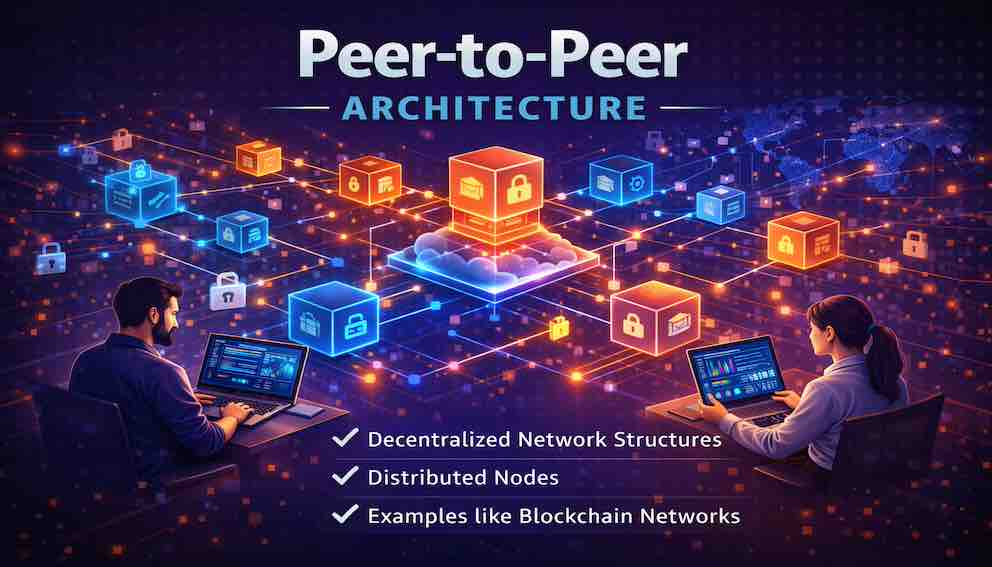
Peer-to-peer (P2P) architecture is a decentralized system design where computers (called nodes) communicate directly with each other instead of relying on a central server. Every participant can both request and provide resources—each node acts as both client and server simultaneously.
This contrasts sharply with client-server architecture, where clients request data and servers provide it. In P2P, there is no hierarchy. Nodes are equals.
Key distinction: In centralized systems, the server is a single point of control and failure. In P2P networks, responsibility distributes across all participants. If any node fails, the rest continue operating.
How P2P Differs from Earlier Architecture Styles
Throughout this series, we've examined architectures that distribute work—microservices, event-driven systems, space-based architecture—but all operate under some form of centralized control. Someone owns the infrastructure. Someone manages the servers.
P2P removes that entirely. No central server. No single controlling organization. Just independent nodes communicating directly.
This isn't just a technical difference—it's a fundamental shift in who controls the system and how trust is established.
Core Components: How P2P Networks Actually Work
Nodes and Their Roles
Every node in a P2P network can:
- Request resources from other nodes
- Provide resources to other nodes
- Store data locally
- Relay messages to propagate information
- Validate information received from peers
Many networks introduce specialization without abandoning decentralization:
Full nodes store complete datasets and validate everything. In Bitcoin, full nodes maintain the entire transaction history and verify all rules.
Light nodes store only what they need. A mobile wallet might keep just your balance and rely on full nodes for everything else.
Validator nodes participate in consensus, often requiring a financial stake (like staked tokens) to prevent malicious behavior.
Peer Discovery: Finding Others Without a Central Phonebook
When a new node joins, how does it find anyone?
Bootstrap nodes provide initial connections. These are well-known, stable nodes that help newcomers get started. Crucially, they're not central controllers—once you have a few peers, you no longer need them.
Gossip protocols then take over. Nodes share information about other nodes they know. Your new node asks its initial connections: "Who else is out there?" Those peers share their lists, and gradually you build a richer view of the network.
Distributed Hash Tables (DHT) create a decentralized directory. Each node is responsible for a small portion of the lookup space. When you need to find something, you query the DHT to locate which node has it—without flooding the entire network. BitTorrent's modern implementation (Kademlia) uses this to eliminate central trackers.
Information Propagation: How Gossip Protocols Work
When a node receives new information, it shares it with a random subset of its peers. Those peers share with their peers. The information fans out exponentially.
In Bitcoin, when you submit a transaction:
- Your node receives and validates it
- It broadcasts to all connected peers
- Those peers validate and rebroadcast
- The transaction reaches most nodes within seconds
Why gossip works:
- Resilience: Information travels multiple independent paths
- Scalability: Each node only talks to a handful of peers
- Efficiency: Information reaches all nodes in logarithmic time
The trade-off is tuning: aggressive gossip spreads faster but consumes more bandwidth. Conservative gossip saves bandwidth but slows propagation.
Real-World Example: BitTorrent and Distributed File Sharing
BitTorrent solves a classic problem: distributing large files to thousands of users.
Centralized approach: Everyone downloads from one server. Bandwidth becomes a bottleneck. Infrastructure costs scale with demand. One failure stops everything.
BitTorrent's P2P approach: Files are split into many small pieces. Users download different pieces from different peers simultaneously. As soon as you receive a piece, you start uploading it to others.
The remarkable property: More users make the network faster, not slower. Each new participant contributes bandwidth and storage. Workload distributes across everyone, enabling massive distribution without massive server farms.
Modern BitTorrent uses DHT (Kademlia) for peer discovery, removing the need for any central tracker. The network is entirely self-organizing.
Real-World Example: Blockchain Networks
Blockchains like Bitcoin and Ethereum are perhaps the most significant application of P2P architecture.
The problem: Traditional finance relies on central authorities—banks, payment processors—that create single points of failure, require trust in intermediaries, and can censor transactions.
The P2P solution: Each full node maintains a complete copy of the distributed ledger. Nodes communicate to propagate transactions, validate them against consensus rules, and agree on the ledger's state.
Transaction flow:
- User creates and signs a transaction, sending it to a node
- That node validates (correct signature, sufficient balance, valid format)
- Node broadcasts to peers, who validate and rebroadcast
- Transaction propagates across the network within seconds
- Miners or validators eventually include it in a new block
Consensus mechanisms enable agreement without central authority:
Proof of Work (Bitcoin): Nodes (miners) compete to solve computationally expensive puzzles. The winner proposes the next block. Others validate and accept it if correct. Rewriting history would require redoing all that work—making attacks prohibitively expensive.
Proof of Stake (Ethereum): Validators are chosen to propose blocks in proportion to cryptocurrency they've staked as collateral. Malicious behavior results in losing that stake.
Both ensure all nodes eventually agree on transaction history without any central authority.
Why Choose P2P? The Advantages
True decentralization: No single organization controls the network. Participants collectively maintain it. This matters for systems that must resist censorship, operate across jurisdictions, or avoid platform lock-in.
Resilience through elimination of single points of failure: The network survives node failures, regional outages, and DDoS attacks (which have no single target). In Bitcoin, you could shut down 90% of nodes and the network would continue.
Organic scalability: Centralized systems scale by adding servers—at your cost. P2P systems scale as participants join, because each new node contributes bandwidth, storage, and processing. Network capacity grows with user base.
Censorship resistance: With no central authority, the system is extremely difficult to shut down. Block one node, others continue. Restrict access in one jurisdiction, nodes elsewhere keep working.
No central infrastructure costs: Organizations building P2P systems don't provision massive servers. Participants provide resources, dramatically reducing operational expenses.
The Hard Parts: Limitations and Challenges
Coordination complexity: Without central authority, nodes must coordinate through sophisticated distributed protocols. These address peer discovery, reliable propagation, conflict resolution, and handling nodes that come and go. This requires algorithms drawn from decades of distributed systems research.
Consistency challenges: Different nodes may see different information at different times due to network latency, varying connection speeds, or temporary unavailability. Query one node, you might see different data than querying another. Achieving eventual consistency requires careful protocol design.
Security risks: Open P2P networks may include malicious participants. Threats include:
- Gossip poisoning: Spreading false information
- Sybil attacks: One attacker creates many fake identities to gain disproportionate influence
- Eclipse attacks: Isolating a node from honest peers
- Consensus manipulation: Attempting to control block production
Defenses include cryptographic signatures, consensus algorithms resistant to malicious behavior, and economic incentives that make attacks costly.
Performance variability: Nodes range from powerful servers to mobile devices on spotty connections. This heterogeneity affects performance in ways centralized systems avoid through infrastructure control.
Governance challenges: When no single entity controls the network, decisions about protocol upgrades, bug fixes, and project direction become contentious. Different stakeholders have competing interests. Bitcoin and Ethereum both have histories of contentious debates resulting in hard forks—permanent splits where the community divides.
Regulatory uncertainty: Because no single entity controls them, decentralized systems often exist in legal gray areas. Who's responsible for compliance? This creates ongoing uncertainty for participants and developers.
When P2P Architecture Fits
Good fits:
- Decentralized financial systems: Cryptocurrencies and DeFi protocols requiring no central authority
- Distributed storage: Platforms like IPFS leveraging idle storage across participants
- Content distribution: Large files to many users, especially with demand spikes
- Censorship-resistant communication: Platforms operating where central servers could be shut down
- Mesh networks: Community networks providing connectivity with limited infrastructure
- Collaborative computing: Volunteer computing distributing work across participants
Poor fits:
- You need strong consistency with low latency
- You have simple, well-understood workloads
- You operate in trusted, controlled environments
- You must comply with regulations requiring central oversight
- Your users expect predictable, polished experiences
- You have limited distributed systems expertise
- You need to guarantee performance SLAs
Real-World Systems You Should Know
Bitcoin: The first cryptocurrency, using P2P networks for transaction propagation, blockchain maintenance, and proof-of-work consensus. No central authority controls issuance or validation.
Ethereum: Extends blockchain with smart contracts—programs that run deterministically on the P2P network. Nodes execute code, maintain state, and reach consensus through proof of stake.
BitTorrent: P2P file-sharing protocol splitting files into pieces distributed across peers. Downloaders simultaneously upload pieces they have, creating collaborative distribution. Modern versions use DHT for completely decentralized peer discovery.
IPFS (InterPlanetary File System): P2P hypermedia protocol for storing and sharing content. Files are addressed by their content hash rather than location. Nodes cache and serve files, creating distributed, resilient storage.
Matrix: Open standard for decentralized communication. (Technically federated rather than pure P2P—conversations replicate across participating servers—but shares the goal of eliminating single points of control.)
Key Takeaways
- P2P architecture enables direct node communication without central servers. Nodes act as both clients and servers.
- Decentralization means no single point of control, failure, or censorship. The network survives participant failures.
- Peer discovery happens through bootstrap nodes, gossip protocols, and DHTs, allowing organic network growth.
- Gossip propagation spreads information exponentially through peer-to-peer message passing.
- Consensus mechanisms like proof of work and proof of stake enable agreement without central authority.
- Advantages: True decentralization, resilience, organic scalability, censorship resistance, no infrastructure costs.
- Challenges: Coordination complexity, consistency, security (especially Sybil attacks), performance variability, governance, regulatory uncertainty.
- Real examples: Bitcoin, Ethereum (blockchain); BitTorrent (file sharing); IPFS (storage).
- Good fit when you need decentralization, censorship resistance, or collaborative resource sharing across untrusted participants.
- Poor fit when you need strong consistency, predictable performance, or operate in trusted, regulated environments.
About N Sharma
Lead Architect at StackAndSystemN Sharma is a technologist with over 28 years of experience in software engineering, system architecture, and technology consulting. He holds a Bachelor’s degree in Engineering, a DBF, and an MBA. His work focuses on research-driven technology education—explaining software architecture, system design, and development practices through structured tutorials designed to help engineers build reliable, scalable systems.
Disclaimer
This article is for educational purposes only. Assistance from AI-powered generative tools was taken to format and improve language flow. While we strive for accuracy, this content may contain errors or omissions and should be independently verified.