Learning Paths
Last Updated: March 18, 2026 at 17:30
Serverless Architecture: Functions-as-a-Service, Event-Triggered Execution, and Scaling Without Servers
Understanding how serverless computing enables on-demand execution, automatic scaling, and reduced operational overhead through functions-as-a-service
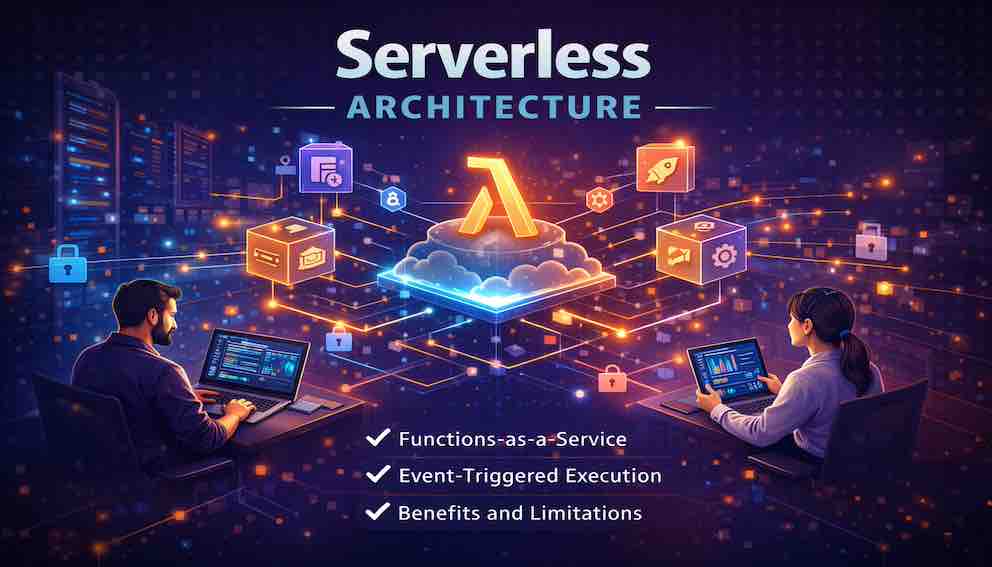
Serverless architecture allows applications to execute code in response to events without requiring developers to manage server infrastructure, enabling highly scalable and cost-efficient systems. In this tutorial, we will explore the core concepts of serverless computing, including functions-as-a-service, event-triggered execution, and the lifecycle of serverless functions. Readers will learn how serverless architecture differs from traditional server-based, microservices, space-based, and event-driven systems. We will examine the benefits, limitations, and operational considerations of serverless, with practical examples from web applications, data pipelines, and real-time processing. By the end, readers will understand when and how to leverage serverless architecture effectively—and when to avoid it
Introduction: From Servers to Serverless
When we consider the previous tutorials in this series, we've seen a progression of architectural styles, each addressing different challenges.
Monolithic architecture gave us simplicity but created scaling bottlenecks. Microservices gave us independence but introduced distributed systems complexity. Event-driven architecture gave us decoupling but required managing brokers and consumers. Space-based architecture gave us extreme scalability but demanded sophisticated infrastructure management.
In every one of these styles, developers still need to manage infrastructure—servers, clusters, load balancers, message brokers, data grids. Even in the cloud, where you might use virtual machines or containers, you're still responsible for provisioning, scaling, patching, and monitoring the underlying resources.
This operational overhead can slow development and increase costs, particularly for applications with unpredictable traffic. You have to provision for peak load, which means paying for idle capacity during lulls. You have to manage scaling policies, which means anticipating demand that you can't always predict.
Serverless architecture emerged to address this challenge by abstracting the server entirely.
The name "serverless" is a bit misleading. There are still servers—code has to run somewhere. But the servers are now the cloud provider's problem, not yours. You don't provision them, you don't scale them, you don't patch them, you don't even know they exist. You simply upload code, and the provider runs it when needed.
This shift is profound. It moves the developer's focus from infrastructure management to business logic. Instead of thinking about how many servers to provision, you think about what your code should do. Instead of configuring auto-scaling rules, you trust the platform to scale automatically.
In this tutorial, we'll explore what serverless architecture really means, how it works under the hood, when it shines, and when it creates more problems than it solves.
What Serverless Architecture Actually Means
The term "serverless" encompasses two related but distinct concepts.
Functions-as-a-Service (FaaS) is the ability to run code in response to events without managing servers. You deploy individual functions, and the platform executes them on demand.
Backend-as-a-Service (BaaS) is the use of managed cloud services—databases, authentication, storage—that replace custom backend code. Instead of building your own user authentication, you use Auth0 or AWS Cognito. Instead of running a database server, you use DynamoDB or Firestore.
In practice, most serverless applications combine both. Functions handle custom logic, and managed services handle data persistence, authentication, messaging, and other concerns. This pairing is what makes serverless genuinely powerful: FaaS handles your unique business logic, while BaaS eliminates the need to build and operate common infrastructure from scratch.
The key characteristics that define serverless are no server management, automatic scaling, pay-per-use billing, and event-driven execution. Functions are triggered by events, not continuously running, and the platform scales your code instantly based on demand.
The Mental Model Shift
To understand serverless, you need to shift how you think about applications—and critically, this means designing for serverless from the start, not retrofitting existing applications onto it. Teams that try to lift-and-shift a traditional application into serverless functions often run into the hardest limitations first, without gaining the real benefits. Serverless rewards a fundamentally different approach to design.
In a traditional server-based application, you have a running process. It starts when the server boots and continues running until the server shuts down. It listens for requests, processes them, and stays ready for the next one. Memory is persistent. Connections are kept open. State can be held in memory between requests.
In a serverless application, you have stateless functions that are invoked only when needed. They start, execute, and stop. There is no persistent process, no in-memory state across invocations, no long-running connections. Each invocation is independent.
This is a fundamentally different model. It's not just about where the code runs—it's about how you design the code itself.
Functions-as-a-Service (FaaS) Deep Dive
At the heart of serverless architecture is Functions-as-a-Service. Let's explore what this really means.
What Is a Function?
In FaaS, a function is a small, self-contained piece of code designed to perform a single task or a narrow set of operations. It's not a whole application—it's a unit of execution.
A function typically has a single responsibility, such as resizing an image, processing a payment, or sending a notification. It is stateless, meaning no data persists between invocations. It has a defined trigger—what event causes it to run—as well as a timeout, usually measured in minutes rather than hours, and resource limits on memory and CPU. Functions are deployed independently, so you can update one without affecting others.
The Function Lifecycle
Understanding what happens when a function executes is crucial for designing serverless applications.
Cold Start
When a function is invoked after a period of inactivity, the platform must acquire a container or execution environment, load the function code, initialize any dependencies, run any initialization code outside the handler, and then begin executing the function. This is called a cold start, and it adds latency to the first invocation. Subsequent invocations that arrive soon after can reuse the warm container—a warm start.
Cold start latency varies by platform, runtime, and function size. It can range from milliseconds to several seconds. This matters for latency-sensitive applications, and it is one of the most important practical constraints to plan for.
Warm Execution
If invocations arrive while the container is still warm, they execute immediately with no initialization overhead. The platform keeps containers warm for some period—typically minutes—after the last invocation.
Concurrent Execution
If many invocations arrive simultaneously, the platform spins up multiple containers to handle them in parallel. Each container runs its own instance of the function. The platform scales automatically, which is the core value proposition of serverless.
Shutdown
After a period of inactivity, the platform reclaims the container. Resources are freed. The next invocation will be a cold start.
Event-Triggered Execution
Serverless functions don't run continuously. They run in response to events, and understanding the range of possible event sources is key to appreciating how widely serverless can be applied.
HTTP requests through an API Gateway can turn a function into a serverless API endpoint. Database changes—when a record is inserted, updated, or deleted—can trigger a function through mechanisms like DynamoDB streams or Firestore triggers. Messages in queues such as SQS or Kafka can trigger functions, with each message invoking the function once. Files uploaded to object storage like S3 or Azure Blob Storage trigger functions immediately on arrival. Scheduled timers allow functions to run on a cron schedule for periodic tasks like daily reports or data cleanup. Streaming data from services like Kinesis triggers functions for real-time processing. IoT messages from connected devices can also trigger functions directly.
When a function is triggered, it receives an event object containing all the relevant data: what happened, when it happened, the data associated with the event, and metadata about the source. The function uses this information to decide what to do.
The Connection to Event-Driven Architecture
There is a deep and important connection between serverless and event-driven architecture. In a previous tutorial, we explored how systems can react asynchronously to events, decoupling producers from consumers. Serverless functions are a natural implementation of those concepts—each function acts as a dedicated event handler, reacting to specific event types.
In an e-commerce platform, for example, an OrderPlaced event can trigger multiple functions independently: one updates inventory, one sends a confirmation email, one logs analytics data, and one triggers payment processing. Each function runs independently, scales independently, and fails independently. This is event-driven architecture implemented without managing any servers.
How Serverless Scales: The Magic and the Reality
The automatic scaling of serverless is often described as magical, but understanding how it works helps you design better systems—and set realistic expectations.
When an event arrives, the platform checks if there is an existing warm container for that function. If not, it creates one. If many events arrive simultaneously, it creates many containers in parallel. This is horizontal scaling at the function level—not at the service level, not at the application level, but at the granularity of individual functions.
If your payment processing function gets 1,000 concurrent invocations, the platform spins up 1,000 containers to handle them. If your notification function receives only 10, it runs 10 containers. Each function scales on its own terms.
During a traffic spike, request volume increases, the platform detects the need for more containers, new containers are initialized—with cold starts for those new invocations—and traffic is distributed across all containers. When load decreases, idle containers are eventually reclaimed. The platform handles all of this automatically.
However, serverless scaling is not infinite. Most platforms enforce default concurrency limits, often around 1,000 concurrent executions per function, with increases available by request. If you exceed these limits, requests are throttled. Each function also has memory and CPU limits, and execution time is capped—AWS Lambda, for example, allows a maximum of 15 minutes per invocation. If traffic spikes faster than containers can be initialized, some requests may experience latency or timeout. These are real constraints that must factor into your design.
Benefits of Serverless Architecture
When it fits, serverless offers compelling advantages.
Automatic scaling is the defining feature. Functions scale instantly and automatically in response to demand. You don't configure auto-scaling policies, provision capacity ahead of time, worry about peak load, or pay for idle capacity. This is particularly valuable for applications with unpredictable or spiky workloads—ticket sales, flash sales, seasonal traffic, viral content.
Reduced operational overhead means you focus on code, not infrastructure. There are no servers to patch, no OS updates, no security hardening, no load balancer configuration, no cluster management. The cloud provider handles all of that. For small teams, this is transformative—you can build and run applications without dedicated operations staff.
Cost efficiency comes from pay-per-use billing. You pay for the number of invocations, execution time measured in milliseconds, and memory allocated. If your function runs for 100 milliseconds once a day, you pay for 100 milliseconds of compute. There is no hourly server cost, no idle capacity, no over-provisioning. For variable workloads, this can be dramatically cheaper than server-based approaches. For steady, high-volume workloads, however, the per-invocation cost may exceed what you'd pay for reserved instances—so it's worth running the numbers before committing.
Rapid development and deployment is enabled by the small, focused, independently deployable nature of functions. You can deploy a new function without touching others, roll back a single function if something goes wrong, test functions in isolation, and have different teams own different functions. This reduces coordination overhead and enables faster iteration.
Language flexibility means most platforms support multiple runtimes. You can write different functions in different languages based on what makes sense for each task—Python for data processing, Node.js for APIs, Java for complex logic.
Built-in observability is another advantage. Cloud providers integrate monitoring, logging, and tracing with serverless functions, giving you execution logs, metrics on invocations and errors, and distributed tracing across functions and services—with significantly less effort than setting this up yourself.
Limitations and Considerations
Serverless is not a silver bullet. Understanding its limitations is essential for making sound architectural decisions.
Cold starts are the most widely discussed limitation. They add latency to function invocations any time a function hasn't run recently, when the platform scales up under load, or when a function is updated. The impact varies by runtime—Java and .NET cold start slower than Python or Node.js—and by function size, since more code and more dependencies mean a slower start. Mitigations include minimizing dependencies and initialization code, using provisioned concurrency to keep containers warm at a cost, and designing applications to tolerate occasional latency. For consistently latency-sensitive workloads, cold starts can be a fundamental problem rather than just an inconvenience.
Statelessness is a design constraint, not just a limitation. Functions cannot rely on in-memory state persisting between invocations, which means no session data in memory, no local caches, no connections reused across calls, and no background threads. Solutions involve externalizing state to managed databases, caches, or object storage, and designing functions to be idempotent so they can be retried safely. This forces a different approach than traditional applications, and teams unfamiliar with stateless design often find it the steepest learning curve.
Execution time limits mean functions cannot run indefinitely. On AWS Lambda the maximum is 15 minutes, with similar limits on other platforms. Long-running processes must be broken into smaller steps, and complex workflows may need orchestration—a topic covered in more depth below.
Resource limits cap memory at typically 3–10GB depending on the platform, with CPU allocated proportionally. Tasks that require more than this need a different approach.
Vendor lock-in is a real concern. Each cloud provider has its own serverless implementation, and while they share concepts, the details differ: event sources, integrations, tooling, and APIs. Migrating between providers after deep adoption can be a significant undertaking.
Debugging complexity is higher in distributed, event-driven, ephemeral systems than in a monolith. You need distributed tracing, aggregated logs, local emulation for development, and careful error handling to make failures visible and diagnosable.
Orchestrating Multiple Functions
One area that deserves particular attention is function orchestration. Real-world workflows often involve multiple steps—process a payment, update inventory, send a confirmation, log analytics—and coordinating these across independent functions is a genuine challenge.
When functions call other functions directly, you create tight coupling and make error handling complex. If one step fails, you need to understand where in the chain the failure occurred and how to recover. For simple pipelines, message queues can pass work from one function to the next. But for complex workflows with branching logic, parallel steps, retries, and timeouts, dedicated orchestration tools become necessary.
AWS Step Functions, Azure Durable Functions, and Google Cloud Workflows all provide ways to define multi-step workflows where the orchestrator manages state, handles retries, and tracks progress across function invocations. These tools make complex serverless workflows manageable, but they add their own learning curve and operational considerations. If your use case involves chaining more than two or three functions in sequence, orchestration should be part of your architecture from the start rather than bolted on later.
Use Cases and Real-World Examples
Serverless architecture excels in specific scenarios.
Web applications with variable traffic are a natural fit. A blog, a marketing site, or an e-commerce store with seasonal traffic might see low activity most of the time, punctuated by spikes when content goes viral or during sales periods. With serverless, you pay only for actual requests, costs are minimal during quiet periods, and spikes are handled automatically without capacity planning. A ticket resale platform is a good example: traffic spikes sharply when popular events are announced, then returns to near-zero. Serverless scales with the demand and scales back to zero when quiet.
Data processing pipelines suit serverless well because each piece of data arriving triggers a function, processing happens immediately and in parallel, and no servers sit idle waiting for work. Resizing uploaded images, transcoding videos, processing log files, extracting metadata from documents, and validating incoming data streams are all natural serverless workloads.
Event-driven automation is another strong use case. Sending notifications when database records change, updating search indexes when content is published, triggering workflows when files arrive, and sending alerts when metrics cross thresholds are all well-suited to serverless. Each action is discrete, short-lived, and triggered by an event.
IoT and mobile backends often have unpredictable traffic patterns. A new app feature might suddenly multiply usage. Device counts can grow overnight. Serverless backends scale with your user base without requiring you to provision servers for unknown future demand.
Scheduled tasks like generating daily reports, cleaning up old data, sending batch emails, and aggregating metrics are natural fits. You pay only for the execution time, not for a server waiting between cron jobs.
API backends using functions behind an API Gateway create scalable, cost-effective APIs where you pay per request rather than for idle server capacity.
Serverless and Other Architectural Styles
Understanding where serverless fits relative to other styles clarifies when to reach for it.
Compared to monolithic architecture, monoliths run continuously on servers, are simple to develop, but require capacity planning and scale as whole units. Serverless scales at function granularity, costs only when used, but imposes statelessness and execution limits. Choose a monolith when your application is simple, traffic is predictable, and operational overhead is acceptable. Choose serverless when traffic is variable, you want to minimize operations, and you can design for stateless functions.
Compared to microservices, microservices give you independent deployability but still require managing servers or containers, scaling policies, and service discovery. Serverless offers even finer granularity with no infrastructure management. Choose microservices when you need control over the runtime environment, long-running processes, or complex service interactions. Choose serverless when you want maximum operational simplicity and your services can be expressed as stateless functions.
Serverless and event-driven architecture are complementary rather than competing. Event-driven architecture is a design pattern; serverless is an implementation approach. Serverless functions are ideal event handlers. Design your system using event-driven concepts—events, decoupled handlers, asynchronous processing—and implement the handlers as serverless functions.
Compared to space-based architecture, space-based distributes data and computation across persistent in-memory grids for extreme performance. Serverless functions are stateless and ephemeral. Choose space-based when you need extreme performance and data-intensive processing with state colocated with compute. Choose serverless when your workload is event-driven, compute-light, and benefits from automatic scaling and pay-per-use billing.
Practical Tips for Implementing Serverless
Design functions around single responsibilities. Each function should do one thing well. This keeps functions small, focused, and independently scalable. Combining image resizing, email sending, and database updates into a single function defeats the purpose of the model.
Make functions idempotent. Functions may be retried due to failures or duplicate events. Design them to handle duplicates safely by checking whether work was already done before acting, using idempotent operations, and storing processed event IDs to detect duplicates.
Externalize state. Don't store state in function memory. Use managed databases for persistent data, caches like Redis or Memcached for temporary state, object storage for files, and orchestration services for multi-step workflows.
Handle cold starts gracefully. Minimize dependencies to reduce initialization time, load dependencies lazily where possible, use provisioned concurrency for latency-sensitive functions, and design your user experience to tolerate occasional latency rather than assuming every response will be instant.
Monitor costs and usage. Serverless costs can surprise you if unmonitored. Set up budget alerts, cost allocation tags, dashboards for invocation counts and duration, and alerts for unusual patterns.
Use infrastructure as code. Define functions, triggers, and permissions in code using tools like CloudFormation, Terraform, or the Serverless Framework. This makes deployments repeatable and auditable.
Design for failure. Functions can fail, networks can be unreliable, and downstream services can be slow. Build retry logic with exponential backoff, dead-letter queues for failed events, circuit breakers for external dependencies, and graceful degradation paths.
Leverage managed services. Use managed databases, managed authentication, managed APIs, and managed workflow orchestration rather than building these yourself. The combination of FaaS and BaaS is where serverless delivers its full value.
Operational Considerations
Running serverless in production requires different practices than traditional systems.
Observability demands particular attention because the distributed, ephemeral nature of serverless functions makes failures harder to trace than in a monolith. You need aggregated, structured, searchable logs; metrics covering invocation count, duration, error rate, throttles, and concurrency; and distributed tracing across functions and services. Tools like AWS X-Ray or Google Cloud Trace can reconstruct the path of a request across multiple function invocations, which is often the only way to diagnose subtle failures in production.
For deployment, canary deployments gradually shift traffic to new function versions, blue-green deployments run old and new versions side by side before switching, and feature flags control which code paths execute without deployment. These strategies matter because updating a function affects every invocation immediately—there is no gradual rollout by default unless you build it in.
Security requires least-privilege permissions for each function, secrets management through dedicated tools rather than environment variables, thorough input validation for any function exposed to the internet, and regular dependency scanning.
Even with auto-scaling, some capacity planning remains necessary. Understanding your peak expected concurrency, confirming it fits within platform limits, and requesting limit increases ahead of anticipated load spikes are all part of operating serverless responsibly.
When NOT to Use Serverless
Serverless is powerful, but it is not always the right choice.
Long-running processes that take more than the platform's execution limit—15 minutes on AWS Lambda—won't work without redesign. Consider containers, batch processing, or dedicated servers for these workloads.
Predictable, steady-state load may make the pay-per-use model more expensive than reserved instances. If you have constant, high-volume traffic around the clock, run the numbers before assuming serverless is cheaper.
Low-latency requirements may be incompatible with cold start behavior. Warm functions are fast, but cold starts add variance that can be unacceptable for applications requiring consistent single-digit millisecond responses.
Stateful applications where complex state management is difficult to externalize will face added complexity with serverless. It is possible, but it may not be the right fit.
Heavy data processing that requires handling gigabytes of data in memory may hit function memory limits. Data processing frameworks designed for large scale are often better suited.
Specialized hardware requirements including GPUs, specialized CPUs, or bare metal performance are not available in serverless environments.
Teams new to distributed systems should approach serverless with caution. Serverless hides infrastructure but not distributed systems complexity. You still need to handle eventual consistency, idempotency, and failure modes. Starting with simpler architectures and gaining experience before adding serverless's additional constraints is often the wiser path.
Regulatory compliance requirements that demand control over and visibility into the underlying infrastructure may not be met by serverless platforms.
The Serverless Ecosystem
Major cloud providers offer mature serverless platforms. AWS Lambda was the original FaaS platform and integrates deeply with AWS services, supporting multiple runtimes, custom runtimes, and containers. Azure Functions is Microsoft's offering, integrating with Azure services and supporting multiple languages and trigger types. Google Cloud Functions is focused and straightforward, integrating with Google Cloud services and well-suited to lightweight tasks. Cloudflare Workers runs at the edge, globally distributed, with extremely low latency and a distinct programming model based on JavaScript and WebAssembly. Other options include Alibaba Function Compute, IBM Cloud Functions, and Knative, which is an open-source, Kubernetes-based serverless framework for teams that want to self-host.
Conclusion: Serverless as a Strategic Tool
Serverless architecture represents a fundamental shift in how we build and operate software. By abstracting servers entirely, it allows developers to focus on business logic while the platform handles scaling, availability, and infrastructure management.
The benefits are compelling for the right workloads: automatic scaling that responds instantly to demand, cost efficiency through pay-per-use billing, reduced operational overhead, and faster development cycles.
But serverless is not a universal solution. The limitations—cold starts, statelessness, execution limits, vendor lock-in, the need for orchestration in complex workflows—mean it must be applied thoughtfully and designed for deliberately, not retrofitted onto existing systems.
Serverless is a tool, not a goal. It excels for event-driven, variable, compute-light workloads. It struggles with long-running, stateful, or latency-sensitive applications. When it fits, it's transformative. When it doesn't, it creates more problems than it solves.
As with all architectural styles, the decision comes down to understanding your requirements and matching them to the appropriate trade-offs. Serverless adds another powerful option to your toolkit—one that, when used correctly, enables building scalable, cost-effective systems with unprecedented speed and simplicity.
Key Takeaways
- Serverless architecture abstracts server management entirely, allowing developers to focus on code while the platform handles scaling and operations.
- Functions-as-a-Service (FaaS) is the core of serverless—small, stateless functions that execute in response to events.
- Backend-as-a-Service (BaaS) complements FaaS by replacing custom backend infrastructure with managed cloud services for databases, authentication, storage, and more.
- Event-triggered execution means functions run only when needed, triggered by HTTP requests, database changes, message queues, schedules, and more.
- Automatic scaling is built-in—functions scale instantly and horizontally based on demand.
- Pay-per-use billing means you pay only for actual execution time, not idle capacity—but for steady, high-volume workloads, reserved instances may be cheaper.
- Cold starts add latency to first invocations and must be considered in latency-sensitive designs.
- Statelessness requires externalizing state to managed services and designing functions to be idempotent.
- Complex workflows involving multiple functions require orchestration tools like Step Functions or Durable Functions—not direct function-to-function calls.
- Limitations include execution timeouts, memory limits, concurrency caps, and vendor lock-in.
- Serverless should be designed for from the start, not retrofitted onto existing applications.
- Serverless fits best for variable-traffic web apps, data pipelines, event-driven automation, IoT backends, and scheduled tasks.
- Serverless may not fit for long-running processes, steady-state high load, sub-millisecond latency requirements, or applications needing specialized hardware.
- Serverless complements event-driven architecture naturally—functions serve as ideal event handlers.
- Success requires idempotent design, externalized state, careful monitoring, orchestration planning, and a clear understanding of platform limits.
About N Sharma
Lead Architect at StackAndSystemN Sharma is a technologist with over 28 years of experience in software engineering, system architecture, and technology consulting. He holds a Bachelor’s degree in Engineering, a DBF, and an MBA. His work focuses on research-driven technology education—explaining software architecture, system design, and development practices through structured tutorials designed to help engineers build reliable, scalable systems.
Disclaimer
This article is for educational purposes only. Assistance from AI-powered generative tools was taken to format and improve language flow. While we strive for accuracy, this content may contain errors or omissions and should be independently verified.