Learning Paths
Last Updated: March 18, 2026 at 17:30
Event-Driven Architecture in Practice: Key Concepts
Moving beyond fundamentals to understand production-ready event-driven systems
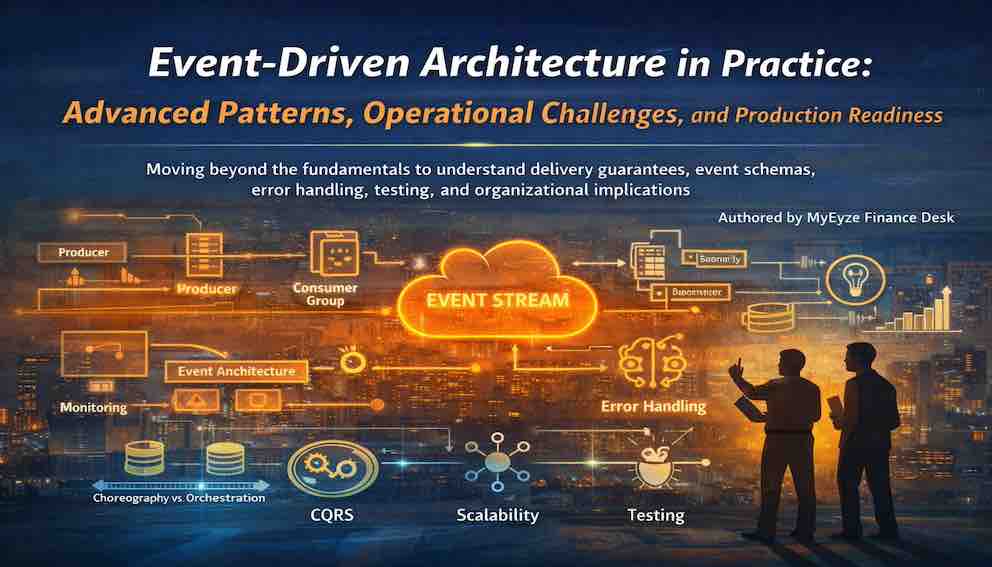
Event-driven architecture moves beyond simple diagrams to tackle the real-world challenges of production systems, where guarantees like at-least-once delivery demand that consumers be designed for idempotency from the start. Managing event schemas as strict contracts through schema registries is critical, as poorly evolved schemas can silently cascade failures across independently deployed services. Operational health hinges on monitoring consumer lag—the primary signal that consumers are falling behind—and implementing dead letter queues to handle poison pill events that would otherwise block processing. Ultimately, success requires aligning team structures with business domains and treating events not as technical artifacts, but as stable representations of business facts
Introduction: From Fundamentals to Practice
Event-driven architecture (EDA) offers powerful benefits, but building production-ready systems requires understanding more than just the basics. When you move from a whiteboard diagram to a system handling real traffic and real failures, new considerations emerge: How do you ensure events aren't lost? How do you handle events that arrive out of order? What happens when a consumer crashes? How do you change an event schema without breaking existing consumers?
This tutorial explores the practical considerations for building robust, scalable event-driven systems—focusing on concepts, patterns, and trade-offs rather than implementation details.
Event Delivery Guarantees
Understanding what guarantees your event broker provides is fundamental to designing your system correctly. These guarantees describe the relationship between producers, brokers, and consumers.
At-Most-Once Delivery: Events may be lost but never duplicated. The producer "fires and forgets" without waiting for acknowledgment. Acceptable for monitoring data or metrics where occasional loss is tolerable, but not for financial transactions or order processing where data loss has business impact.
At-Least-Once Delivery: Events may be duplicated but never permanently lost. The producer retries if acknowledgment isn't received. This is the most common production guarantee and requires that consumers are idempotent—able to handle duplicate events safely.
Exactly-Once Delivery: Events are delivered and processed exactly once—no loss, no duplication. This is the most desirable but hardest guarantee to achieve in distributed systems, requiring coordination across producer, broker, and consumer.
What This Means: Your broker's guarantees directly determine how you must design consumers. If your broker provides at-least-once delivery, idempotent consumers are non-negotiable.
Scaling Models and Flow Control
Consumer Groups and Partitions: To scale event consumption while preserving order, related events must be routed to a single, sequentially processed stream, with many such streams processed in parallel. Brokers achieve this through partitions (Kafka), message groups (SQS FIFO), or queue topologies (RabbitMQ).
Consumer Lag: The difference between the most recently produced event and the last event processed by a consumer. Growing lag means consumers can't keep up, leading to delayed processing, potential storage issues, and downstream system strain.
Managing Lag:
- Scale consumers horizontally (up to partition count)
- Optimize processing throughput (batching, caching, parallelizing)
- Increase partition count (plan ahead)
- Accept bounded lag with monitoring
- Apply back-pressure upstream where possible
Poison Pill Events: An event that causes a consumer to fail on every processing attempt. The dangerous failure mode occurs when the consumer commits no offset, causing the event to be redelivered indefinitely and blocking all subsequent events in that partition.
Solution: Dead letter queues—after configurable retries, move failing events to a separate topic for out-of-band handling, allowing the consumer to advance and continue processing.
Event Schemas and Evolution
Events are contracts between producers and consumers. Poorly managed schema changes can cascade failures across multiple services.
Why Schema Evolution Is Hard: In distributed systems, you cannot atomically update all producers and consumers. Services evolve on independent schedules owned by different teams.
Compatibility Modes:
- Forward compatibility: New schema events can be read by old consumers (add fields, make them optional)
- Backward compatibility: Old schema events can be read by new consumers (don't remove fields, provide defaults)
- Full compatibility: Both directions supported simultaneously (purely additive changes with optional fields)
Key Principle: Treat schemas as API contracts. Add fields, never remove or rename without versioned migration.
Idempotency and Exactly-Once Processing
In at-least-once systems, duplicates are expected outcomes—not edge cases. Your consumers must be designed for this reality.
What Is Idempotency? An operation is idempotent if applying it multiple times produces the same result as applying it once. Setting a status to "confirmed" is idempotent; decrementing a counter by one is not.
Why It Matters: Without idempotent consumers, duplicates cause inventory deducted twice for the same order, customers charged twice, duplicate shipping labels, and analytics double-counting.
Achieving Idempotency:
- Store processed event identifiers (check before processing)
- Use idempotent business operations (reserve with unique identifier rather than decrement)
- Leverage database unique constraints
- Use conditional writes with version checks
Choreography Versus Orchestration
When coordinating multiple services in an event-driven system—for example, processing an order that must check inventory, charge payment, and arrange shipping—you have two fundamental approaches:
Choreography: Services react to events and decide independently what to do. No central coordinator. The overall workflow emerges from individual reactions.
Best for: Simple, independent reactions; fan-out scenarios; domain event propagation
Example: Order service publishes OrderPlaced; inventory, payment, and notification services react independently
Orchestration: A central coordinator manages the sequence of steps and directs services to take action. The orchestrator knows the complete workflow, issues commands, and handles failures.
Best for: Complex multi-step workflows with dependencies; long-running processes; sagas requiring compensation
Trade-off: Services are coupled to the orchestrator, which becomes a critical service
Saga Pattern: A long-lived transaction composed of smaller local transactions. If one step fails, compensating transactions undo completed steps. Can be implemented via choreography or orchestration—orchestrated sagas are generally easier to debug.
Choosing Between Them: Use choreography for independent reactions; use orchestration for multi-step processes with dependencies, compensation needs, or where workflow visibility matters. Most production systems use both.
Domain-Driven Design and Events
Events align naturally with domain-driven design concepts, helping you design events that reflect your business domain rather than your database schema.
Events as Domain Events: Domain events represent meaningful business facts expressed in the ubiquitous language of the domain. They are named in the past tense (OrderPlaced, not OrderCreated) and are immutable—they describe facts, and facts don't change.
Bounded Contexts: Communication between bounded contexts happens through published events, not shared databases. Events crossing context boundaries should carry only information relevant to the consuming context.
Why Business-Aligned Events Are More Stable: Technical events (RecordUpdated, StatusChanged) are coupled to implementation details that change frequently. Business events (OrderShipped, PaymentProcessed) are coupled to stable business concepts and remain meaningful even when underlying systems change.
Command Messages Versus Event Messages
A common source of confusion is conflating commands with events. They serve different purposes and require different handling.
Events: Immutable statements of fact about something that has already happened. Named in past tense. The producer publishes and moves on—it doesn't know or care how many consumers receive it. Multiple independent consumers can react. Events cannot be rejected.
Commands: Requests for something to happen. Named in imperative tense. Directed at a specific handler. Carry expectation of a result—success or failure. Can be rejected if the request cannot be fulfilled.
Why the Distinction Matters: Mixing them causes real problems. Publishing ReserveInventory as an event to multiple consumers could cause double reservation. Treating OrderPlaced as a command and waiting for a response will wait forever—events don't have reply semantics.
How to Handle Both: Use commands (via direct API calls or queues with reply queues) when the sender needs to know the outcome immediately. Use events (via topics to multiple subscribers) when the intent is to notify and let others react.
Event Sourcing (Concept Level)
Event sourcing is an advanced pattern where you store the sequence of events that led to the current state, not the state itself.
Conventional Approach: Store current state (when address updates, overwrite previous address—history lost).
Event Sourcing: Store events (when address updates, append AddressChanged event). Current state is derived by replaying all events for that entity. History is always preserved because it is the data.
Benefits: Complete audit log without extra effort; temporal queries possible; bugs reproducible by replaying events; event log source for analytics and new read models.
Challenges: Different mental model from traditional CRUD; schema evolution more complex; querying across aggregates requires separate projections; performance requires snapshot management.
When It Makes Sense: Systems where auditability is a first-class requirement (financial ledgers, medical records); complex domains where understanding history matters; systems needing temporal queries. Overkill for simple CRUD applications or teams without time to learn the pattern thoroughly.
Integration with External Systems
Real systems integrate with third-party services, partners, and legacy systems—each with its own protocols and reliability characteristics.
Anti-Corruption Layer: A translation boundary between an external system's model and your internal domain model. It receives raw external events, validates them, transforms them into your internal format, and publishes them internally. This insulates your domain from external system changes.
Idempotency Across Boundaries: External systems often can't guarantee delivery semantics equivalent to your internal broker. Your anti-corruption layer should deduplicate using external event identifiers and persist received events before processing.
Security in Event-Driven Systems
EDA requires security considerations that differ from request-response architectures.
Encryption: Events should be encrypted in transit (TLS between services and brokers) and at rest (broker-level disk encryption or application-level field encryption for sensitive data). For PII or financial data, consider field-level encryption before publishing.
Access Control: Enforce least-privilege topic-level authorization. Each service should have its own cryptographic identity (mutual TLS certificates or service accounts). Rotate credentials regularly.
Compliance and Data Retention: Immutable event logs create tension with regulations like GDPR's right to erasure. The most robust approach is encryption-based erasure: encrypt events containing personal data with per-user keys; when erasure is requested, delete the key. Events remain but are permanently unreadable.
Monitoring and Observability
Request-response systems fail loudly and synchronously. Event-driven systems fail quietly and asynchronously. Robust observability is essential.
What to Monitor:
- Consumer lag: The single most important metric—growing lag means consumers can't keep up
- Error rates: Percentage of events failing processing
- End-to-end latency: Time from event production to final business outcome
- Dead letter queue depth: Events failing beyond retry budget
- Throughput: Events per second by topic
- Broker health: Disk usage, replication lag, connection counts
Distributed Tracing: In choreographed systems, a single business transaction may produce dozens of events across many services. Include a correlation identifier in every event envelope to trace the complete lifecycle. Tools can visualize the full trace, identify where latency is introduced, and show where failures originated.
Structured Logging: Centralized logging with JSON records including correlation IDs, event IDs, service identifiers, and timestamps enables searching and correlating across all services.
Organizational Implications
EDA affects how teams collaborate, not just how systems are built.
Event Ownership: Each service owns the events it produces. Changes affect consuming teams. Establish clear ownership, documented dependencies, and a change process for schema evolution.
Event Discovery: Engineers need to find what events exist, what they contain, and who produces and consumes them. An event catalog (internal registry of published events with schemas, owners, consumers, and examples) enables teams to self-serve information.
Team Structure: EDA works best when teams are aligned with business domains (bounded contexts) and each team owns the events for their domain. Domain-aligned teams enable autonomous evolution.
Cultural Shifts: Event-driven thinking requires different mental models—reasoning about eventual consistency, designing for idempotency from the start, debugging asynchronous failures. Plan for a learning curve.
Key Takeaways
- Delivery guarantees shape consumer design: At-least-once delivery requires idempotent consumers—this is non-negotiable.
- Consumer lag is the primary health signal: Monitor it continuously, alert before it threatens your retention window.
- Poison pill events block processing: Dead letter queues with retry limits are essential infrastructure.
- Event schemas are contracts: Manage with schema registries and compatibility enforcement. Add fields—never remove or rename without versioned migration.
- Idempotency must be designed in: Store processed event identifiers, use idempotent operations, test duplicate handling.
- Choreography vs. orchestration: Choreography for independent reactions, orchestration for complex workflows. Use both.
- Events should reflect business facts: Technical events coupled to implementation details are fragile.
- Commands request action, events announce facts: Mixing semantics causes duplicate processing and incorrect error handling.
- Anti-corruption layers protect your domain: All external event integration should pass through translation boundaries.
- Observability requires distributed tracing: Asynchronous failures do not surface on their own.
- Organizational alignment matters: Domain-aligned teams, event catalogs, and clear ownership are prerequisites for sustainable EDA.
Event-driven architecture offers powerful benefits, but those benefits come with significant complexity. The patterns and practices in this tutorial exist because real systems have failed without them. When done well, EDA enables systems that scale horizontally, tolerate failure gracefully, and evolve without coordination overhead.
About N Sharma
Lead Architect at StackAndSystemN Sharma is a technologist with over 28 years of experience in software engineering, system architecture, and technology consulting. He holds a Bachelor’s degree in Engineering, a DBF, and an MBA. His work focuses on research-driven technology education—explaining software architecture, system design, and development practices through structured tutorials designed to help engineers build reliable, scalable systems.
Disclaimer
This article is for educational purposes only. Assistance from AI-powered generative tools was taken to format and improve language flow. While we strive for accuracy, this content may contain errors or omissions and should be independently verified.