Learning Paths
Last Updated: March 17, 2026 at 17:30
Event-Driven Architecture Explained: Beyond the Request-Response Mentality
A practical guide to the fundamentals of asynchronous, decoupled systems.
Move beyond simple CRUD. Learn what event-driven architecture (EDA) really is, why it emerged to solve the problems of synchronous communication, and how to know if it's the right fit for your next project
Introduction: The Problem with "Ask and Wait"
Modern software systems are rarely simple, isolated programs. They are distributed networks of services, each responsible for a specific piece of business functionality. But how do these services talk to each other? The traditional answer is the request-response model.
Think of it like a phone call. Service A calls Service B, asks for something, and waits on the line until Service B replies. This is synchronous communication. It's simple and intuitive, which is why it powers most of the web APIs we use today.
However, as a system grows from a few services into a complex architecture, this "phone call" model starts to create problems. Imagine a chain of calls: a user request hits Service A, which calls B, which calls C, which finally calls D. The user waits for the entire chain to complete. If any single service is slow or down, the whole request fails. Services become tightly coupled; A can't function without B, and B can't function without C. The system's reliability becomes the product of each part's reliability, making it fragile.
This compounding complexity is the primary reason Event-Driven Architecture (EDA) evolved. It offers a fundamentally different way for services to communicate, moving from "ask and wait" to "announce and react."
How EDA Makes Life Better: The Shift to "Announce and React"
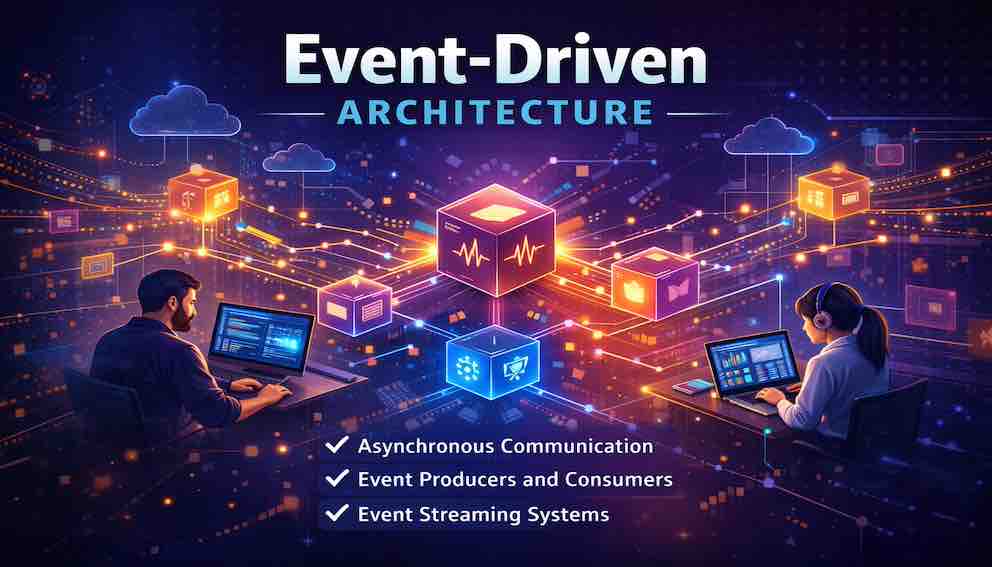
Instead of a phone call, imagine a radio broadcast. A service announces something important has happened—an "event"—and doesn't wait for a response. Any other service that cares about that information is tuned in and can react to it in its own time. This is the essence of asynchronous communication in EDA.
This simple shift has profound effects, making life better for both your system and your team:
- For Your Users: They get immediate feedback. Placing an order doesn't require them to wait for payment processing, inventory checks, and email confirmations. They click "buy," get an instant "Order Received!" message, and the rest happens in the background. The experience feels fast and responsive.
- For Your Services: They become independent and resilient. If the service that sends confirmation emails is slow or temporarily down, it doesn't hold up the order or payment services. Events queue up, and the email service processes them when it recovers. This is failure isolation. A problem in one place stays in one place.
- For Your Teams: They can move faster. A team building a new fraud detection service can simply "tune in" to the existing
OrderPlacedevent stream. They don't need to ask the order team to change their code or add a new API endpoint. This is extensibility. The system is open for extension but closed for modification.
The Architecture of an Event-Driven System
To make this work, EDA introduces a few key components that work together.
The Event: A Statement of Fact
An event is a simple, immutable record of something that happened. It’s not a command or a request. It’s a fact, like OrderPlaced, PaymentProcessed, or UserLoggedIn.
A well-designed event is self-contained and includes everything a consumer needs to know:
- What happened? (e.g.,
eventType: "OrderPlaced") - When did it happen? (e.g.,
timestamp: "2024-03-15T14:23:45Z") - A unique ID so consumers can recognize if they see the same event twice.
- The relevant data. For
OrderPlaced, this is theorderId,customerId,items, andtotalAmount.
The Producer: The Announcer
A producer is any service that detects an event and broadcasts it. Its only job is to create the event and send it to a central intermediary. It does not know—or care—who will consume it. The order service doesn't need to know about the inventory, payment, or shipping services. It simply announces, "An order was placed!"
The Consumer: The Interested Party
A consumer is any service that listens for specific events and reacts to them. The inventory service consumes OrderPlaced events to deduct stock. The notification service consumes the same event to send a confirmation email. Consumers are independent. They don't call the producer's API; they just react to the events they receive from the intermediary.
The Broker: The Durable Intermediary
The broker (like Apache Kafka, RabbitMQ, or AWS SNS/SQS) is the backbone of the system. It's the reliable message board where events are posted. It serves several critical functions:
- Decoupling: Producers and consumers never interact directly.
- Durability: It can store events, ensuring they aren't lost if a consumer is down.
- Scalability: It can handle massive volumes of events and distribute them efficiently.
Within a broker, events are organized into queues and topics. A queue delivers each event to a single consumer, perfect for distributing work like sending emails. A topic delivers every event to all interested consumers, perfect for broadcasting a fact like OrderPlaced to inventory, shipping, and analytics services simultaneously.
The Difference Between Sync and Async: An Analogy
To solidify the difference, consider making a reservation at a popular restaurant.
- Synchronous: You call the restaurant and stay on the line while the host checks the book. If they need to check with the manager, you wait. If the line is busy, you get a busy signal. You are blocked until the entire operation is complete.
- Asynchronous: You put your name on a waiting list using a tablet at the host stand. You go to the bar and have a drink. The host continues working, and when a table is ready, your name is called (an event is sent to you). You don't need to stand at the host stand the whole time, and the host can seat other parties while waiting for your table to be ready. You are decoupled and can operate independently.
Where Does EDA Fit? And Where Doesn't It?
EDA is a powerful tool, but it's not a silver bullet. Knowing where it fits is key to using it effectively.
Use EDA when:
- You need to handle unpredictable traffic. The broker acts as a shock absorber, buffering spikes in traffic so your downstream services don't get overwhelmed.
- Multiple independent services need to react to the same event. This is the "radio broadcast" scenario, where one event triggers a fan-out of parallel, independent processes.
- Your system requires high resilience and availability. Failure isolation means a problem in one consumer doesn't cascade and take down the whole system.
- You need an audit log. The event stream itself becomes a permanent, immutable record of everything that has happened in your system.
Avoid EDA when:
- You're building a simple CRUD application. The added complexity of a broker and asynchronous thinking is overkill.
- Your team is new to distributed systems. Mastering synchronous communication, retries, and timeouts is a necessary prerequisite. Start simple.
- Your business transaction requires immediate, strong consistency. For example, a seat reservation system that must not double-book. EDA is inherently eventually consistent. While you can build strong consistency on top of it, it adds significant complexity.
How EDA Influences Architecture Qualities
Adopting EDA is a deliberate choice that profoundly shapes your system's architecture qualities:
- Scalability: It enables independent scalability. You can scale up the inventory service during a flash sale without touching the order or payment services.
- Resilience: It provides fault isolation. A failing consumer doesn't block the producer, preventing cascading failures.
- Maintainability & Evolvability: It enforces loose coupling. Teams can change, deploy, and even rewrite services independently, as long as they continue to honor the event contracts.
- Testability: This can be more challenging. You're no longer testing simple API calls but asynchronous, event-driven workflows.
- Performance: User-facing performance improves dramatically, as you're not waiting for long chains of background processing. End-to-end processing time might increase, but perceived performance improves.
Using EDA Effectively: Key Considerations
To reap the benefits and avoid the pitfalls, keep these principles in mind:
- Design for Idempotency. Most brokers guarantee "at-least-once" delivery, meaning a consumer might receive the same event twice. Your consumers must be able to handle duplicate events safely (e.g., checking if an email has already been sent before sending it again).
- Treat Events as Contracts. Once a consumer depends on an event's structure, changing it is difficult. Evolve your event schemas carefully, making only backward-compatible changes (like adding optional fields).
- Plan for Failure. Always use Dead-Letter Queues. When a consumer fails to process an event after several retries, the event should be moved to a special queue for manual inspection and debugging. Never just drop it.
- Monitor Consumer Lag. Your broker will show you how far behind a consumer is in processing events. This is a vital health metric. A growing backlog often signals a problem with the consumer.
In conclusion, Event-Driven Architecture is more than just a technology choice; it's a shift in design philosophy. By embracing asynchronous communication and focusing on events as the core building blocks, you can create systems that are not only scalable and resilient but also adaptable and a pleasure to evolve over time. It’s about building systems that are ready for the unexpected.
Summary: The Foundation of Event-Driven Thinking
Event-driven architecture represents a fundamental shift in how services communicate: from "ask and wait" to "announce and react."
Instead of tightly coupled request-response chains, services publish facts about what happened and let interested parties respond asynchronously. This decoupling is the source of EDA's scalability, resilience, and adaptability.
The core concepts covered here:
- Asynchronous communication differs from synchronous request-response in ways that have profound implications for coupling, latency, and resilience.
- Producers announce facts without knowing who will consume them.
- Consumers react independently without depending on producer availability.
- Events are structured contracts containing the data consumers need; schema design matters.
- Queues deliver each event to one consumer; topics deliver each event to all subscribers.
- Consumer groups allow multiple instances of the same service to share load while different services each receive all events.
- Brokers (Kafka, RabbitMQ, SQS, etc.) provide the durable, reliable intermediary layer.
- Pipelines chain stages of event processing: validation, enrichment, routing, and archival.
- EDA complements microservices by preserving their independence through asynchronous communication.
- EDA is a tool, not a goal. Use it when the problem fits: high scalability, multiple consumers, loose coupling, or audit requirements. Avoid it when simplicity is more valuable.
Key Takeaways
- EDA enables asynchronous, decoupled communication through a broker — producers emit events, consumers react independently.
- Asynchronous communication eliminates blocking dependencies; services continue working after publishing an event.
- Events are structured contracts; design them carefully because breaking changes are costly.
- Queues route each event to one consumer (work distribution). Topics route each event to all subscribers (notifications).
- Consumer groups provide both horizontal scaling within a service and independent consumption across services.
- At-least-once delivery is the default; design consumers to be idempotent.
- Choose your broker based on throughput, durability, routing needs, and operational constraints.
- EDA fits high-scale, multi-consumer, loosely coupled systems. It's overkill for simple CRUD apps and challenging for strongly consistent domains.
- EDA and microservices are complementary; events preserve service independence that synchronous APIs erode.
- Always configure dead-letter queues; always monitor consumer lag.
About N Sharma
Lead Architect at StackAndSystemN Sharma is a technologist with over 28 years of experience in software engineering, system architecture, and technology consulting. He holds a Bachelor’s degree in Engineering, a DBF, and an MBA. His work focuses on research-driven technology education—explaining software architecture, system design, and development practices through structured tutorials designed to help engineers build reliable, scalable systems.
Disclaimer
This article is for educational purposes only. Assistance from AI-powered generative tools was taken to format and improve language flow. While we strive for accuracy, this content may contain errors or omissions and should be independently verified.