Learning Paths
Last Updated: March 16, 2026 at 17:30
Layered Architecture in Modern Systems: From Logical Design to Physical Deployment
Understanding the distinction between what a system does and where it runs
Layers are logical; tiers are physical. Layers describe what code does—presentation, business logic, data access—and exist at design time as a way of organizing responsibilities. Tiers describe where code runs—browsers, servers, databases—and exist at runtime as a deployment choice. Understanding the difference matters because you can have clean layers within a single tier, or you can distribute those same logical layers across multiple physical tiers, but each tier you add introduces network latency, operational complexity, and new security considerations. The art of architecture lies in deciding which logical layers truly need to be separate physical tiers—and which can remain colocated behind clean interfaces
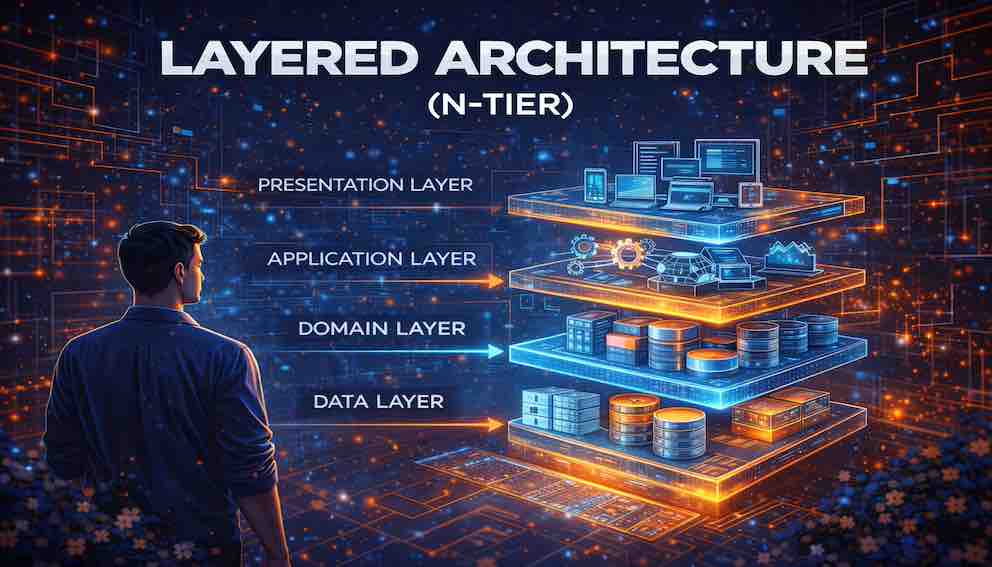
A development team gathers to design a new e-commerce platform. The architect draws a diagram with three boxes stacked vertically: "Presentation," "Business Logic," and "Data." Everyone nods. But later, confusion emerges.
A mobile developer asks: "Does my app count as presentation layer, or just the web team's code?" A backend engineer wonders: "If we split into microservices later, do we still have layers?" A DevOps specialist points out: "The database is on separate hardware—does that change the architecture?"
They're all using the same words to mean different things. This confusion—between logical layers (what code does) and physical tiers (where code runs)—is one of the most common sources of miscommunication in software architecture.
This article provides a clear, modern framework for understanding both concepts, how they relate, and how to make intentional architectural decisions in today's distributed world.
Part I: The Core Framework
What Layers Actually Are
Layers are a logical concept. They describe the responsibilities different parts of your system have, independent of where the code lives or how it's deployed.
When architects talk about the "presentation layer," they mean: the part of the system responsible for user interaction. That could be a React application in its own repository, a mobile app deployed through an app store, a chatbot interface, or server-side templates rendered by a backend framework. The logical responsibility is what makes it the presentation layer, not its physical location.
Similarly, the "business logic layer" encompasses all code that enforces domain rules, regardless of whether it runs in a monolith, a set of microservices, or serverless functions. The "data layer" includes everything that manages persistent state, from PostgreSQL to Redis to S3.
Key insight: Layers are about what code does. They exist at design time. They help us reason about separation of concerns, testability, and maintainability.
What Tiers Actually Are
Tiers are a physical concept. They describe where code runs and how it's deployed.
When architects talk about "three-tier architecture," they mean: the system is deployed across three distinct infrastructure targets—web servers (or CDN edges), application servers (or container clusters), and database servers. Each tier runs in a separate environment, potentially on separate machines, communicating over a network.
Key insight: Tiers are about where code runs. They exist at runtime. They help us reason about scalability, security, reliability, and operational concerns.
The Relationship That Causes Confusion
Layers and tiers relate to each other, but not one-to-one:
- A single tier can contain multiple layers. A traditional web application deployed on one server still has presentation logic (templates), business logic (services), and data access code (repositories) internally. The layers exist logically even though they run together physically.
- A single logical layer can span multiple tiers. Your presentation layer might include a React SPA running in browsers (tier 1), a Backend for front end service running in containers (tier 2), and an API gateway running elsewhere (tier 3). They're all part of the presentation layer logically because they handle user interaction and request routing, not business rules.
- Tiers are always physical. Layers are always logical. The confusion comes from using the same words ("presentation tier" and "presentation layer") interchangeably when they're actually different concepts.
Part II: The Logical Layers in Detail
Every system has responsibilities. Layered architecture organizes those responsibilities into coherent groups with clear relationships.
The Presentation Layer
Responsibility: Handle interaction with users or external systems.
This layer presents information, collects input, manages user experience, and routes requests to the appropriate downstream components. It contains no business rules. It doesn't calculate prices, validate complex domain constraints, or enforce business policies. It delegates those responsibilities to deeper layers.
What belongs here:
- User interface components (buttons, forms, displays)
- Input validation (format checks, required fields)
- Session management
- Request routing
- Response formatting
What does not belong here:
- Business rule enforcement
- Complex calculations
- Data persistence logic
- Domain invariants
Modern forms: React SPAs, mobile apps, API gateways, Backends for Frontend (BFFs), chatbot interfaces, voice assistants, CLI tools.
The Business Logic Layer
Responsibility: Implement the rules and workflows of the business.
This is the heart of the system. It contains everything that makes the system uniquely valuable—the rules, constraints, calculations, and processes that reflect how the business operates. This layer should be completely independent of how information is presented to users or stored in databases.
What belongs here:
- Domain rules (e.g., "orders must have at least one item")
- Calculations (e.g., tax, discount, shipping logic)
- Workflow coordination
- Validation that enforces business policies
- State transitions that reflect real-world processes
What does not belong here:
- User interface code
- Database queries
- HTTP requests or responses
- External API calls (these should be abstracted)
Modern forms: This layer may be a single service, many microservices, serverless functions, or a shared library. Its defining characteristic is that it knows nothing about the outside world—it only knows domain concepts.
The Data Layer
Responsibility: Manage persistent state.
This layer handles all interaction with storage technologies. It abstracts the underlying database so that the business logic layer doesn't need to know whether data lives in PostgreSQL, MongoDB, Redis, or cloud object storage.
What belongs here:
- Database queries
- Repository implementations
- Data mapping (objects to tables/documents)
- Connection management
- Transaction coordination
What does not belong here:
- Business rules
- Workflow logic
- Presentation formatting
Modern forms: Relational databases, document stores, key-value caches, search indexes, object storage, event logs. Often multiple data technologies coexist, each serving different access patterns.
The Dependency Rule
The most important constraint in layered architecture is dependency direction:
- Presentation layer depends on Business Logic layer
- Business Logic layer depends on Data layer (through interfaces)
- Data layer depends on nothing (it implements interfaces)
This means the business logic layer defines what data access it needs (interfaces), and the data layer provides implementations. The business logic never calls database-specific code directly. This keeps the core of the system independent and testable.
Part III: The Physical Tiers in Detail
If layers answer "what does the code do?", tiers answer "where does it run?"
Single-Tier Deployment
All layers run in the same process space, on the same physical or virtual machine.
Characteristics:
- Presentation, business logic, and data access code in one application
- Database may be on the same machine or accessed locally
- Communication is through method calls, not network protocols
- Simplest deployment and operational model
Latency profile: Method calls within a process: nanoseconds to microseconds.
When this makes sense:
- Small applications with few users
- Development and testing
- Embedded systems
- Situations where network latency is unacceptable
Limitations:
- No independent scaling
- Weak security boundaries
- Any failure affects everything
Two-Tier Deployment (Client-Server)
Presentation separates from everything else.
Characteristics:
- Tier 1: Presentation (client application)
- Tier 2: Business logic + data access + database (server)
Variations:
- Fat client: Business logic runs on the client, server primarily handles data
- Thin client: Client only handles presentation, all logic on server
- Database as server: Clients talk directly to database, which may contain stored procedures
Latency profile: Network round trip between client and server: 10-100ms typically (highly variable based on geography).
When this makes sense:
- Desktop applications with shared databases
- Simple client-server tools
- Legacy systems
Limitations:
- Business logic location ambiguous
- Scaling challenges
- Often leads to logic leaking into client or database
Three-Tier Deployment
Presentation, business logic, and data each run in separate tiers.
Characteristics:
- Tier 1: Presentation (web servers, CDN, browsers, BFFs)
- Tier 2: Business logic (application servers, containers, functions)
- Tier 3: Data (database servers, storage systems)
Each tier can be deployed, scaled, and maintained independently. Communication between tiers happens over network protocols.
Latency profile:
- Presentation to business logic: 1-5ms in same data center
- Business logic to data: 1-2ms in same data center
- Cross-region: 50-200ms per hop
When this makes sense:
- Most enterprise web applications
- Systems needing independent scaling
- Multiple client types (web, mobile, API)
- Security requirements demanding database isolation
Advantages:
- Independent scaling
- Better security (data tier isolated from direct client access)
- Technology heterogeneity (different tiers can use different stacks)
Trade-offs:
- Increased operational complexity
- Network latency between tiers
- More failure modes to handle
N-Tier and Beyond
Modern systems often extend beyond three tiers with specialized components:
Content Delivery Networks (CDNs): Cache presentation-tier assets at the network edge, reducing latency for global users.
API Gateways: Sit between clients and business logic, handling authentication, rate limiting, request routing, and response aggregation.
Backends for Frontend (BFFs): Server-side components tailored to specific client needs (one for web, one for mobile), reducing chattiness and adapting responses.
Caching Tiers: Redis, Memcached, or CDN caches that store frequently accessed data, reducing load on databases.
Search Tiers: Elasticsearch, Solr, or Algolia that provide specialized query capabilities, often synchronized from primary data stores.
Message Queues: Kafka, RabbitMQ, or SQS that decouple components and enable asynchronous processing.
Service Meshes: Sidecar proxies (Envoy, Linkerd) that handle cross-cutting concerns like encryption, observability, and access control for communication between tiers.
Latency accumulates: Each network hop adds latency. A request traversing presentation → gateway → cache miss → business logic → database might incur 4-5 network round trips before responding.
Part IV: How Layers Map to Tiers—The Critical Decision
The architectural question isn't "should I use layers or tiers?" It's "which logical layers should run in which physical tiers?"
Mapping Strategies
Option 1: All layers in one tier
The classic monolith. All code—presentation, business logic, data access—deploys together. Layers exist only in code organization.
Option 2: Presentation alone, everything else together
Common in early client-server. The UI runs separately (mobile app, desktop app), but business logic and data share a server.
Option 3: Strict three-tier mapping
Each logical layer gets its own physical tier. Presentation tier, business logic tier, data tier—clearly separated.
Option 4: Presentation split across multiple tiers
Modern web apps often do this: browser (tier 1a), BFF (tier 1b), API gateway (tier 1c)—all part of the logical presentation layer, but multiple physical tiers.
Option 5: Business logic split across multiple tiers
Microservices architecture: many small services, each containing its own slice of business logic, each potentially in its own tier or cluster.
Option 6: Data layer split across multiple tiers
CQRS and polyglot persistence: command database (tier 3a), read database (tier 3b), cache (tier 3c), search index (tier 3d)—all part of the logical data layer.
The Decision Framework
Consider colocating layers (fewer tiers) when:
- Development speed is the priority
- The team is small
- You don't yet understand scaling requirements
- Network latency would harm user experience
- Operational complexity would overwhelm the team
Consider separating layers (more tiers) when:
- Different parts need to scale independently
- Security demands physical isolation of data
- You have multiple client types with different needs
- Specialized technologies are needed for specific concerns
- The organization is structured to own tiers separately
The rule of thumb: Start with fewer tiers and clean internal layers. Add tiers deliberately, one at a time, only when a specific problem requires it.
Part V: Security Across Tiers
Tiered architecture introduces two security dimensions:
North-South Traffic
Traffic entering the system from outside—users to presentation tier, partners to APIs, administrative access. This is where traditional perimeter security focuses:
- Firewalls and WAFs at the edge
- TLS termination
- Authentication at API gateways
- Rate limiting and DDoS protection
East-West Traffic
Traffic flowing between tiers inside the system—presentation to business logic, business logic to cache, business logic to database, service to service.
Modern assumption: East-west traffic is not inherently safe. In zero-trust architectures, every inter-tier communication should be:
- Encrypted (mTLS between services)
- Authenticated (each service verifies the identity of callers)
- Authorized (policies enforce what each service can access)
- Observable (logs and traces capture all communication)
Service mesh technology automates this by attaching sidecar proxies to each service instance. The proxies handle encryption, authentication, and policy enforcement without modifying application code.
Part VI: Common Points of Confusion—Clarified
"Is React the presentation layer or a separate tier?"
React code is part of the logical presentation layer—its responsibility is user interaction. Physically, it runs in browsers (a tier). If you also have a BFF, that's also part of the logical presentation layer (handling client-specific concerns) but runs on servers (a different tier). The presentation layer is a concept; it can span multiple physical tiers.
"If we use microservices, do we still have layers?"
Yes. Each microservice should internally organize its code into logical layers—even if those layers are just packages within the service. The service's API is its presentation layer (to other services). Its internal logic is its business layer. Its database access is its data layer. Layers exist at design time within each service.
"Is the database always the bottom tier?"
Not necessarily. In modern architectures, there may be multiple data tiers with different relationships:
- A cache tier sits between business logic and primary database
- A search tier may be populated asynchronously from the primary database
- A reporting tier may aggregate from multiple sources
All are part of the logical data layer, but they may have different physical tier placements and different relationships to other tiers.
"Doesn't adding tiers always make the system better?"
No. Every additional tier introduces:
- Network latency (even 1ms adds up across multiple hops)
- Operational complexity (more things to monitor, deploy, troubleshoot)
- Failure modes (network partitions, timeouts, partial failures)
- Testing complexity (integration tests become harder)
- Security surface (more communication paths to secure)
Tiers are tools, not goals. Add them only when they solve a specific problem.
"Can I change my tiering later?"
Yes, if your internal layers are clean. A system with well-separated logical layers can be redeployed across different physical tiers without rewriting. The presentation code that assumes it's calling in-process methods can be adapted to call remote APIs—if the boundaries were clean to begin with.
This is the real value of layered thinking: it preserves the option to redistribute later.
Part VII: A Worked Example—E-Commerce Platform
Let's trace a complete flow through logical layers and physical tiers to make the distinction concrete.
The Logical View (What)
Presentation Layer responsibilities:
- Display product catalog
- Render shopping cart
- Show checkout form
- Collect payment details
- Show order confirmation
Business Logic Layer responsibilities:
- Calculate tax and shipping
- Apply discount rules
- Validate inventory availability
- Process payment authorization
- Create order record
Data Layer responsibilities:
- Store product information
- Persist orders
- Update inventory counts
- Record payment transactions
The Physical View (Where)—Option A: Simple Start
Tier 1 (Single server): Everything runs on one cloud VM.
- The Django/Spring/Rails application contains presentation templates, business logic, and data access code
- Database runs on same VM (or separate managed instance for data safety)
- Layers exist only in code organization
Latency: All communication in-process except occasional database calls.
The Physical View (Where)—Option B: Three-Tier
Tier 1 (Presentation): React SPA hosted on CDN, running in users' browsers.
Tier 2 (Business Logic): Node.js API running in containers, auto-scaling based on load.
Tier 3 (Data): PostgreSQL managed database, read replicas for reporting.
Latency: Browser → CDN (cached), CDN → API (10-50ms), API → DB (1-2ms).
The Physical View (Where)—Option C: Evolved N-Tier
Tier 1a (Client): React SPA in browsers.
Tier 1b (BFF): Lightweight Node.js BFF per client type, handling session and aggregation.
Tier 1c (Gateway): API Gateway handling auth, rate limiting, routing.
Tier 2 (Business Logic): Domain services (inventory, pricing, order) as separate containerized services.
Tier 3a (Cache): Redis for product catalog and session data.
Tier 3b (Primary DB): PostgreSQL for transactional data.
Tier 3c (Search): Elasticsearch for product search.
Tier 4 (Async): Kafka for order processing events, feeding analytics and notifications.
Latency: Browser → BFF → Gateway → service → cache (miss) → DB → response. Four to five network hops.
The Insight
In all three physical options, the logical layers remain the same. Presentation still handles user interaction. Business logic still enforces rules. Data still manages persistence. The physical distribution changed, but the logical separation of concerns didn't.
This is why understanding both concepts matters: it lets you change where things run without redesigning what things do.
Part VIII: Making Intentional Choices
Questions to Ask at Design Time
About logical layers:
- Have we clearly separated presentation, business logic, and data access responsibilities in our code?
- Does the business logic layer know nothing about UI or database technology?
- Can we test business rules without a database or HTTP requests?
- Are our layer boundaries defined by interfaces, not concrete implementations?
About physical tiers:
- What problem would adding a tier solve?
- What latency will each inter-tier hop introduce?
- How will we secure east-west traffic between tiers?
- Can we operate the resulting complexity?
- Does our team structure align with our tiering choices?
Principles to Hold
- Layers are always there. Even in a monolith, organize code as if it might need to split later.
- Tiers are investments. Each tier costs complexity; spend only where you get return.
- Dependencies point inward. Business logic should not depend on presentation or infrastructure, whether in-process or across a network.
- APIs are layer boundaries. When layers span tiers, the contract between them becomes critical. Design APIs for the layer above, not for internal convenience.
- Start simple, evolve deliberately. A well-structured monolith with clean internal layers can become a distributed system. The reverse is nearly impossible.
Summary: The Distinction That Matters
Layers are logical. They exist at design time. They describe what code does. They are about separation of concerns, maintainability, and testability. They are always present, even in a single process.
Tiers are physical. They exist at runtime. They describe where code runs. They are about scalability, security, and operations. They are choices we make about deployment.
The two are related: layers can be deployed across tiers, and tiers contain layers. But they are not the same thing.
Understanding this distinction lets architects:
- Communicate clearly with teams (developers, operations, security)
- Make intentional trade-offs between simplicity and distribution
- Evolve systems over time without rewriting
- Keep business logic independent of deployment technology
In modern systems, the presentation layer may span browsers, CDNs, BFFs, and gateways. The business logic layer may be one service or many. The data layer may include multiple storage technologies. Through all this variation, the layered concept endures because it answers a timeless question: what should this code be responsible for?
The answer to that question shapes every other decision that follows.
About N Sharma
Lead Architect at StackAndSystemN Sharma is a technologist with over 28 years of experience in software engineering, system architecture, and technology consulting. He holds a Bachelor’s degree in Engineering, a DBF, and an MBA. His work focuses on research-driven technology education—explaining software architecture, system design, and development practices through structured tutorials designed to help engineers build reliable, scalable systems.
Disclaimer
This article is for educational purposes only. Assistance from AI-powered generative tools was taken to format and improve language flow. While we strive for accuracy, this content may contain errors or omissions and should be independently verified.