
Learning Paths
Last Updated: May 28, 2026 at 16:30
Pair Programming: The Complete Guide for Modern Agile Engineering Teams
A balanced guide to when pair programming helps, when it hurts, and how high-performing teams actually use it
Pair programming is one of the few engineering practices that divides teams as sharply as it unites them. The debate usually misses the point — pairing is not universally good or bad, it is a high-cost, high-benefit tool whose value depends entirely on where and how it is used. This article covers the different models, the real reasons developers and organisations resist it, what the evidence actually shows, and how AI is shifting the economics of human collaboration. If your team is wrestling with whether to pair, when to pair, or why it is not working, this is the complete guide.
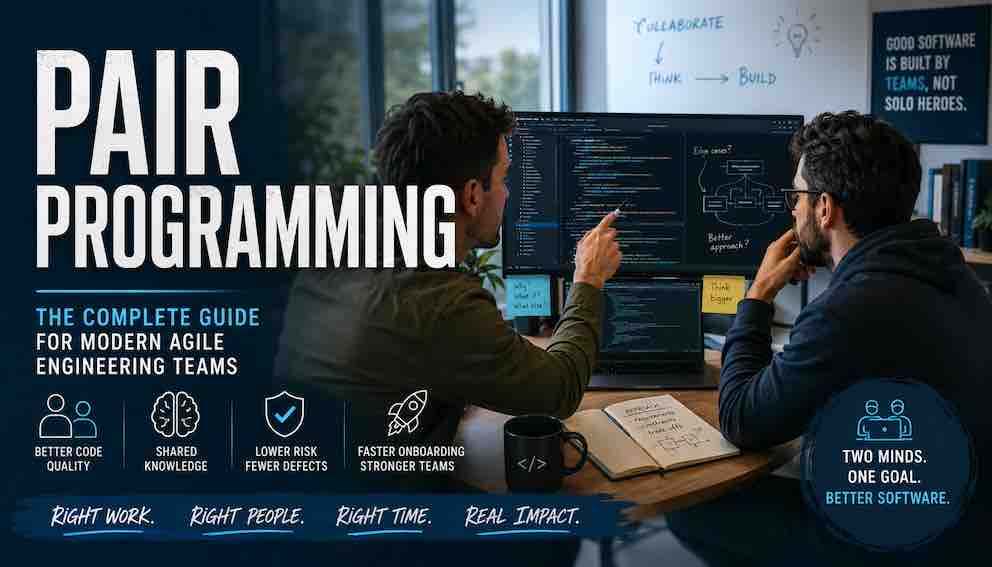
Pair programming is one of the most debated practices in software engineering. Some teams swear by it. Others tried it once and moved on. Strong opinions exist on both sides, and the gap between how it works in theory and how it lands in practice is wider than most introductions acknowledge.
The most useful position is neither wholesale adoption nor outright rejection. Pair programming is a high-cost, high-benefit tool — valuable for reducing rework and spreading knowledge, but only where those benefits exceed the cost of disrupted flow and diffused ownership. That means pairing selectively, not universally.
This article covers everything: where pair programming came from, the different models, when it works and when it fails, what the research says, and how AI is changing the conversation.
Where Pair Programming Came From and Why It Matters
Pair programming emerged from Extreme Programming (XP), developed by Kent Beck in the late 1990s — a direct response to waterfall's failures: long feedback loops, defects discovered months after introduction, isolated specialists, and painful late-stage integration.
The goal was never team bonding. It was reducing the cost of defects. The insight: the later a bug is found, the more expensive it is to fix. Catching a logic error at the moment it is written avoids a debugging session that might happen weeks later.
That framing changes how you evaluate pairing. The question is not "are two developers more productive than one right now?" but "does pairing reduce the total cost of building and maintaining software?"
Whether the founding premise holds in practice is a more open question than it first appears. Pairing assumes two developers will catch what one would miss — but diffused ownership can work the other way, with both assuming the other is responsible for correctness. The defect landscape has also changed: static analysis, automated testing, CI pipelines, code review, and AI coding tools now handle much of what pairing was originally designed to prevent. These do not make pairing redundant, but they do mean the case for it today is more specific and contextual than its origins suggest.
What Pair Programming Actually Is
Pair programming is two developers working on the same code, at the same time. One writes — the driver — focused on immediate implementation. The other watches and thinks — the navigator — holding the bigger picture, spotting mistakes before they are committed, and asking "does this actually solve the problem?"
Together they cover more mental ground than either could alone. Human working memory is limited; you cannot simultaneously hold the architecture, requirements, edge cases, and syntax. Pairing externalises that cognitive load across two people.
Verbalisation matters too. Explaining what you are doing exposes assumptions. Engineers regularly describe starting to explain an approach and realising mid-sentence it was wrong. Articulating forces a different kind of reasoning — the same mechanism that makes rubber duck debugging work.
The Different Models of Pair Programming
Driver and Navigator is the classic XP model. One writes, one thinks, switching every twenty to thirty minutes. Works well for complex implementation where holding the big picture and the detail simultaneously is genuinely hard.
Ping-Pong Pairing is built around TDD. One developer writes a failing test, the other writes the minimum code to pass it, then they switch. Enforces testing discipline and keeps both equally engaged.
Strong-Style Pairing has the more experienced developer navigate and the less experienced drive. The navigator cannot type — only describe. Uncomfortable at first, but effective as a mentoring model: the junior executes the senior's thinking rather than just watching.
Tour-Guide Pairing is one developer walking the other through an unfamiliar codebase. About knowledge transfer, not feature delivery. Useful for onboarding and debugging in unfamiliar territory.
Research Pairing is two people exploring an unknown together — an unfamiliar library, a new pattern, an ambiguous requirement. Ideas are challenged in real time rather than siloed and compared later.
Unstructured Pairing is what happens between senior peers who trust each other. No formal roles; they shift fluidly based on who has the insight.
Purpose-Led Pairing is a more pragmatic model that does not require two developers to stay together for the full session. The pair comes together for the part of the work that genuinely benefits from collaboration — agreeing an approach, working through a complex decision, combining two different skill sets — and then splits to execute independently, reconvening to review and integrate. It works particularly well when the pairing goal is delivery alignment, a specific mentoring moment, or a decision that should not rest with one person alone.
Choosing the right style matters — and the right style can change across the life of a single piece of work. The model should fit the people, the work, and the moment — not be applied uniformly across all three.
The Case For Pair Programming
Almost every argument against pairing is an argument about individual efficiency. Two developers working separately appear to produce more output. Measured by lines of code or story points per person, solo working wins.
But that measures the wrong thing. The real question is what the work costs end to end — not just at the keyboard.
Defects in solo work are discovered later — in review, QA, or production. By the time a production bug is resolved, it has cost five to ten times what it would have cost to catch at the point of writing. Pairing moves that cost to the cheapest moment.
Solo working also creates knowledge silos. When one developer owns a module, others cannot safely touch it. Pairing distributes knowledge by default.
A related benefit appears when the two developers bring complementary skills — a backend engineer pairing with someone who knows the data layer well, or a developer pairing with a domain expert who understands the business logic deeply. In these cases pairing does not just share existing knowledge; it combines different kinds of knowledge that would otherwise have to be transferred sequentially, through documentation or handoffs, with the inevitable loss of nuance that entails.
One underappreciated benefit is the unblocking effect. When one person in a pair has encountered a similar problem before, they can shortcircuit what would otherwise be hours of solo research — the kind of blocked work that historically consumed the most development time. This benefit is narrowing as AI coding tools get better at resolving exactly that class of problem, but it remains meaningful for domain-specific or architectural challenges that require human experience to navigate.
There is also a depth-of-thinking benefit that is easy to underestimate. When two people work through a problem together, the solution tends to be more thoroughly considered. Edge cases get surfaced earlier, alternative approaches get weighed, and the reasoning behind a design decision is tested in real time rather than only in retrospect. A story worked through by two developers typically produces a more robust outcome than one worked through by one — not because either developer is inadequate, but because thinking out loud to another person who is genuinely engaged produces a different quality of thought.
Many discussions of pair programming assume relatively balanced contributors. In practice, capability varies significantly — in experience, domain knowledge, and judgement — even between developers with similar titles. When two developers are significantly mismatched, the pairing model needs to be chosen carefully. Without that, the more experienced developer is slowed by the pace, and the less experienced one is guided through work rather than genuinely developing — which serves neither person well.
Benefits and Drawbacks of Pair Programming
The benefits, when pairing is used well, are real. Defects are caught earlier and at lower cost. Knowledge spreads across the team rather than concentrating in individuals. Onboarding accelerates. Complementary skills combine in ways that documentation and handoffs cannot replicate. High-risk decisions are less likely to rest with a single person. And the unblocking effect — where one developer's prior experience shortcircuits hours of solo research — can meaningfully improve delivery speed on complex problems.
The drawbacks are equally real. Pairing is socially and cognitively demanding in ways that accumulate over time. It disrupts the deep focus that many developers need for their best work. It diffuses individual ownership, which matters both for motivation and for performance visibility. It can carry senior developers into sustained mentoring at the expense of their own output. And when applied to the wrong work, the wrong people, or the wrong moment, it costs more than it returns.
The honest summary is that pairing's benefits are most visible at the system level — quality, knowledge distribution, risk reduction — while its costs are most visible at the individual level. That gap between where the value lands and where the cost is felt is the root of most disagreements about it.
Pair Programming vs Code Review
Pairing and code review are both quality mechanisms but operate differently.
Code review is asynchronous — a developer submits work and waits for feedback. This introduces latency but allows reviewers to think carefully and provide architectural perspective without time pressure. Pairing moves review to the moment of creation, continuous and in context, but both developers are inside the same problem and can share each other's blind spots.
The two are complementary. Pairing catches implementation errors and edge cases as code is written. Code review catches broader architectural problems that only become visible when reading the code fresh.
Pairing also has a standards-enforcement effect: two developers working together are less likely to drift from team conventions, cut corners under time pressure, or make undiscussed architectural choices. That said, code review achieves much of the same outcome asynchronously — the question is whether the real-time enforcement of pairing is worth the cost compared to a well-run review process.
For paired code, many teams reduce the formality of review rather than eliminating it. The code is already higher quality, so the review does less work. That said, reducing review too aggressively carries a risk: two developers working together are inside the same problem and share the same context, which means they can also share the same blind spots. A reviewer reading the code fresh, without that shared context, may catch something neither developer thought to question. The case for keeping meaningful review on paired code is not about distrust — it is about the value of a genuinely independent perspective.
When to Pair and When Not To
A useful way to think about the decision is across two dimensions: how well-understood the work is, and how much is at stake if it goes wrong.
When the work is high-risk and ambiguous — a new architecture, a production incident, an unfamiliar problem domain — pairing consistently earns its cost. When the work is low-risk and well-understood — boilerplate, a simple bug fix, a minor config change — it rarely does. The interesting cases are in between, and those depend on team context.
Pair for: architecturally significant decisions where mistakes are expensive to reverse; production incidents; onboarding; complex refactoring across interconnected areas; security-critical or compliance-sensitive code; debugging where the problem is subtle and the system is large.
It is worth noting that some of these benefits — particularly around important decisions not being made by a single person — can be achieved through other means. Architecture reviews, design documents, and RFC processes all provide a second perspective on consequential decisions without requiring full-time pairing. Pairing is one route to that outcome, not the only one.
Do not pair for: straightforward implementation with well-understood patterns; simple bug fixes where cause and solution are obvious; minor configuration changes; solo prototyping where one developer is exploring an idea not yet ready for shared examination; repetitive work with no meaningful second-perspective value. A useful test is whether similar code already exists elsewhere in the codebase. If a developer can largely follow an existing pattern, there is little to think through together — the work just needs doing, and pairing adds friction without adding thought.
The middle ground — complex but routine work, moderate risk, familiar domain — is where team context matters most. High-trust teams with established pairing cultures often benefit here. Teams new to pairing, under time pressure, or with developers who find pairing draining often do not.
When Pair Programming Fails
The most common failure is expert dominance: the senior person drives most of the time, the junior becomes a passive observer, and no knowledge transfer happens. It looks like pairing but functions as an inefficient lecture.
The reverse is also a failure mode. Two developers without sufficient experience between them can reinforce each other's misconceptions. Pairing amplifies whatever is in the room — if both share an incorrect mental model, pairing cements it.
Forced pairing damages engineering culture quickly. When mandated as policy, developers who find it difficult experience it as a lack of trust. The psychological safety pairing needs is destroyed before it can develop.
Pairing can also mask poor performance. When two developers produce work together, it becomes hard to identify who is struggling. Teams that pair extensively can be surprised when a developer works solo — on an incident or a new team — and the capability gap becomes visible for the first time. Regular solo work keeps individual capabilities visible and developable.
Pairing on trivial work is a waste. Simple bugs, minor configuration changes, and repetitive implementation with well-understood patterns do not benefit from two people working simultaneously.
Continuous pairing without breaks causes burnout. Sessions should be timeboxed — ninety minutes to two hours — with solo work between them.
Why Some Developers Find Pair Programming Difficult
The most common difficulty is loss of autonomy. For many engineers, coding is a flow state where complex problems feel tractable. Pairing disrupts that flow — every choice has to be communicated. For developers who think best in solitude, this changes something fundamental.
Social exhaustion is real. Sustained interaction requires energy, and for many — particularly introverts — that energy runs out. A full day of pairing can leave engineers more depleted than a physically demanding day.
Visibility of reasoning adds pressure. Junior developers can feel constantly evaluated. Senior developers face the opposite: the expectation of always having the answer.
Experienced engineers who pair frequently can carry a disproportionate mentoring load. If senior developers spend most of their time guiding others through work they could do alone faster, the quality of their own work suffers — and this rarely shows up in metrics.
Ownership is a quieter cost. There is something meaningful about pointing to part of a system and saying "I built that." Pairing diffuses ownership by design, which benefits team resilience but can dilute the personal achievement that motivates many engineers.
The effect on learning is two-sided. Pairing accelerates exposure to how more experienced developers think. But struggling through a problem alone — hitting dead ends and finding the answer independently — builds a different and arguably more durable kind of capability. Teams that rely heavily on pairing for learning should ensure developers also have enough solo work to develop independent judgement.
Why Many Organisations Reject Pair Programming
Two engineers working on one task looks expensive in a way that is immediately legible to management. The savings from fewer defects, less rework, and faster onboarding are diffuse and delayed — they do not appear on the sprint board. Under staffing pressure, the optics alone can close the conversation. The measurement problem compounds this: story points per engineer makes pairing look like a 50% productivity loss, utilisation-based thinking treats a navigator as idle, and individual ownership metrics actively reward the solo behaviour pairing is designed to prevent.
Scheduling complexity is underappreciated. Pairing requires two people available, focused, and uninterrupted simultaneously. In organisations with heavy meeting cultures or fragmented attention, finding consistent two-hour windows is genuinely difficult.
Distributed and offshore models present structural challenges. Teams split across time zones cannot pair synchronously without inconvenience to at least one party. Established asynchronous handoff workflows are often disrupted more than they are improved.
Engineering cultures built around individual ownership are perhaps the deepest barrier. When performance reviews reward personal contribution and career progression is tied to visible individual output, pairing threatens the incentive structure the organisation runs on. Introducing it without addressing those incentives rarely works.
Remote Pair Programming
Tools like VS Code Live Share, JetBrains Code With Me, and Tuple provide shared environments that work well for remote pairing. The tooling problem is largely solved.
The communication overhead is harder. Body language, tone, and natural conversation are stripped away. Video call fatigue compounds pair fatigue — the brain works harder to interpret compressed social signals. The practical implication: shorter sessions remotely, ninety minutes rather than three hours, with deliberate breaks.
For teams across time zones, async pairing models — screen recordings, annotated code walkthroughs, detailed pull request descriptions — serve a similar knowledge-transfer function with less synchronous demand. A weaker version of pairing, but a pragmatic middle ground.
AI Has Changed the Pair Programming Conversation
Tools like GitHub Copilot, Cursor, and Claude Code now provide continuous code suggestions, completions, and explanations as developers write — a second presence offering alternative approaches and catching some categories of error. This changes the pairing conversation in three concrete ways.
AI narrows the unblocking benefit. One traditional advantage of pairing is that when one person has encountered a problem before, they shortcircuit hours of solo research. AI now resolves that class of problem for many common scenarios — API usage, boilerplate, known patterns. The remaining unblocking value is for domain-specific or architectural challenges that require human experience to navigate.
AI changes what the navigator does. The navigator traditionally caught syntax errors, suggested alternatives, and held context. AI handles the first two reasonably well. That makes the navigator's distinctive value now: questioning whether the right problem is being solved, challenging architectural assumptions, and providing the business context AI lacks. The navigator becomes more strategic, less tactical.
AI introduces a new choice: human pair, AI pair, or solo. For learning a new language or framework, a human pair transfers knowledge AI cannot. For implementing well-defined logic with known patterns, AI-assisted solo work is often sufficient. For complex architectural decisions with real trade-offs, a human pair provides the real-time challenge and shared context that matters. For verifying AI-generated code, a brief human pair or a careful solo review may be more appropriate than extended pairing.
What AI does not replace is the back-and-forth where both people's understanding of a problem evolves together. That is qualitatively different from prompting a model. As AI improves, the value of human pairing shifts toward ambiguous, architecturally significant work where judgement is irreplaceable.
How Organisational Context Shapes Whether Pairing Works
In early-stage startups, pairing often emerges naturally. Small teams on novel problems in close proximity tend to pair informally without labelling it. The conditions — trust, shared context, low overhead — are already there.
In large platform organisations, pairing is more structured. Teams with explicit pairing cultures build it into hiring, onboarding, and engineering norms. It works because it is embedded in how the organisation thinks about quality, not bolted on afterward.
In regulated industries — finance, healthcare, government — pairing on critical code is often compliance-motivated. Four-eyes principles and mandatory review of security-sensitive code fit the model naturally.
Legacy enterprise environments are the most difficult. Large codebases, political silos, low psychological safety, and individual performance metrics hostile to collaboration make organisation-wide pairing culture largely infeasible. Pairing within a single high-trust team is achievable; beyond that, rarely.
What High-Performing Teams Usually Converge On
Teams that have used pairing long enough to form considered views tend to land in a similar place. When starting out, the ones that succeed typically begin with the obvious wins — onboarding, complex debugging, high-risk architectural changes — make outcomes visible, and let results build the case rather than policy.
They pair selectively. Teams that try to pair on everything typically pull back to where it genuinely earns its cost: complex implementation, onboarding, production incidents, and high-risk architectural decisions.
They maintain large blocks of solo focus time — often pairing for part of the morning on the most complex work, then switching to individual work. This preserves the flow and independent thinking developers need while capturing pairing's benefits where they matter.
They combine pairing with code review rather than replacing one with the other. Paired code is reviewed, but more lightly — focused on architectural consistency rather than implementation correctness, which pairing has handled.
They never mandate pairing. Opt-in cultures sustain it better than policy-driven ones.
They treat onboarding pairing as close to non-negotiable. Even teams otherwise sparing with pairing tend to pair heavily in a new developer's first weeks. The knowledge transfer value is clear enough that even sceptics accept it.
The pattern is not a full pairing culture in the XP sense. It is a team that uses pairing as a precision tool — deliberate, at the right moments, by willing participants.
The model that best captures how mature teams actually work is Purpose-Led Pairing. Rather than staying together for the full duration of a task, developers come together for the part that genuinely benefits from two minds — agreeing an approach, working through a complex decision, combining two different skill sets — then split to execute independently, and reconvene to integrate and review. This preserves the quality and alignment benefits of pairing while returning each developer to the focused, owned solo work that produces their best individual thinking. It also makes pairing sustainable: sessions are purposeful rather than open-ended, and the cost is proportionate to the benefit at each stage of the work.
The Honest Verdict: Pair Programming Is a Tool, Not a Religion
Pair programming has genuine advocates and genuine critics. The mistake is treating it as an ideology to adopt or reject wholesale.
Done well, in appropriate contexts, it improves code quality and reduces defects more consistently than it improves raw productivity. It transfers knowledge and accelerates onboarding in ways solo working with code review cannot fully replicate. In organisations that measure flow metrics honestly — cycle time, defect escape rate, PR cycle time — benefits are often visible. In organisations measuring individual utilisation, costs are more visible than benefits.
It also has real costs: socially demanding, requires psychological safety many organisations lack, can burden senior developers with disproportionate mentoring, and conflicts with the deep focus many developers need.
The most important question is not "does pair programming work?" but "what problem are we trying to solve?" Defect rates point toward targeted pairing on high-risk work. Knowledge silos point toward structured pairing for onboarding and knowledge transfer. Individual output per developer points away from pairing entirely.
If your team is using pairing or considering it, run this audit honestly:
- Does it preserve enough independence for developers to think and grow individually?
- Is it improving quality — measured by defect escape rate, not by feeling?
- Is it helping or hurting learning, and are you seeing both effects in different contexts?
- Is it helping delivery speed on the work where you use it?
- What is the genuine effect on developer satisfaction?
- Would the team be better served by selective pairing — coming together for decisions and complex work, then splitting to execute — rather than continuous pairing?
- And the hardest question: is the team performing better with pairing, or would it be more effective without it?
Answering those seven questions is what separates pairing as a genuine engineering tool from pairing as an inherited habit.
About N Sharma
Lead Architect at StackAndSystemN Sharma is a technologist with over 28 years of experience in software engineering, system architecture, and technology consulting. He holds a Bachelor’s degree in Engineering, a DBF, and an MBA. His work focuses on research-driven technology education—explaining software architecture, system design, and development practices through structured tutorials designed to help engineers build reliable, scalable systems.
Disclaimer
This article is for educational purposes only. Assistance from AI-powered generative tools was taken to format and improve language flow. While we strive for accuracy, this content may contain errors or omissions and should be independently verified.