Learning Paths
Last Updated: July 18, 2026 at 10:00
How to Organize Software Support: Choosing the Right Support Model for Your Engineering Team
A practical guide to developer-owned support, support rotations, dedicated support engineers, tiered support, SRE, and how to know when it's time to evolve.
Every software team has to decide who owns production support—and that answer changes as products, customers, and operational maturity grow. This guide explains the major software support models, from developer-owned support and rotations to dedicated support engineers, tiered support, platform teams, SRE, outsourcing, and AI. It provides a practical framework for choosing the right support model based on support demand, team capability, system capability, and organizational priorities, helping you recognize exactly when it's time to evolve.
Introduction
It's mid-afternoon, and an engineer is three hours into a complex refactor when the team chat lights up: a customer's payment has failed, and a support agent needs an engineer to look. The question in that moment is rarely "who understands this system best?" It's simply "who's free?" — and every organization routes that differently, depending on how much demand it faces and how much of the diagnosis the software can already do for itself.
That's the hidden cost of an immature support model: every support issue creates two problems, solving it and deciding who stops what they're doing to solve it. Most organizations measure the first. Almost none measure the second, even though it's what quietly erodes a team's ability to plan its own work.
Two companies with identical products, customers, and headcount can handle that same failed payment in completely different ways. The difference comes down to three forces: how much demand for support the system generates, how capable the team is of absorbing it, and how much the system itself can detect, explain, and recover from its own problems before a person gets involved. Change any one of those forces and the right model changes with it — and how they combine is what the rest of this piece works through.
What Software Support Actually Covers
When people hear the word support, they usually picture a help desk answering "how do I reset my password?" In an engineering organization, that's only a fraction of it — support covers everything that keeps software usable, available, and effective in production, from answering customer questions to investigating incidents and feeding what's learned back into the product. Support is also an engineering capability, not something bolted on after launch — the architecture, logging, and documentation decisions made while building the system determine whether a future problem takes a generalist five minutes to fix or a senior engineer half a day. It's also distinct from maintenance — support keeps the software running, maintenance changes it — and confusing the two is a common source of friction.
Several functions typically divide this work: customer support (product knowledge and communication), technical support (reproducing issues, diagnosing integrations), production support (the health of live systems), and engineering or on-call support (genuine defects) — with platform engineering, site reliability engineering (SRE), and infrastructure and application support layered on top in larger organizations. This piece focuses on the layer most teams wrestle with directly: technical and production support. Production support itself splits further once a problem is severe enough to become an incident rather than a ticket — a payment service down for twenty minutes needs incident command, customer communication, and a postmortem.
What Determines the Right Support Model?
Every support model balances two questions. The first: what does the product actually need? That's a question of environment — demand, team capability, and system capability — and it determines what's feasible. The second: what is the organization optimizing for? That shifts over time, from learning, to protecting engineering focus, to scaling efficiently, to reliability and availability — and it determines which feasible option gets picked. That's why two teams facing identical demand can still land on different models: they're solving for different things.
The Operating Environment
- Demand: how much support the software generates, in users, requests, incidents, and severity
- Team capability: who can realistically handle that demand — engineers, dedicated support staff, or both
- System capability: how much the software can detect, explain, and recover from its own problems before a person gets involved at all
A support model is what comes out when these three forces meet, and none of them behaves the way intuition suggests. Demand is the easiest to measure and the easiest to over-index on (ticket volume, query volume, incident count) — high demand looks like an obvious argument for a large support organization, but on its own it doesn't determine the right structure. Team capability is what the organization can actually field against that demand, and two companies facing identical demand can carry very different capability simply because one has invested in support staffing and the other hasn't gotten there yet.
System Capability: From Reactive to Predictive
System capability is the force most often left out of the conversation, and it changes everything else — the accumulated investment in monitoring, logging, runbooks, and automation that decides how much human effort a problem requires before anyone touches it. It roughly follows five stages: reactive, where problems surface only when customers report them and support leans heavily on developers; observable, with monitoring and alerts that catch problems before customers do; diagnosable, with structured logging, tracing, and runbooks that let support understand problems without an engineer — and where AI starts to help, scanning logs and past incidents to turn "search for the cause" into "review a suggested cause"; automatable, where remediation, self-healing, and self-service resolve known problems on their own, often with AI drafting the fix or the customer explanation; and predictive, where the organization prevents demand rather than responding to it, catching capacity issues early and often using AI to spot the pattern first.
Consider two teams running the same kind of payment system. Team A's engineer spends an hour manually reading logs after a customer reports a failed payment. Team B's monitoring catches the failure first, a dashboard names the affected service, and a runbook walks the on-call engineer through the fix in minutes. Both might have five engineers and ten thousand customers — but only Team A needs those engineers pulled into the payment queue every time something breaks.
What the Organization Is Optimizing For
Environment sets the boundaries; it doesn't pick the model inside them. That choice comes down to what the organization values most right now — learning, engineering focus, cost, scalability, reliability, or availability — and that priority shifts as a team grows, which is why the same organization can rationally choose a different model at year one than at year five without its demand or capability changing at all. The models covered next are different combinations of environment and optimization goal: each one is a specific answer to "given what's feasible, what are we solving for?"
The Support Models: From Developer-Owned to Specialized
Organizations tend to move through a recognizable sequence of support models as demand grows — though it isn't a mandatory ladder. A small team might deliberately stay at the simplest model for years because the tight feedback loop is worth more than the interruptions it causes. A large enterprise might run several of these models at once, for different products.
Every Model Is Optimizing for Something Different
That's the optimization layer applied to each specific model:
- Developer-owned support optimizes for learning
- Shared rotation optimizes for focus
- Dedicated support developer optimizes for engineering productivity
- First-line support optimizes for scale
- Tiered support optimizes for specialization
- Platform and SRE optimizes for reliability
- Global support optimizes for availability
Keeping that in view matters more than memorizing any single model: a team that reaches for tiered support because it sounds more mature, when what it actually needs is focus, ends up with structure that doesn't solve its real problem. What follows walks through each model: why it works, where it tends to break, and the signal that it's time for the next.
Model 1: When Developers Handle Support Themselves
In the simplest model, the people who build the system also support it. There's often no formal support function at all — a customer issue goes straight to an engineer, who investigates, fixes it, and ships the change.
Why it works: engineers sit closest to customers, creating the shortest feedback loop available to any organization. Developers see directly what confuses users, which features break, and which bugs actually matter — feedback that would otherwise arrive filtered, delayed, or not at all.
Where it breaks: the same openness that produces fast feedback also produces constant interruption. Engineers become reactive, roadmap work stalls unpredictably, and the team's ability to plan depends on how quiet production happens to be that week.
This model fits small products, small customer bases, and teams still learning what their users actually need. Signal to evolve: "What are you working on this week?" starts getting answered with "I don't know — depends what breaks."
Model 2: Shared Support Responsibility Through Rotation
The team still owns support, but now it's organized: one engineer rotates into a support role — a week at a time, for example — and becomes the first point of contact while the rest of the team works uninterrupted. As demand grows, teams often formalize this further, blocking out real, protected time for whoever is on duty rather than squeezing support in around other work — same underlying model, just with firmer boundaries.
Why it works: interruptions concentrate on one person at a time instead of hitting everyone, and that person gets enough dedicated attention to build real context rather than skimming the surface of each ticket. The goal isn't to remove engineers from support — it's to stop support from interrupting everyone at once.
Where it breaks: without a clear handover process, context gets lost every time the rotation changes hands, and ownership of in-flight issues turns fuzzy right at the boundary between one person's shift and the next. The rotation also doesn't discriminate by seniority — a senior engineer who could be building the team's most important feature spends their week on the same password resets and routine diagnostics as everyone else, work that someone with far less experience could handle just as well. And whoever's on duty, informal or protected-time, is pulled off roadmap work entirely for that stretch; rotate the role too fast on top of that and nobody stays in it long enough to build real context, so the team pays the ramp-up cost over and over.
Signal to evolve: the person on duty is spending the whole rotation on support, not a manageable slice of it, and the same few issues keep reappearing no matter who's staffing it. That's a sign they're being handled, not fixed — usually the moment a permanent, specialized role starts to make more sense than a rotation.
As the rotation matures, it usually starts splitting into two distinct kinds of work: reactive support — customer issues, bugs, incidents — and proactive operational work — monitoring, alerting, capacity, reliability. The same person can hold both, but they call for different mindsets, and eventually different processes.
Model 3: Hiring a Dedicated Support Developer
That gap is exactly what a dedicated support developer is built to close: a permanent role, technical enough to investigate issues in the codebase, but not necessarily as deep as the team's senior engineers.
The economic case: senior engineers routinely spend real hours on logs, diagnostics, and known fixes — work that doesn't need their expertise but currently costs their salary. A support developer absorbs that routine work and leaves engineers for the escalations, matching the cost of the resource to the complexity of the work.
There's a subtler gain too: less context switching. A regular engineer bounces between feature work and tickets all day, paying a cost on every switch. A support developer's attention stays on support, which makes them faster at it while freeing everyone else to stay in deep work longer.
A third advantage is easy to miss: a rotating engineer resets context every handover, but a permanent support developer compounds knowledge every week — from handling whatever arrives, to knowing common failure modes, to building runbooks, to automating the worst diagnostics, to eventually telling engineering exactly which recurring issues are costing the most time.
The model fits best when support is frequent but routine, specialists are worth protecting, and enough tooling exists for the developer to work independently — and fits poorly when volume is low, issues need deep expertise, or the product moves too fast to build lasting knowledge. Either way, the role needs an explicit boundary between what it owns and what gets escalated, or it becomes a dumping ground for unpleasant work.
Model 4: First-Line Support With Engineering Escalation
Once support volume outgrows what a rotation or a single support developer can absorb, a dedicated support function usually appears — customer questions, known problems, and configuration issues get handled by support directly, while software defects, complex technical problems, and incidents get escalated to engineering.
Why it works: it protects engineering capacity while keeping a reliable path upward for problems that genuinely need it. This is often the first real organizational split between the people who talk to customers and the people who build the product.
Where it breaks: escalation can calcify into a wall. Support says "that's engineering's problem," engineering says "support should have caught that," and the escalation path becomes something neither side wants to use. That only stays avoidable if the split in responsibility is agreed before a problem arrives, not negotiated in the middle of one: customer support owns the conversation, technical support owns the investigation, engineering owns the defect, and product owns what happens next. Without that agreement in advance, a single failed payment can bounce between four teams before anyone actually fixes it.
Signal to evolve: escalation volume swings for reasons that have nothing to do with problem complexity — a sign the split itself needs fixing, not the problems flowing through it.
Model 5: Tiered Support
As volume grows further, support itself specializes into tiers: Tier 1 handles basic, known questions; Tier 2 handles deeper technical troubleshooting; Tier 3, or engineering, handles genuine investigation. The flow becomes customer to first-line support, to technical support, to engineering.
Why it works: this is fundamentally a scalability model, built on a simple bet — if ninety percent of problems can be resolved without an engineer, engineers shouldn't be handling ninety percent of support requests.
Where it breaks: tiers add headcount without adding clarity if ownership and tooling underneath them are still unclear. The escalation boundary between tiers should track problem complexity, not seniority or internal politics. Signal to evolve: the same category of issue keeps escalating past the same tier, regardless of who's staffing it — a sign the tier boundary is drawn in the wrong place, not that the tier needs more people.
Model 6: Product Teams Plus Platform, SRE, and Operations
This one works differently from the models before it: it isn't a replacement for how support requests get routed, but a capability layer underneath them — a team can run tiered support or a rotation and still invest in platform and SRE at the same time. At scale, product teams that own their systems end to end — development, deployment, monitoring, incidents, fixes — run into the same problem from every direction: each one ends up rebuilding its own monitoring, deployment tooling, and incident process from scratch. Specialized teams absorb that repeated infrastructure work without taking ownership away: platform engineering owns deployment infrastructure and shared tooling, SRE improves reliability through automation and observability rather than by staffing more responders, and customer and technical support continue handling first-line and diagnostic work. Product teams still answer for how their systems behave — platform and SRE provide capability, not accountability. The risk is treating SRE as just the next tier of support waiting to catch what product teams miss, rather than the team actively reducing operational burden by improving the systems underneath it.
Signal to evolve: every product team is independently solving the same infrastructure or observability problem — a sign the work belongs in a shared platform, not five different backlogs.
Model 7: Global, Follow-the-Sun Support
Large organizations operating across time zones sometimes distribute support regionally — Asia-Pacific handing off to Europe, then to the Americas, then back — to provide continuous coverage, faster response, and regional expertise without any one region carrying an overnight burden alone. Continuous customer coverage doesn't require continuous engineering availability: a support organization can run around the clock while engineering escalation still follows severity, service level agreements (SLAs), and on-call policy. This model is rarely needed before the others above — most organizations never require it at all, and reaching for it too early adds coordination cost for little benefit.
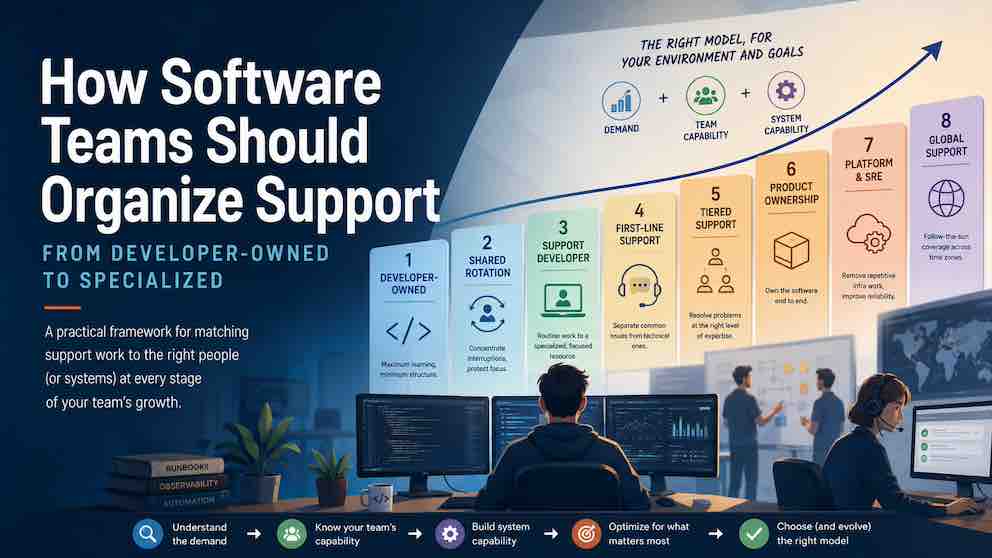
The Progression at a Glance
A quick way to hold the progression in view:
- Developers handle everything — maximum feedback, minimum structure
- Shared rotation, formalizing into protected time — concentrates interruptions on one person instead of the whole team
- Dedicated support developer — matches routine work to a less specialized, more focused resource that compounds knowledge over time
- First-line support with escalation — separates common issues from technical ones, with clear ownership at each handoff
- Tiered support — resolves problems at the right level instead of over-escalating
- Product teams plus platform and SRE — keeps ownership with product teams while removing repetitive infrastructure work
- Global, follow-the-sun support — provides continuous coverage across time zones
None of these models is inherently more mature than another in a way that obligates every team to climb toward the last one. The goal across all of them isn't maximum separation between engineering and support — it's optimal distance: enough that engineers keep their focus, without losing the signal support carries back to them. The question worth asking isn't which model an organization should eventually reach — it's which model fits its current environment and its current optimization goal, which is exactly what the next section works through.
How to Choose a Support Model — and Know When to Change It
The environment already covered — demand, team capability, and system capability — sets what's feasible; it doesn't fully explain the pick. Two organizations with identical headcount, identical customer counts, and identical environment can still rationally run different support models, because they're optimizing for different things — one protecting learning, the other protecting engineering focus. What's harder to see in the moment is how environment and priority together translate into a decision, and how to tell when either one has shifted enough to warrant a change.
A support model shouldn't be more sophisticated than the organization's ability to operate the system behind it. Standing up a three-tier support structure doesn't make support scalable if nobody owns the service, logs don't explain failures, and runbooks don't exist. That just adds more people passing the same unsolved problem along a longer chain.
Knowing When to Change Models
The signals worth watching are the specific version of a broader pattern already visible in each model above: a rotation stops being enough once repetitive volume outgrows what one person can absorb, tiers become worth the added structure once problems clearly need different levels of expertise, and platform or SRE investment pays off once every product team is solving the same infrastructure problem independently. The common thread is that the trigger is never a fixed number — it's the moment the current structure starts producing predictable, expensive collisions with something the organization also cares about, whether that's planning, expertise, or coverage.
Urgency vs. Importance
Not every problem needs the same speed of response, either. It's worth separating urgent work from important work, because they aren't the same axis. A problem that's both urgent and important — customers blocked, revenue affected, an SLA at risk — needs an immediate response. A problem that's important but not urgent, a recurring issue that costs three hours of engineering time every few weeks, say, is often better served by logging it, acknowledging the customer, and scheduling the investigation as planned engineering work aimed at a permanent fix, rather than dropping everything to patch it again. That second path usually takes longer to resolve the specific occurrence, but it can save far more time over the following year than a fast fix would.
The Hidden Cost of a Support Model
Cost is part of this decision too, and it's easy to undercount. The visible cost of a support model is salaries and headcount. The hidden costs are just as real: the engineering time consumed by support, the cost of pulling a senior engineer out of deep work for two hours, the cost of incidents that better tooling would have prevented. A model with no dedicated support staff can look cheap on an org chart while quietly consuming hundreds of hours of the most expensive people in the building. The question worth asking isn't just how many support people are needed — it's how much human intervention the software and its operational environment actually require, and whether that intervention is happening at the right cost. The clearest sign a model is paying off isn't how many tickets it closes — it's whether the same category of problem shows up less often over time, and whether the hours engineering spends on support are shrinking rather than merely feeling faster.
How AI Is Changing Software Support
The maturity stages covered earlier show where AI fits conceptually — inside diagnosable, automatable, and predictive system capability. In practice, its role is amplification, not replacement: cutting the time spent searching for information, triaging tickets, and drafting routine communication, while judgment stays with humans.
The clearest wins: a support assistant that searches documentation, runbooks, and past tickets for an answer in seconds instead of twenty minutes; diagnosis support that scans logs and traces to suggest probable causes; automatic ticket triage and routing; and pattern detection across thousands of tickets to surface which problems are increasing and where engineering effort would pay off most — the same aggregate signal a mature support function builds by hand, only automatic.
None of this removes the need for judgment. AI can misread incomplete logs, suggest a plausible but wrong root cause, or miss business context a human would catch immediately — so it should recommend and accelerate, not decide, and high-impact actions like deleting data or issuing a refund still need explicit human approval. Used this way, AI is one more item in the enablement stack engineering already owes support, alongside dashboards, runbooks, and automation.
Principles for an Effective Support Organization
A handful of principles determine whether any of the models above actually works in practice — a tiered support structure and a single support developer can both succeed or fail depending on whether these hold.
Principle 1: Match the Skill to the Complexity
Route every problem to the lowest level of expertise capable of solving it well — not the cheapest person available regardless of ability, but the least specialized person who genuinely has the context, access, and knowledge to fix it. A password reset doesn't need an engineer. A distributed-systems concurrency bug doesn't belong with a first-line support agent working from a script.
Principle 2: Make Escalation About Complexity, Not Hierarchy
Escalating a hard-looking ticket to the most senior person by default trains the organization to treat "difficult" and "needs an expert" as the same thing. They aren't always the same. Escalation should trigger when a problem exceeds the current handler's ability, authority, or tooling, and nothing more.
Principle 3: Protect Engineering Focus on Purpose, Not by Accident
Interruptions cost more than the minutes they consume, because every switch away from deep work has a re-entry cost. Rotations, dedicated support developers, async ticket queues, and clear escalation paths all exist to make engineering involvement in support a deliberate decision rather than a constant background tax.
Principle 4: Prefer Eliminating the Problem to Repeatedly Resolving It
When the same issue surfaces fifty times, resolving fifty tickets is the visible work, but the more valuable question is why the organization keeps paying humans to solve the same problem. The answer usually points to a product fix, a documentation gap, better monitoring, or straightforward automation. Recurring manual support that never gets addressed is its own kind of debt, compounding in the same quiet way technical debt does. This is the philosophical core of everything else in this article — the rest of these principles are largely about making elimination possible.
Principle 5: Build Supportability Into the Software Itself
Good error messages, structured logging, tracing, feature flags, and safe rollbacks aren't operational nice-to-haves bolted on after launch — they determine whether a problem takes five minutes or five hours to diagnose. Supportability belongs in architecture and application programming interface (API) design decisions, not in a runbook written after the fact.
Principle 6: Keep Ownership Unambiguous
When something breaks, everyone involved should already know who investigates, who communicates with the customer, who decides, and who follows up. A surprising number of support delays turn out to be ownership problems dressed up as technical ones.
Principle 7: Let Support Signal Reach the People Who Can Act on It
Support sees things engineering doesn't — confusing workflows, disproportionate error contact, quietly unreliable features. None of that is worth much until it reaches someone with the ability to change something because of it.
Principle 8: Keep Recurring Work Moving Down the Ladder
Every recurring support task should slowly travel the same path: engineering judgment, to support specialist, to general support, to knowledge base, to customer self-service, to automation, to the problem no longer existing at all. A problem that needs an engineer today can become a documented runbook next quarter and a fully automated fix a year later, if the organization keeps asking why that level of expertise was needed and closing that gap. The direction of travel matters more than any single placement on the ladder.
Taken together, these principles point at one underlying idea worth holding onto: a mature support organization isn't judged by how many tickets it closes. It's judged by whether each generation of support work is faster, leaner, and less dependent on scarce expertise than the one before it.
Support Is Product Intelligence, Not a Cost Center
A dedicated support team's value isn't limited to taking work off engineering's plate. Handling the same categories of problem repeatedly lets them spot patterns an engineering team — which only sees support through occasional escalations — is unlikely to catch: a third of tickets tracing back to one confusing workflow, the same integration getting misconfigured over and over, an error message generating far more contact than its severity warrants.
A customer reporting the same configuration problem every week is a useful test of this. A weak support model just answers it again, quickly, every time. A mature one asks why the customer needs to ask at all — and traces it back to a confusing setup screen or a missing default.
That habit of asking why is what turns support from a cost center into a useful signal. Instead of "100 tickets this month," a mature function can report that forty percent trace back to the same workflow, each taking twenty minutes — something engineering can actually prioritize, not just a sense that support has been busy. A support developer close to the daily volume often spots this before an engineer who only sees the occasional escalation.
None of this works if the organization adds structure faster than demand justifies, or treats support as something to eliminate rather than learn from. A three-tier structure on top of unclear ownership doesn't make support scalable — it just lengthens the chain the problem travels along. And optimizing purely for fewer interruptions cuts off the very information support generates. A support model is genuinely maturing when the same category of problem shows up less often, not just when it's closed faster.
Support Teams Shape Software Before It Ships
A support function doesn't merely support software once it's live — done well, it helps decide whether the software should ship at all.
Software quality usually gets discussed in terms of performance, security, reliability, and maintainability. There's a fifth quality that deserves the same standing: supportability, how easy a system's failures are to detect, diagnose, explain, and recover from. A system can run without failing often and still be nearly impossible to diagnose the one time it does, which is why supportability needs to be designed in, not bolted on after launch — engineering progressively handing support the tools to see what's happening (dashboards, alerts, structured logs), understand why (clear error messages, correlation IDs), act safely (scoped, permissioned operational tools), and automate what's repeatable.
The strongest support functions don't wait for a release to find out whether a system is supportable — they act as a quality gate beforehand, through a support or operational readiness review where engineering, operations, and support check whether a release is genuinely ready to hand over, not just functionally complete:
- How will the team know this feature is unhealthy?
- Does a dashboard, alert, or runbook already exist for it?
- What information will support need from a customer to diagnose it?
- Which failures can support resolve alone, and which need engineering?
Production readiness includes support readiness. Support should never be the team that discovers, after the fact, whether software is supportable — that question belongs earlier, in the design of the system itself.
In-House vs Outsourced Support: What Could Actually Be Outsourced
The more useful question about outsourcing isn't whether to do it — it's what to hand off. The principle that keeps the decision sound: outsource work, not ownership. Engineering should always remain accountable for the product and its operational health; what can reasonably move outside is work that's well understood, repeatable, and governed by clear process. The test is simple — does a task depend primarily on documentation and process, or on judgement about why the system was built the way it was? The first makes a good candidate: answering common customer questions, password resets, following runbooks, ticket triage, maintaining knowledge-base articles. The second doesn't: root-cause analysis, architecture decisions, reliability improvements, and turning support patterns into product priorities all need context that lives with the people who built the system.
Outsourcing everything creates a specific risk: engineering becomes insulated from the reality customers experience, no longer hearing which features confuse people or which workarounds have quietly become normal practice. Outsourcing should remove repetitive work, not the learning that comes with it.
The hybrid model that tends to hold up in practice puts a possibly-outsourced first tier on routine enquiries and runbook-driven fixes, keeps a technical tier — in-house support engineers or support developers — on deeper investigation, and reserves engineering for novel problems and permanent fixes. The provider executes the process; engineering stays responsible for reviewing support metrics and making the process better. Done this way, outsourcing isn't a wall between engineers and customers — it's a way of freeing engineering from routine work without losing the signal that work produces.
Summary
Every engineering organization ends up answering the same underlying question, whether it does so deliberately or by accident: who owns what happens after release, and how much of the engineering team's time should that cost? The models covered here — from developers handling everything themselves, through rotations and dedicated support developers, to tiered support, platform and SRE teams, and global coverage — are different answers to that question, shaped by how much demand for support a product generates, how capable the team is of absorbing it, and how much the system itself can detect, explain, and recover from its own problems.
None of them is a mandatory destination. The right one is whichever combination of environment — demand, team capability, and system capability — and optimization goal actually describes the team today, re-evaluated as either one changes. What stays constant across every model is the discipline underneath it: route problems to the right level of expertise, protect engineering's attention on purpose rather than by accident, and let support's signal reach the people who can act on it. Outsourcing and AI both extend that same discipline rather than replacing it, moving routine, well-understood work to less specialized hands or to automation while keeping ownership and judgment firmly in-house.
The most mature support organizations aren't the ones with the biggest support teams. They're the ones that steadily make themselves less necessary. Every recurring issue becomes a runbook, every runbook becomes automation, and every automated fix becomes one less interruption for tomorrow's engineers. That's why software support isn't simply about responding to production problems — it's about designing systems and organizations that need progressively less human support over time.
The next time a payment fails, that's the difference this framework is meant to produce: not that nobody gets interrupted, but that everyone already knows who looks at it, how they diagnose it, and how the organization makes sure that same failure doesn't need a human at all the next time around.
About N Sharma
Lead Architect at StackAndSystemN Sharma is a technologist with over 28 years of experience in software engineering, system architecture, and technology consulting. He holds a Bachelor’s degree in Engineering, a DBF, and an MBA. His work focuses on research-driven technology education—explaining software architecture, system design, and development practices through structured tutorials designed to help engineers build reliable, scalable systems.
Disclaimer
This article is for educational purposes only. Assistance from AI-powered generative tools was taken to format and improve language flow. While we strive for accuracy, this content may contain errors or omissions and should be independently verified.