Learning Paths
Last Updated: March 19, 2026 at 17:30
Microkernel Architecture: Building Extensible Platforms with Plugins and Modular Core Systems
Understanding how minimal cores with plugin-based extensibility enable long-lived platforms like IDEs, operating systems, and enterprise software ecosystems
Microkernel architecture is a software design pattern that structures applications around a minimal core system while allowing additional functionality to be added through plugins. Instead of embedding every feature directly into the core application, this approach enables developers to extend the system by installing independent modules. Microkernel architecture powers many extensible platforms such as integrated development environments (IDEs), developer tools, operating systems, and large software ecosystems. In this tutorial, we explore how microkernel systems work, how plugins interact with the core platform, and why this architecture enables flexible and evolving software. We'll also examine the practical challenges—plugin compatibility, versioning, dependency management, security, and performance—that architects must address. By the end, you will understand when microkernel architecture is the right design choice and how it differs from other architectural styles
Introduction: When Software Becomes a Platform
Most software is built to solve a specific, well-defined problem. A tax calculator computes taxes. An email client sends email. These applications have a known scope and a clear boundary.
But some software is designed to be something more fundamental: a platform. A platform provides a foundation on which other people can build solutions to problems you haven't even imagined yet.
Think about Visual Studio Code. At its heart it's a text editor, but through extensions it becomes a full-featured IDE for any language, a Git client, a database browser, and much more. The VS Code team didn't build all of that. Thousands of developers around the world did, by extending the platform.
Or consider WordPress. Its core handles content storage and publishing, but the plugin ecosystem transforms it into an e-commerce engine, a membership site, a booking system, or virtually anything else. Over 40% of the web runs on WordPress, largely because of its extensibility.
This is the challenge that Microkernel Architecture—also called Plugin Architecture—exists to solve.
The Core Problem: Growing Without Breaking
Imagine you're building an IDE that needs to support dozens of programming languages. You have two broad choices.
Option A: Build it all in. Put language support directly into the core application. The codebase grows larger and more fragile with every new feature. Your team becomes the bottleneck for every new capability users want.
Option B: Build a platform. Define the core IDE capabilities—the editor, the file system, the UI framework—and create well-defined hooks where external developers can plug in language support, debuggers, and tools. Your team maintains a small, stable core. The community builds everything else.
Option B is the microkernel approach. The problems that arise from Option A are predictable: the codebase becomes enormous and difficult to change safely; the core team cannot keep up with the pace of change; third-party developers have no clean way to add functionality; upgrading the platform risks breaking customizations.
Microkernel architecture solves these problems by drawing a clear line between the essential, stable core and the extensible, ever-growing set of plugins that surround it.
What Is Microkernel Architecture?
Microkernel architecture structures a system around two distinct parts:
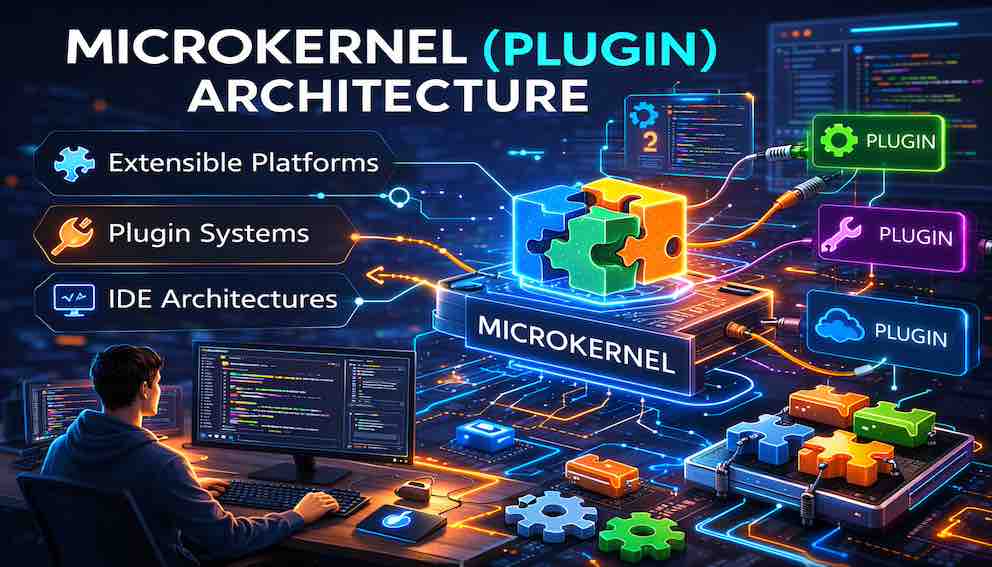
The core system (the microkernel) provides the minimum essential services the platform needs to function. It coordinates everything but implements as little as possible directly.
Plugins (also called extensions or modules) implement additional functionality. They are independent packages that attach to the core through well-defined interfaces, called extension points.
Conceptually, the core sits at the center with plugins surrounding it, each adding a specific capability. The core defines where plugins can attach and how they must do it—but not what they contribute. That's up to each plugin.
The core's most important characteristic is that it remains small, stable, and focused. The system's overall power grows through plugins, not through an ever-expanding core.
The Core System: The Stage Manager, Not the Performer
A useful analogy for the core system is a stage manager in a theatre. The stage manager doesn't perform the play. They coordinate lighting, actors, props, and scene changes so that the performance runs smoothly. The microkernel is the stage manager. It coordinates the plugins but doesn't perform their roles.
What the Core Does:
- Plugin Lifecycle Management. The core discovers, loads, initializes, and shuts down plugins. It decides when plugins become active and ensures they start and stop cleanly. It also handles plugin failures—aiming for graceful degradation rather than a complete crash.
- Extension Point Definition. Extension points are the hooks where plugins can attach. The core defines these hooks precisely. For each one, it specifies what the plugin must provide and how the core will use it. These contracts are the most important design artifacts in a microkernel system.
- Shared Services. Rather than every plugin reinventing common functionality, the core provides services that all plugins can use: logging, configuration management, event broadcasting, and similar infrastructure.
- Communication Between Plugins. Plugins sometimes need to interact. The core provides mechanisms—a service registry or event bus—that allow plugins to find and work with each other without being directly coupled.
- Security and Policy Enforcement. The core enforces boundaries. It controls what resources plugins can access and what APIs they can call. This sandboxing makes it safe to run third-party code.
What the Core Must Not Do:
Equally important is restraint. The core should not implement business features that belong in plugins, contain code specific to any particular plugin, or grow beyond its essential coordination role. Every feature that creeps into the core chips away at the architecture's benefits. A core that has absorbed too many features gradually becomes a large monolith with plugins bolted on—the worst of both worlds.
A small core is easier to reason about, easier to test, and easier to secure. When the core is well-understood and stable, plugin developers can build on it with confidence. They know what the platform promises, and they know those promises won't change unexpectedly.
Plugins: Where the Real Work Gets Done
Plugins are the components that give a platform its practical value. They are independent modules that integrate with the core through its defined extension points. A plugin is a packaged unit of functionality that can be installed, updated, or removed without touching the core or disrupting other plugins.
Characteristics of a Well-Designed Plugin:
- Independent. A plugin can be developed, versioned, and distributed separately from the core and from other plugins.
- Self-contained. A plugin packages everything it needs: its code, resources, and configuration.
- Contract-bound. The plugin communicates with the core through defined interfaces. As long as it honors those contracts, it can be implemented in any way the plugin developer chooses.
- Isolated. A bug in one plugin should not crash the platform or corrupt other plugins. Isolation is the core's responsibility to enforce.
The Plugin Developer's Experience:
From a plugin developer's perspective, the platform is a stable foundation with clear instructions for how to extend it. They can focus entirely on the capability they're adding without needing to understand—or worry about breaking—the rest of the system.
This developer experience is what enables ecosystems. When it's straightforward to build a plugin, more developers do it. More plugins attract more users. More users attract more plugin developers. The platform becomes more valuable than any single organization could make it alone.
How Plugin Systems Work: The Mechanisms
Building a plugin system requires solving several practical problems.
Plugin Discovery:
The core must first locate available plugins. Common approaches include directory scanning (scanning a folder for plugin packages), configuration files (reading a manifest that lists which plugins to load), or package manager integration (discovering plugins installed via npm, pip, or Maven).
Plugin Loading and Initialization:
Once discovered, plugins must be loaded into the running platform. In JVM-based platforms like Eclipse, each plugin is typically loaded with its own class loader to prevent library conflicts between plugins. Initialization follows a defined sequence: the core calls each plugin's setup method, and the plugin registers its contributions.
Extension Points: The Heart of the System:
Extension points are where plugins attach to the platform. Each one is a precisely defined hook with a specified interface. For example, an IDE might define extension points for language support (syntax highlighting, code completion), debugger integration, and source control providers.
Designing good extension points is one of the most important skills in platform architecture. They need to be stable—changing them breaks existing plugins—but also expressive enough to support the range of plugins developers will want to build.
Plugin Communication:
Plugins often need to interact, but direct dependencies create coupling that makes the system brittle. Better alternatives include a service registry (plugins register services for others to discover) or an event bus (plugins publish and subscribe to events without knowing about each other).
Real-World Example: Visual Studio Code
VS Code is one of the clearest modern examples of microkernel architecture done well.
The Core: The VS Code core is deliberately minimal. It provides the editor window and tab management, file system access, a basic UI framework, a command system, and the extension host infrastructure. Notably, the core does not include support for any specific programming language. All of those are extensions.
Extension Points: VS Code defines a rich set of extension points for languages, debuggers, themes, commands, views, and source control. Each has a documented API. Extension developers implement the API; VS Code calls their implementations.
Extension Isolation: One of VS Code's most important architectural decisions is running extensions in separate processes. This means a crashing extension cannot take down the editor. The UI remains responsive even when an extension is doing heavy work. Security is improved because extensions have constrained access to system resources.
The Result: The VS Code extension marketplace contains tens of thousands of extensions contributed by developers worldwide. The core editor remains stable and fast; the ecosystem makes it capable of almost anything.
Real-World Example: WordPress
WordPress illustrates microkernel architecture in a web application context.
The Core: WordPress core handles user authentication, content storage and retrieval, a basic publishing workflow, a theme system, an admin interface, and the plugin API itself. It is relatively lean.
Extension Points: WordPress exposes extension points through a hooks system—actions and filters. Actions let plugins execute code at specific moments (when a post is saved, when a page loads). Filters let plugins modify data as it flows through the system (change content before display, alter a query before it runs).
Because hooks are inserted throughout WordPress core at nearly every meaningful point, plugins can intercept and extend almost any behavior.
The Result: The WordPress plugin repository contains over 60,000 plugins. A stock WordPress installation is a blogging platform. With plugins, it becomes a full e-commerce system, a learning management platform, a membership community, or anything else.
Advantages of Microkernel Architecture
- Extensibility Without Core Modification: New capabilities can be added without touching the core platform. The foundation stays stable while the system's overall functionality grows continuously.
- Customization: Users can shape the platform to exactly their needs. A Java developer's VS Code looks different from a Python developer's. The same platform serves radically different use cases.
- Independent Development at Scale: Plugins can be built by separate teams, third-party companies, or individual developers worldwide, all working in parallel without needing to coordinate with the core team.
- Distributed Maintenance: The core team maintains only the core. Plugin maintainers maintain their own plugins. The maintenance burden is distributed across the ecosystem.
- Independent Upgrades: Plugins can be updated independently of the core, and vice versa. A bug fix in one plugin doesn't require a core release.
- The Ecosystem Effect: Well-designed platforms attract ecosystems that make them indispensable. More plugins attract more users. More users attract more plugin developers. The platform becomes far more valuable because the ecosystem itself is a massive asset.
Challenges and Trade-offs
Microkernel architecture is not free of complexity. Architects must be prepared to manage several significant challenges.
API Stability and Plugin Compatibility:
Plugins depend on the interfaces the core exposes. If those interfaces change, plugins break. The larger the ecosystem, the more painful a breaking change becomes. The core team must balance the desire to improve the platform with the need to protect plugin developers' investments through long deprecation cycles and explicit API versioning.
Plugin Management Complexity:
As the number of plugins grows, managing them becomes operationally complex. Which plugins are installed? Which version? Do any conflict? Good tooling is essential: a plugin manager, explicit dependency declarations, and conflict detection.
Performance Overhead:
Every boundary between the core and a plugin represents a potential performance cost. With dozens or hundreds of plugins, these costs accumulate. Mitigation strategies include lazy loading, batching API calls, and caching plugin-provided data.
Security Risks:
Allowing third-party code to run inside your platform is a genuine security concern. Malicious or poorly written plugins can steal data or crash the system. Mitigation strategies include sandboxing, permission systems, code signing, and curated plugin repositories with review processes.
Dependency Conflicts:
As the ecosystem grows, dependency conflicts become increasingly common. Plugin A requires version 1.x of a library. Plugin B requires version 2.x. Resolving this without breaking either plugin can be difficult. Class loader isolation and bundling dependencies with the plugin are common approaches.
UI Fragmentation:
When many plugins add menu items, toolbar buttons, and panels, the user interface can become cluttered and inconsistent. Good extension point design, clear style guidelines, and user control over UI contributions can help.
Comparison with Other Architectural Styles
Microkernel vs. Monolith: A monolith packages all functionality together. It's simpler when the feature set is known and controlled. Microkernel architecture is the right choice when the platform needs to support third-party extensions or when users need to customize the system significantly.
Microkernel vs. Microservices: Microservices distribute functionality across independently deployable services over a network. Microkernel architecture organizes a single platform application that can be extended through plugins. A large platform might use both: a microservices backbone with microkernel architecture governing how the platform itself is extended.
Microkernel vs. Modular Monolith: A modular monolith organizes code into internal modules but still deploys as a single unit. If you need team organization but not runtime extensibility, a modular monolith is simpler. If you need third-party plugins, microkernel architecture is the appropriate choice.
Designing a Microkernel System: Key Principles
If microkernel architecture is the right fit, these principles provide a sound design path:
- Start with the core's responsibilities. Ask what absolutely must be in the core. When in doubt, leave features out. You can always move something from a plugin into the core later, but removing a core feature is painful.
- Design extension points with care. They are the most consequential design decisions. Define precisely what a plugin can contribute, the interface it must implement, and how it will be versioned. These interfaces will be harder to change than anything else.
- Define plugin packaging and discovery. Decide how plugins are packaged, where they are installed, and how the core finds them.
- Design the plugin lifecycle. Specify how plugins are initialized, started, stopped, and unloaded. Define what happens when a plugin fails to load.
- Choose appropriate isolation mechanisms based on your security requirements and performance constraints.
- Invest in the plugin SDK. The quality of your plugin development experience directly determines the size and quality of your ecosystem. Good documentation, examples, and testing tools are core investments.
When Microkernel Architecture Is and Isn't the Right Choice
Microkernel architecture is most appropriate when a system must function as a long-lived platform rather than a fixed application. It excels in developer tools and IDEs, operating systems, enterprise platforms, content management systems, and browser extension systems.
It is a poor fit for simple, fixed-scope applications where the feature set is stable—plugins add complexity without benefit. It's also problematic for real-time systems with strict latency requirements, highly secure environments where running third-party code is prohibited, or teams without API design experience.
Conclusion: The Architecture of Evolving Systems
Microkernel architecture is the right choice when you're building not just an application, but a platform—a foundation that other developers and users will extend over time to solve problems you haven't anticipated.
Its central idea is simple: keep the core small, stable, and focused on coordination. Define clear extension points where plugins can attach. Let the ecosystem do the rest.
This separation gives you stability where you need it and flexibility where you need it. It distributes development effort across potentially thousands of contributors. It enables users to customize the system to their exact needs. And it creates the conditions for an ecosystem effect that can make the platform far more valuable than any single organization could achieve alone.
The challenges—API compatibility, versioning, security, dependency management—are real and must be addressed with deliberate design. But for systems that must grow and evolve over years or decades, these are the right problems to be solving.
The most successful platforms in software—VS Code, WordPress, Eclipse, the Linux kernel—all embody this principle. Their core is not where most of their value lives. Their value lives in the ecosystems they enabled.
Key Takeaways
- Microkernel architecture structures systems around a minimal, stable core with functionality added through independently developed plugins.
- The core provides essential services and defines extension points—the contracts that plugins implement. It should contain as little as possible.
- Plugins are self-contained, independent modules that can be developed and updated without touching the core.
- Extension points are the most important design decisions—they are harder to change than anything else.
- Key advantages: extensibility, customization, independent development at scale, and the ecosystem effect.
- Key challenges: API compatibility, versioning, dependency conflicts, security, and performance overhead.
- Best fits: developer tools, IDEs, content management systems, enterprise platforms.
- Poor fits: fixed-scope applications, real-time systems, highly secure environments.
- Successful plugin architectures don't just add features—they create conditions for ecosystems that make the platform indispensable.
About N Sharma
Lead Architect at StackAndSystemN Sharma is a technologist with over 28 years of experience in software engineering, system architecture, and technology consulting. He holds a Bachelor’s degree in Engineering, a DBF, and an MBA. His work focuses on research-driven technology education—explaining software architecture, system design, and development practices through structured tutorials designed to help engineers build reliable, scalable systems.
Disclaimer
This article is for educational purposes only. Assistance from AI-powered generative tools was taken to format and improve language flow. While we strive for accuracy, this content may contain errors or omissions and should be independently verified.