Learning Paths
Last Updated: March 21, 2026 at 15:30
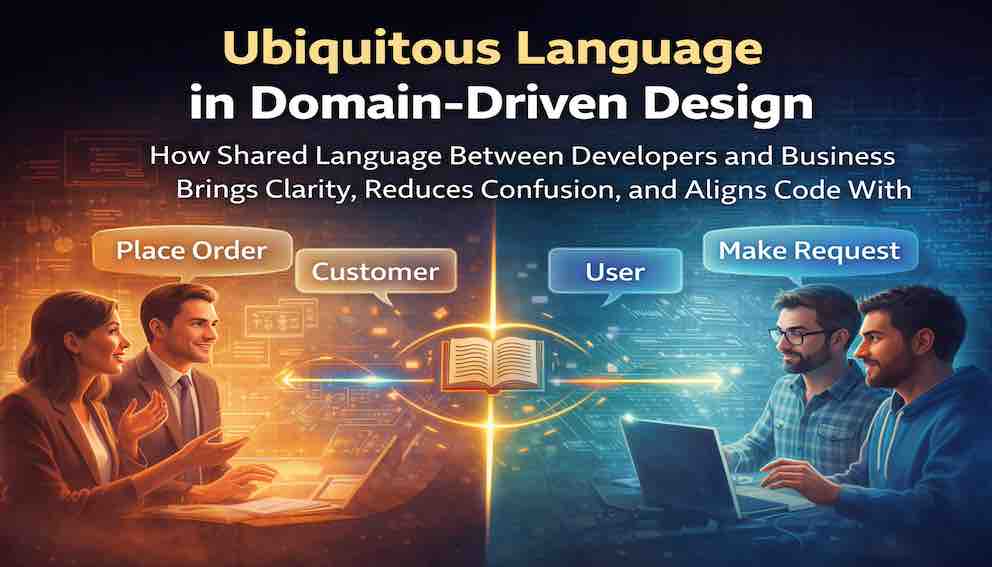
Ubiquitous Language in Domain-Driven Design
How Shared Language Between Developers and Business Brings Clarity, Reduces Confusion, and Aligns Code With Reality
Ubiquitous Language is the practice of using a single, shared vocabulary between developers and business experts across conversations, documentation, and code. It prevents the slow drift that occurs when technical terms replace the real words of the domain, a drift that leads to confusion and misaligned systems. By capturing language directly from domain experts and reflecting it faithfully in the code—such as using account.placeHold() instead of a vague technical placeholder—the code begins to mirror business reality. This alignment removes guesswork and ensures that everyone involved is thinking about the same thing, making the system clearer, more reliable, and truly connected to the world it serves
There comes a moment, when you’ve been working with Domain-Driven Design for a little while, when something subtle begins to surface in your thinking. It’s the kind of thought that doesn’t arrive with fanfare but rather settles in quietly, almost imperceptibly.
You’ve been focused on moving logic into the domain. You’ve been separating concerns—not just technically, but conceptually. You’ve started to see how the structure of your system can begin to mirror the structure of the business itself.
And yet.
Even with all of that in place—even with well-designed entities, carefully structured aggregates, and a clean architecture—there remains a risk. A quiet, creeping risk that your system will begin to drift away from the reality it is meant to represent.
What’s surprising is that this drift rarely happens because of bad code. It doesn’t come from a bug or a flawed algorithm. It comes from something far more ordinary, and far more human.
It comes from language.
The Quiet Drift
In most software teams, something happens over time. It happens so gradually that no one really notices. The developers begin using one set of words. The business people use another.
At first, this doesn’t feel like a problem. Everyone still seems to understand each other, after all. But slowly, the differences start to accumulate.
A business user might say, “We need to freeze this customer account.” A developer, hearing this, might implement something like account.status = "SUSPENDED". Or perhaps account.isActive = false.
At a glance, these seem like reasonable interpretations. But are they? Is “frozen” the same as “suspended”? Does “inactive” truly mean the same thing as “frozen” in the eyes of the business? Are there different rules attached to each state? Different behaviors?
These small differences, taken in isolation, seem trivial. But they multiply. They accumulate across hundreds of conversations, dozens of features, years of development. And one day you realize: the system no longer reflects how the business actually thinks. It reflects a translation of how the business thinks—a translation that has drifted, slowly, into something else entirely.
A Single Language
Ubiquitous Language is one of the most important ideas in Domain-Driven Design, though it can be easy to overlook precisely because it isn’t a technical pattern. It isn’t a framework. It isn’t something you install or configure.
It is simply this: a shared language between developers and domain experts, used consistently across conversations, documentation, and code.
What this means in practice is that the words used in meetings are the same words used in diagrams, which are the same words used in the code itself. There is no translation layer. There is no “developer version” of the business language. There is only one language.
When this is done well, something shifts. A developer no longer has to interpret what a business person means and then find a technical approximation. They simply use the same term, in the same way, with the same meaning.
Why Words Matter
It is easy to underestimate the importance of language. After all, words are just words. But language shapes how we think. When you name something in your code, you aren’t just labeling it—you are defining how you understand it.
Consider a simple example. You might write order.calculateTotal(). This feels natural enough. But compare it to order.computeFinalAmountAfterTaxAndDiscounts(). Both are technically valid, but they carry very different tones. One is succinct; the other is explicit to the point of heaviness.
Now imagine your business consistently uses the term “final payable amount” in their conversations. Suddenly, the right name becomes clear: order.calculateFinalPayableAmount(). It’s no longer a guess. It’s not a developer’s interpretation. It is the term itself, lifted directly from the business and placed into the code.
This is the power of Ubiquitous Language. It removes guesswork. It aligns thinking. And, most importantly, it ensures that everyone is talking about the same thing—whether in a meeting room or in a pull request.
Learning to Listen
One of the most important practices in Domain-Driven Design is learning to listen carefully to domain experts. These are the people who understand the business deeply. They aren’t thinking about code or databases or APIs. They are thinking about reality—about how things actually work.
And when they explain things, they naturally use the language of the domain.
Imagine you are building a banking system. A domain expert might say, “Funds are reserved before they are captured.” They might mention that “a transaction can be reversed within twenty-four hours,” or that “a hold is placed on the account.” At this point, these are just statements. But if you listen carefully, something important is happening. You are hearing the vocabulary of the domain.
Now, instead of creating your own technical terms—temporaryLock, pendingTransaction, softHold—you can reflect the real language: account.reserveFunds(amount), transaction.reverse(), account.placeHold(). The code begins to mirror the business. And when that happens, understanding becomes immediate. Anyone looking at the code for the first time—whether a new developer or a domain expert—can grasp what is happening without needing a translation.
The Problem with Developer-Speak
One of the biggest risks in software development is the gradual introduction of what might be called “developer-speak.” These are terms that make sense to developers but have no meaning in the business domain. Words like DTO, Manager, Helper, or Service often end up as placeholders for meaning that hasn’t been fully articulated.
Consider a class named OrderManager. What does it actually do? The word “Manager” tells us almost nothing. Does it manage orders? Payments? Inventory? It’s a vague term, and vagueness in code eventually leads to confusion.
Now compare it to OrderProcessor. This is slightly better, but even here the real question is: is “processor” the word the business uses? If the business talks about “placing an order,” then the term we should use is order.place(). If they talk about “confirming an order,” then perhaps order.confirm() is the right choice.
The goal is not to sound technical. The goal is to sound accurate.
When Language Drifts Apart
In real systems, language doesn’t always stay clean. Different teams may use different terms for the same concept. Or worse: the same term might mean different things in different parts of the system.
Imagine that in one part of your system, “customer” means someone who has made a purchase. In another part, “customer” means someone who has simply signed up for an account. These are not the same thing. But if both are called Customer, confusion becomes inevitable.
When language becomes inconsistent in this way, the consequences ripple outward. Code becomes harder to understand. Teams miscommunicate. Bugs become more frequent. Assumptions replace clarity. And over time, the system starts to feel unreliable—not because of technical flaws, but because of linguistic confusion.
Different Contexts, Different Meanings
Domain-Driven Design does not try to force a single universal meaning for every term across the entire system. Instead, it offers a more flexible approach: different contexts can have different meanings. What we are describing here is the principle that language should align with the boundaries of business functionality, rather than being forced into a one-size-fits-all model.
This is where the idea of bounded contexts connects back to language. If "customer" means different things in different parts of your system—such as in billing versus in support—you do not force them to mean the same thing. You allow each context to define its own language. Within each bounded context, the language remains consistent. But across contexts, differences are accepted and made explicit.
This removes confusion without forcing artificial uniformity. It respects the reality that words often carry different meanings in different parts of a business. By acknowledging these differences rather than hiding them, the system remains truthful to how the business actually operates.
Language in Code
One of the most powerful aspects of Ubiquitous Language is how it shows up directly in code. Because your code is not just implementation—it is communication. When someone reads your code, they are reading a description of your system.
Instead of writing:
You might write:
Now the intent is clear. The method name reflects the business rule. The reader does not need to interpret the logic; they simply understand the meaning.
This shift—from technical condition to business intent—is subtle but transformative. It turns code into a narrative rather than a puzzle.
Alignment
Ubiquitous Language is not really about naming. It is about alignment. It ensures that conversations in meetings, documents and diagrams, and the actual code all tell the same story. There is no translation layer. No ambiguity. No silent drift.
In large systems, confusion is expensive. Every misunderstanding leads to incorrect implementations, misaligned expectations, increased maintenance costs, and slower development. Ubiquitous Language reduces this friction because when everyone uses the same words, fewer assumptions are made. And when fewer assumptions are made, fewer mistakes occur.
A Reflection of Reality
If we look back at the journey through Domain-Driven Design, we see a progression. We began by exploring how software often loses connection with the real world. We saw how layered architecture can scatter logic and create confusion. We understood how DDD brings structure and behavior into the domain. We explored how tactical and strategic DDD shape systems at different levels.
And now, we arrive at something even more fundamental. Because none of those ideas work properly without this one: a shared language that keeps everything aligned.
Ubiquitous Language is not a technical optimization. It is a way of ensuring that your system speaks the same language as the business it represents. It removes translation. It removes ambiguity. And it creates clarity across every layer of your system.
When used well, it allows developers and domain experts to think together, not separately. And when thinking becomes shared, building becomes far more precise. Because now, your code is no longer just code. It becomes a reflection of how the business actually works.
About N Sharma
Lead Architect at StackAndSystemN Sharma is a technologist with over 28 years of experience in software engineering, system architecture, and technology consulting. He holds a Bachelor’s degree in Engineering, a DBF, and an MBA. His work focuses on research-driven technology education—explaining software architecture, system design, and development practices through structured tutorials designed to help engineers build reliable, scalable systems.
Disclaimer
This article is for educational purposes only. Assistance from AI-powered generative tools was taken to format and improve language flow. While we strive for accuracy, this content may contain errors or omissions and should be independently verified.