
Learning Paths
Last Updated: March 21, 2026 at 15:30
Domain-Driven Design vs Traditional Layered Architecture
Where Business Logic Should Live, Why Layered Systems Break Down, and How DDD Changes Your Code Structure
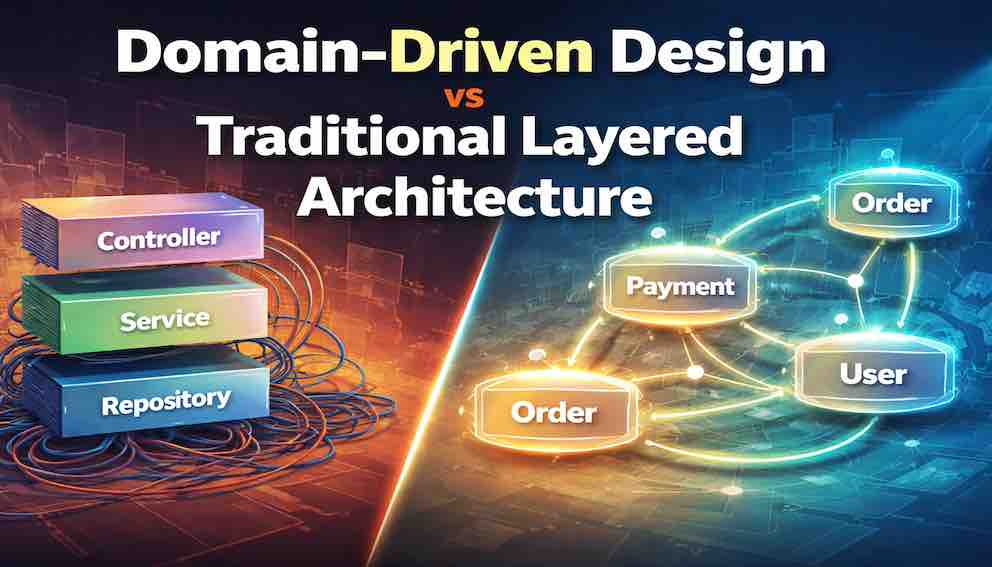
Most developers start with a familiar layered architecture: Controller → Service → Repository. It feels clean, organized, and easy to understand—until the system grows and business logic begins to scatter across layers. In this article, we explore why this happens, what the “anemic domain model” really means, and how Domain-Driven Design offers a different way of structuring code around business behavior. By the end, you’ll develop a clear intuition for where logic truly belongs
The Architecture We All Know
If you have built any non-trivial application, you have likely used some variation of layered architecture. The pattern is simple: a controller handles requests, a service contains the business logic, and a repository manages database interactions.
In the early days of a project, this works beautifully. Responsibilities feel separated. New developers can jump in quickly. You can build features without thinking too deeply about structure.
But this clarity rests on a hidden assumption: that business logic can be neatly contained within the service layer. As systems grow, that assumption quietly breaks down.
The Logic That Scatters
Consider a simple e-commerce feature: placing an order. The steps seem straightforward—validate the request, check inventory, calculate the total, apply discounts, save the order.
In a layered system, however, these steps rarely stay together.
Validation often ends up in the controller. A rule like “an order must contain items” is treated as request validation, but it is actually a business rule. The service handles core operations: checking user status, calculating totals, applying discounts. Over time, performance tweaks and new requirements push logic into the repository or even database queries—like filtering only in-stock products or enforcing stock constraints at the data level.
What began as a clean separation becomes fragmentation. To understand how an Order truly behaves, you now have to trace across controllers, services, and repositories. Logic duplicates itself. Ownership becomes fuzzy. And something that should be simple becomes surprisingly hard to reason about.
The Anemic Domain Model
At the heart of this fragmentation is a concept called the anemic domain model. The name sounds technical, but the idea is straightforward: your core business objects—Order, Account, Customer—become little more than data containers. They hold fields, but they contain no behavior.
Take a bank account. In a typical layered system, you might have an Account class with a balance field and an AccountService that handles withdrawals. The service checks the balance and updates the account. But think about what this implies: the account itself does not know how to protect its own funds. Any part of the system that manipulates the account directly could bypass the rules.
This separation creates real costs. Understanding how a concept works requires jumping across files. Rules get implemented in slightly different ways across services. And perhaps most importantly, the models lose their connection to the business they represent. They become passive structures rather than meaningful representations of reality.
Why This Happens
Layered architecture organizes code by technical concerns—presentation, business logic, data access. But the business does not think in terms of layers. The business thinks in terms of orders, payments, customers, and inventory. These are conceptual boundaries, not technical ones.
When you organize by layers, you group things by how they work. When you organize by domain, you group things by what they mean. The mismatch is subtle at first, but over time it creates friction. Your code is structured one way, but your understanding of the problem is structured another.
How Domain-Driven Design Shifts the Approach
Domain-Driven Design begins with a different question. Instead of asking, “Which layer should this logic go into?” it asks, “Which concept in the business owns this behavior?”
The shift is small in wording but profound in outcome.
Behavior moves into the domain. Instead of orderService.applyDiscount(order), you write order.applyDiscount(). Instead of a service managing a withdrawal, the Account class itself handles it:
Now the transfer becomes a simple composition: from.withdraw(amount); to.deposit(amount);
The account enforces its own rules. The logic lives alongside the data it governs. And if any part of the system tries to withdraw more than is available, the account itself prevents it.
This is not merely a code reorganization. It is a shift in thinking. You stop wondering where to place logic and start asking what the natural home for that rule is. More often than not, the answer lies within the domain model itself.
A Mental Model for the Difference
To make the contrast clearer, consider how decisions are made in an organization.
In a traditional layered system, it is like a company where all decisions flow through a central office. Every branch, every department, waits for instructions. The branches themselves have little authority or understanding of their own role.
In a DDD-aligned system, each part of the organization understands its responsibilities. A branch manager knows what decisions they can make without calling headquarters. The system distributes authority to where it naturally belongs.
In code terms: layered architecture scatters logic and leaves models passive. DDD consolidates logic within the domain and gives models active responsibility.
When to Use Each
It would be a mistake to declare one approach universally better. Both have their place.
Layered architecture remains an excellent choice for simple systems—applications that are mostly data entry, basic CRUD operations, or projects where the business rules are minimal. It is easy to understand, quick to build, and requires less upfront design.
Domain-Driven Design becomes valuable when complexity grows. When business rules are nuanced, when logic changes frequently, when multiple teams work on the same system, or when the domain itself is rich and evolving—that is where DDD pays off. But it comes with costs. It demands deeper thinking, disciplined modeling, and close collaboration with domain experts. It is a deliberate investment, not a default.
Conclusion
What we have explored here is not a battle between two architectures. It is a shift in perspective.
Layered architecture gives us clarity in structure, especially early on. It helps us move quickly when the domain is simple. But as systems grow, its limits become visible. Logic spreads, models become passive, and understanding the system becomes harder than it should be.
Domain-Driven Design offers a different path. It asks us to align our code with the business, to give our models responsibility, and to place behavior where it naturally belongs. It is not always necessary, and it is not always easy. But when applied in the right context, it brings something unmistakable: a sense that the code finally matches the reality it is trying to represent.
About N Sharma
Lead Architect at StackAndSystemN Sharma is a technologist with over 28 years of experience in software engineering, system architecture, and technology consulting. He holds a Bachelor’s degree in Engineering, a DBF, and an MBA. His work focuses on research-driven technology education—explaining software architecture, system design, and development practices through structured tutorials designed to help engineers build reliable, scalable systems.
Disclaimer
This article is for educational purposes only. Assistance from AI-powered generative tools was taken to format and improve language flow. While we strive for accuracy, this content may contain errors or omissions and should be independently verified.